
Reviewed · TRIANA TOURS
Complete Triana Tour “Corrales included”
Triana is Seville’s neighborhood with its own accent, traditions, and stubborn sense of identity. This two-hour walk takes you from the riverfront into flamenco, ceramics, churches, courtyards, and old working streets, with stops that show why Triana feels different from the city across the water.
I like the strong mix of culture and everyday life. You get the famous Triana Bridge and Calle Betis, but also the Chapel of the Sailors, ceramic workshops, the market, and the old corrals. I also like the price: at $9.49, it is an easy way to add local context to your Seville visit.
The main concern is reliability and meeting-point clarity. One part of the information names the Gold Tower as the starting place, while the stated meeting point is at the Flamenco Art Monument by Triana Bridge. One booking account also reports that the guide failed to appear, while another praises Jose for making the two hours pass quickly. Confirm the start point and guide details before you set out.
In This Review
- Key points to know before booking
- Why Triana deserves a separate walk
- Starting by the river: Torre del Oro and the bridges
- From the first voyage to Calle Betis
- Cervantes, Carmen, and the old port
- Crossing the Puente de Triana
- Santa Ana and the Hope of Triana
- San Jacinto and the working side of Triana
- The Chapel of Carmen and Triana’s flamenco spirit
- The market, the castle, and ceramic country
- What Isla de la Cartuja adds
- Price, group size, and the pace of the walk
- Who should book this Triana walk
- Should you book Complete Triana Tour?
- FAQ
- How long does the Complete Triana Tour last?
- How much does the tour cost?
- Where does the tour start?
- Where does the tour end?
- Is admission to the Gold Tower included?
- What sites are visited in Triana?
- Is the tour suitable for most people?
- How many people can join the tour?
- Can I cancel for a refund?
Key points to know before booking
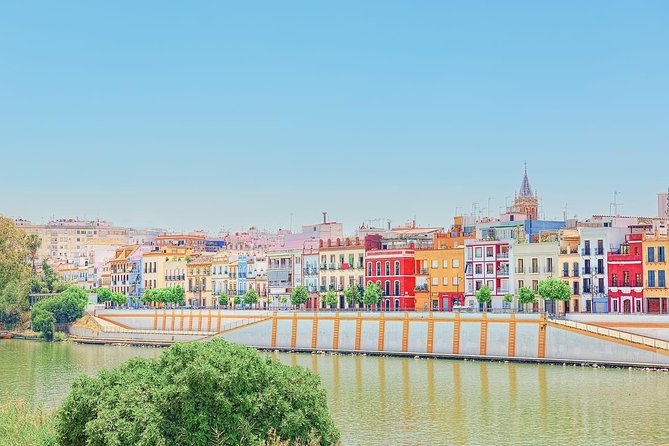
- Triana beyond the postcard: The walk goes past Calle Betis and the bridge into courtyards, churches, workshops, and ordinary neighborhood streets.
- Flamenco and faith together: You visit the Flamenco Art Monument, Santa Ana Church, the Chapel of the Sailors, and the Hope of Triana.
- Ceramics are central: The route includes old furnace areas, small workshops, and the Centro Cerámica Triana.
- A short, fast route: The tour lasts about two hours and lists 23 stops, so most places receive only a brief explanation.
- Good value at $9.49: Most stops are free, though entrance to the Gold Tower is not included.
- Small risk with operations: The group can reach 30 people, and the stated meeting details need checking before departure.
Why Triana deserves a separate walk
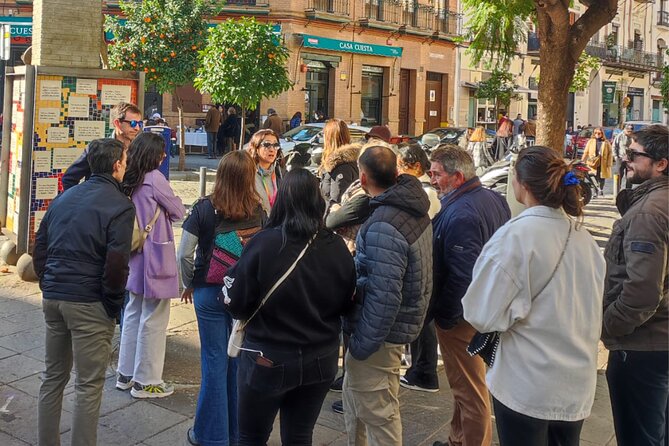
Triana sits across the Guadalquivir River from central Seville. That short distance matters. The neighborhood developed with a strong identity of its own, shaped by sailors, potters, religious brotherhoods, flamenco artists, and workers connected to the river and nearby factories.
A guided walk helps you read details that are easy to miss on your own. A tiled facade may point to the area’s ceramic trade. A chapel may connect to a centuries-old brotherhood. An ordinary-looking courtyard may be one of the last traces of a once-common form of housing.
This tour also gives you a useful contrast. The riverfront and Calle Betis are the polished, photogenic side of Triana. The lanes around Santa Ana, San Jacinto, San Jorge, and the market show the neighborhood as a living part of Seville rather than a scenic backdrop.
The pace is brisk. With 23 listed stops in two hours, you should expect short talks and frequent movement. That suits you if you want an orientation walk before exploring alone. It is less suitable if you prefer long visits inside churches or museums.
More Triana walks:
- Seville: Live Flamenco Show at “Teatro Flamenco Triana”
★ 4.6 · 3,290 reviews - Seville: Baraka Sala Flamenca Show with Drink in Triana
★ 4.8 · 1,761 reviews - Seville: Traditional Flamenco Show in Triana
★ 4.8 · 1,580 reviews
Starting by the river: Torre del Oro and the bridges
The route is connected with the Torre del Oro, Seville’s old defensive tower and river beacon. The monument gives you a useful starting point for understanding how the river shaped the city. Its role was practical, but its position also provides one of the better views toward Seville and Triana.
Admission to the tower is not included, and the stop is listed as only about five minutes. Treat it as an exterior introduction rather than a museum visit.
The walk then crosses the San Telmo Bridge. This is a short stop, but the river views help you see the relationship between the historic center and Triana. The bridge crossing is also a pleasant change from narrow streets later in the route.
One detail needs attention here. The tour information gives the Gold Tower as the meeting location in the first stop, but the formal meeting point is listed at the Monumento al Arte Flamenco beside the Puente de Isabel II. Since these are different parts of the riverfront, check the exact location before leaving your hotel.
From the first voyage to Calle Betis
The Monumento Milla Cero de la Tierra recalls the expedition that set out on the first circumnavigation of the world. The stop also brings in the April Fair, Seville’s famous spring celebration, and its connection with Triana.
You will not have much time here, but the guide can help connect the monument to the wider story of Seville’s river, port, and public celebrations. This is one of the stops where a short explanation adds more than a quick photograph.
Calle Betis follows. The street is one of Triana’s best-known sights, with views back across the river and a line of restaurants and bars. It is attractive, but its fame can make it feel more like a scenic promenade than an ordinary neighborhood street.
The useful part of the stop is the explanation of Triana’s long separation from Seville. The two areas are physically close, yet the river created a strong social and cultural boundary. If you are trying to understand why Triana has such a distinct character, this is the right place to begin.
Cervantes, Carmen, and the old port

Calle Troya brings Miguel de Cervantes into the story. Cervantes lived in Seville for a period, and the route points to a place associated with his inspiration. The stop lasts only four minutes, so expect a compact literary connection rather than an extended discussion.
At El Embarcadero, the focus shifts to Triana’s old port. From here, you get views toward Seville and hear about Carmen and the Cigarreras, the women associated with work at Seville’s Tobacco Factory.
This is a good example of the tour’s approach. It does not treat Triana as only churches and pretty tiles. It brings in work, movement, myth, and the people who crossed the river each day. The Carmen story also gives a human face to a famous figure often reduced to opera and romance.
A few more Seville tours worth comparing
- Seville: Royal Alcázar Entry Ticket
★ 4.6 · 28,378 reviews - Seville: Cathedral and La Giralda Entry Ticket
★ 4.5 · 24,592 reviews - Seville: Live Flamenco Dancing Show Ticket at the Theater
★ 4.7 · 16,396 reviews - Seville: Casa de la Memoria Flamenco Show
★ 4.8 · 12,964 reviews
Crossing the Puente de Triana
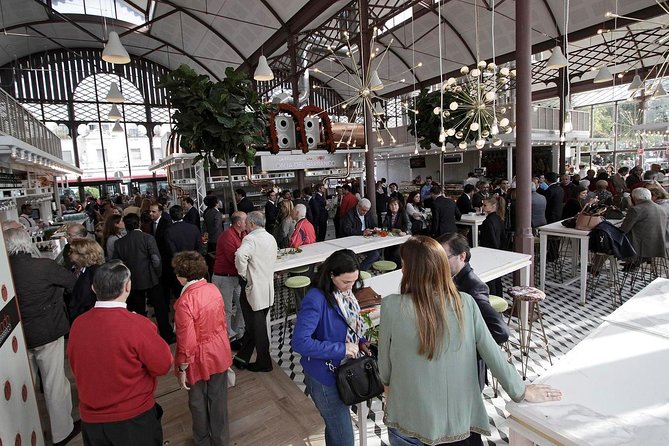
The Puente de Isabel II, usually called the Puente de Triana, is one of Seville’s signature structures. Built in 1852, it is described as the oldest preserved iron bridge in Spain.
The bridge is both a sightseeing stop and a practical landmark. If you are meeting at the Flamenco Art Monument near the bridge, you are starting close to one of Triana’s most recognizable entrances. The bridge also offers strong views in both directions, so keep your camera ready, but do not expect a long pause.
From here, the walk turns inward. The route refers to Triana’s former corrals, once numbering more than 100, with about 15 remaining. These communal courtyards are among the most important reasons to take this tour instead of simply following the riverfront.
The word corrales refers to shared residential courtyards, where homes opened onto a common space. The tour does not promise entry to every courtyard, so you should not assume private interiors are included. Still, seeing the surviving examples and hearing how they functioned gives you a clearer picture of old Triana life.
Santa Ana and the Hope of Triana
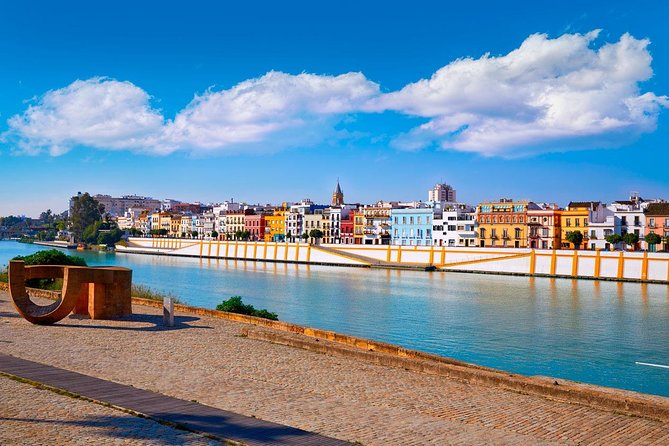
The Plazuela de Santa Ana is one of the neighborhood’s notable meeting places. The route links it with earlier flamenco activity, giving you a chance to connect the square with Triana’s artistic traditions.
The Real Parroquia de Señora Santa Ana is described as the center of old Triana. Its story includes the local Gypsy community, legends, and religious traditions. The stop is listed as free, but the information does not promise a formal interior visit or special access.
The Chapel of the Sailors is one of the tour’s strongest cultural stops. Inside, you may see the Hope of Triana, the much-loved image associated with the brotherhood. The guide explains why the image has such importance and why Triana’s religious life is tied so closely to neighborhood identity.
Triana has five brotherhoods, and the tour introduces you to one of them. This is useful even if you are not especially religious. Seville’s processions and brotherhoods shape local art, music, family traditions, and public life. A short visit here can explain more about the city than another general monument stop.
San Jacinto and the working side of Triana
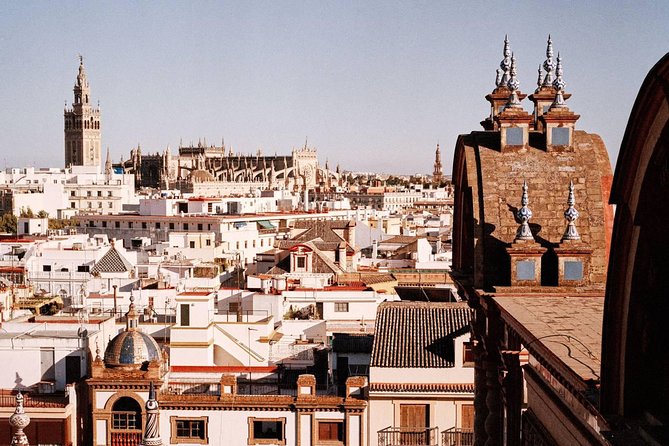
The Parroquia de San Jacinto began as part of a Dominican convent connected with an old hospital. The surrounding area was also used as a mass burial ground during one of Seville’s plague epidemics.
That detail gives the route a harder edge. Triana’s story includes devotion and celebration, but also disease, poverty, and death. The stop is brief, so you will get a concise account rather than a full treatment of the convent’s past.
San Jacinto pedestrian street is described as Triana’s busiest street. The guide points out places to stop for a drink and recalls the former Hispano-Aviación factory, where the first Spanish reactor was made. This industrial connection may surprise you. Triana is often presented through pottery and flamenco, yet modern manufacturing also belongs to its story.
The route continues along Calle San Jacinto, where you can look for old courtyards, tiled facades, bars, and the easygoing southern atmosphere that defines the neighborhood. This section is less about one major monument and more about seeing how the old and new sit side by side.
The Chapel of Carmen and Triana’s flamenco spirit
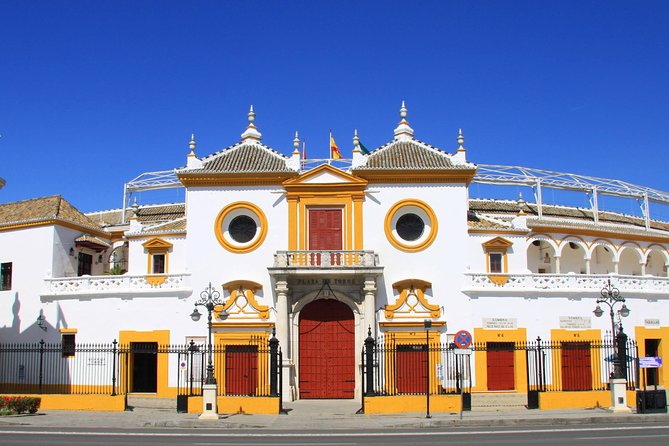
The Chapel of the Virgen del Carmen is linked with architect Aníbal González, whose work also includes Seville’s Plaza de España for the 1929 exhibition. It is a small but useful architectural link between Triana and one of Seville’s grandest public projects.
The route then returns toward the river and the Monument to Juan Belmonte. Triana has produced major bullfighters, and the monument gives that tradition a clear place on the walk.
The Monumento Triana al Arte Flamenco honors singing, dancing, guitar, and hand clapping. Flamenco is recognized as an Intangible Cultural Heritage of Humanity, but you should keep your expectations precise: this is a monument stop, not a scheduled flamenco performance.
That distinction matters. The tour can explain how flamenco belongs to Triana, but it does not list a live show or music included in the price. If you want a full evening of flamenco, plan that separately.
The market, the castle, and ceramic country
The Mercado de Triana is a practical highlight. It brings food and daily neighborhood life into the route, and it is a good place to return after the tour for a snack or meal. The tour promises recommendations for the best tapas in the neighborhood, which adds value at the end of a food-focused walk.
The market is also near the stated end point on Calle Arfian. That makes it a sensible place to continue exploring after the guide leaves you. You can browse, eat, or use the area as a base for more independent wandering.
The Castillo de San Jorge introduces one of Seville’s darker chapters. The castle is tied to the creation of the Inquisition by the Catholic Monarchs. The route uses the site to discuss persecution and the many cultures that have shaped Seville.
The visit is listed as free, but no extended admission time is promised. Expect an exterior or short interpretive stop rather than a full museum visit.
On Calle San Jorge, the guide points out areas where large ceramic furnaces once operated. Some small workshops still survive. This leads naturally to the Centro Cerámica Triana, where the neighborhood’s ceramic tradition receives its own museum setting.
Ceramics are not a decorative footnote here. Tiles shape the look of Triana, from household details to public facades. The museum stop helps you see the work behind those surfaces, though the schedule allows only about five minutes.
What Isla de la Cartuja adds
The final stop is Isla de la Cartuja, presented as part of Triana’s change over time. The guide connects yesterday’s Triana, today’s neighborhood, and its future through Calle Pagés del Corro.
This closing idea is useful because Triana is not frozen in the past. Old corrals, churches, bars, market stalls, workshops, and newer developments all belong to the same district. The tour ends by asking you to see the neighborhood as an evolving place rather than a museum display.
The formal end point is listed as C. Arfian 13, near Triana Market. That is convenient if you want to eat or keep walking, though the route information also associates the market with the heart of the neighborhood.
Price, group size, and the pace of the walk
At $9.49 per person, this is one of the least expensive ways to get a guided introduction to Triana. The value comes from the number of themes packed into the route: river history, flamenco, religious brotherhoods, ceramics, industrial work, bullfighting, food, and the Inquisition.
You are not paying for substantial entrance admissions. Most stops are free, and the Gold Tower ticket is not included. The tour is best understood as a guided orientation walk, not a series of museum visits.
The group can include up to 30 people. That is manageable on open streets, but it may feel less personal at busy churches, the market, or narrow lanes. Since each stop lasts about three to five minutes, a large group can also make it harder to hear every word.
One account specifically praises Jose as friendly and clear, with a style that makes the two hours feel short. That is the best-case version of this experience. Another account describes waiting without the guide appearing, so I would treat confirmation as important rather than optional.
The tour requires good weather and a minimum number of participants. If poor weather or low enrollment cancels it, you are offered another date or a full refund. You can also cancel for a full refund up to 24 hours before the start time. Changes or cancellations inside that window are not refunded.
Who should book this Triana walk
I would choose this tour if you are visiting Seville for the first time and want a quick map of Triana before returning on your own. It suits you especially well if you like neighborhoods, local traditions, architecture, and short stories more than long indoor visits.
It is also a good pick for anyone who wants to connect famous sights with less obvious details. The bridge, Calle Betis, and market are easy to find, but the corrals, old furnace areas, brotherhoods, and industrial references are harder to interpret without help.
You may want something else if you need guaranteed museum entry, a long church visit, a live flamenco show, or a slow photography walk. The route covers a lot, but it does so in brief bursts.
Wear comfortable shoes and leave room in your schedule to continue at the market or return to a courtyard, church, or street that catches your attention. The tour gives you the outline. Your independent wandering supplies the detail.
Should you book Complete Triana Tour?
For $9.49, I think this is a strong-value introduction to one of Seville’s most distinctive neighborhoods. The mix of flamenco, religious life, ceramics, old housing, river views, and food makes it more useful than a simple bridge-and-Calle-Betis stroll.
Book it if you want a lively overview and can accept a quick pace. Before departure, verify whether you should meet at the Gold Tower or the Flamenco Art Monument by the Puente de Triana. That small check matters because the two locations are not the same. If the operator confirms the details and Jose is guiding, the tour can give you a helpful first look at Triana without straining your budget.
FAQ
How long does the Complete Triana Tour last?
The tour lasts approximately two hours.
How much does the tour cost?
The listed price is $9.49 per person.
Where does the tour start?
The information gives two start references: the Gold Tower entrance and the Monumento al Arte Flamenco beside Puente de Isabel II at Puente de Isabel II, 23. Confirm the exact meeting place before departure.
Where does the tour end?
The stated end point is C. Arfian, 13, near Triana Market in the center of the neighborhood.
Is admission to the Gold Tower included?
No. Admission to the Gold Tower is listed as not included.
What sites are visited in Triana?
The route includes Calle Betis, Calle Troya, the old port, the Puente de Triana, Santa Ana Church, the Chapel of the Sailors, San Jacinto, the Virgen del Carmen Chapel, Triana Market, San Jorge Castle, Calle San Jorge, the Centro Cerámica Triana, and other landmarks.
Is the tour suitable for most people?
Most people can participate, and service animals are allowed. The tour is near public transportation.
How many people can join the tour?
The maximum group size is 30 people.
Can I cancel for a refund?
You can cancel up to 24 hours before the experience for a full refund. Cancellations or changes made less than 24 hours before the start time are not refunded. If poor weather or insufficient enrollment cancels the tour, you are offered another date or a full refund.
Just added around Seville
- Seville: Wine and Gourmet Tapas Tour★ 5.0 · 3 reviews
- Tapas Tour Cordoba & Wine Experience with chef and sommelier★ 4.8 · 3 reviews
- The most complete tour of Seville: All the highlights included★ 5.0 · 3 reviews
- Seville: Spritz Tasting Experience★ 4.8 · 3 reviews
- Ronda and White Villages Private Day Trip from Seville★ 5.0 · 3 reviews
- Jerez: Historic center of Jerez and horse show★ 5.0 · 3 reviews
- SEVILLE: REAL ALCÁZAR TOUR★ 5.0 · 3 reviews
- Royal Alcazar of Seville Guided Tour★ 5.0 · 3 reviews
Triana Tours, compared.
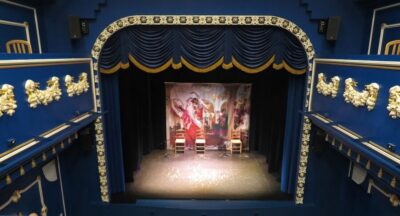
Live Flamenco Show at “Teatro Flamenco Triana”
Read our review →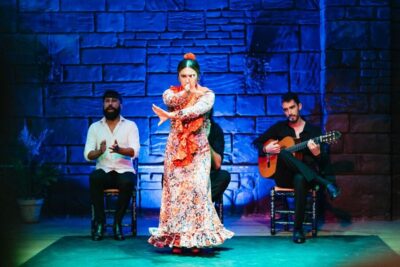
Baraka Sala Flamenca Show with Drink in Triana
Read our review →

Spanish Cooking Class & Triana Market Tour in Sevilla
Read our review →
3.5-Hour Spanish Cooking Class & Triana Market Tour
Read our review →
Flamenco Show Tickets to the Triana Flamenco Theater
Read our review →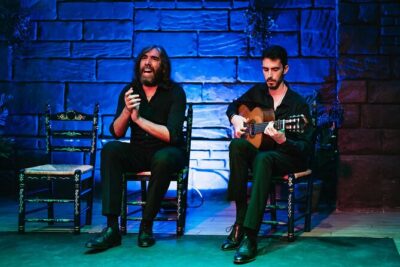

Browse the lists this tour appears in