
Reviewed · TRIANA TOURS
Legends of Triana Walking Tour in Spanish
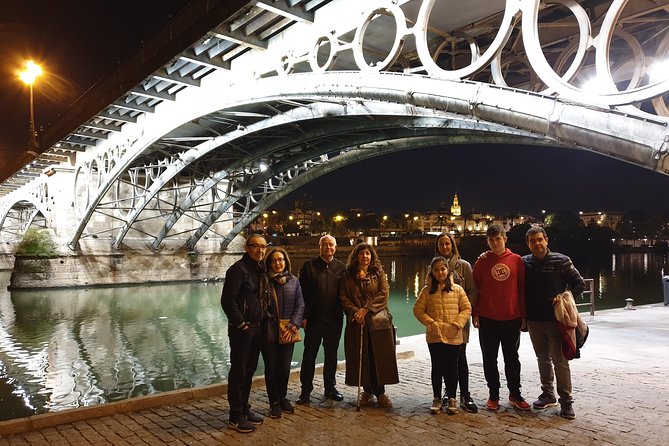
Triana gives Seville a different voice. Across the Guadalquivir River, this old quarter brings together flamenco lore, ceramic workshops, church towers, river views, and stories that rarely appear on a standard city-center walk. The tour starts at the Isabel II Bridge and follows the oldest streets of Triana, where legends are tied to specific buildings and corners.
I like the route’s focus on local stories, not just big monuments. I also like the small-group limit of 15 people, which gives a guide such as Johanna, Mari Paz, Jesús, Bárbara, or Valentín a better chance to keep the group together and answer questions. The main thing to consider is the language: this is a Spanish-language tour, and the nearly two-hour walk requires moderate physical fitness.
In This Review
- Key points to know before you book
- Why Triana deserves a separate walking tour
- Starting at the Isabel II Bridge
- Calle Betis and the riverfront views
- The old navigators university
- Monipodio’s house and Triana’s legends
- Santa Ana Church and the old pottery quarter
- The former Inquisition headquarters
- What the guides add to the experience
- Why the small group and price matter
- Timing, walking comfort, and practical details
- Who will get the most from this walk
- Should you book Legends of Triana?
- FAQ
- Where does the Legends of Triana Walking Tour begin?
- Where does the tour finish?
- How long does the tour last?
- Is the tour conducted in English?
- What places are included on the route?
- How many people can join the tour?
- Can I cancel for a full refund?
Key points to know before you book
- Triana’s flamenco connection: The quarter is closely linked with flamenco dance, and the walk uses its streets and stories to explain that connection.
- A route with variety: You visit Calle Betis, Santa Ana Church, the pottery district, Monipodio’s house, the former Inquisition headquarters, and the riverbank.
- A good small-group size: The maximum is 15 people, far more manageable than a large city tour.
- Strong guide-led storytelling: Guides such as Jesús, Bárbara, Johanna, Mari Paz, Grecia, Cristina, Adrián, and Valentín have been praised for humor, detail, and clear explanations.
- Good price for two hours: At $14.23 per person, this is a low-cost way to add context to a neighborhood many people only photograph from across the river.
- Easy cancellation terms: You can receive a full refund if you cancel at least 24 hours before the start time.
Why Triana deserves a separate walking tour
Many first-time visitors to Seville stay on the cathedral side of the river. That makes sense, since the historic center holds the city’s biggest sights. But Triana has a strong identity of its own, and crossing the river changes the feel of your visit.
The quarter is known for colorful buildings along Calle Betis and church steeples rising above the rooftops. From the riverfront, you get one of Seville’s most recognizable views, but this tour goes beyond the postcard angle. It takes you into the older streets, where the guide explains how Triana’s customs, crafts, religious buildings, and legends fit together.
I find this type of walk especially useful early in a Seville stay. You learn the shape of the neighborhood, then can return later for a meal, a flamenco performance, a riverside stroll, or another look at the tiled façades. The tour does not include food or drinks, so you are free to choose your own stop afterward.
More Walking Tours in Seville
- Seville: Small-Group City Highlights Walking Tour
★ 5.0 · 1,204 reviews - Cultural Walking Tour of Seville Monumental
★ 5.0 · 861 reviews - Seville: Tapas, Taverns, and History Walking Tour
★ 4.9 · 676 reviews
Starting at the Isabel II Bridge
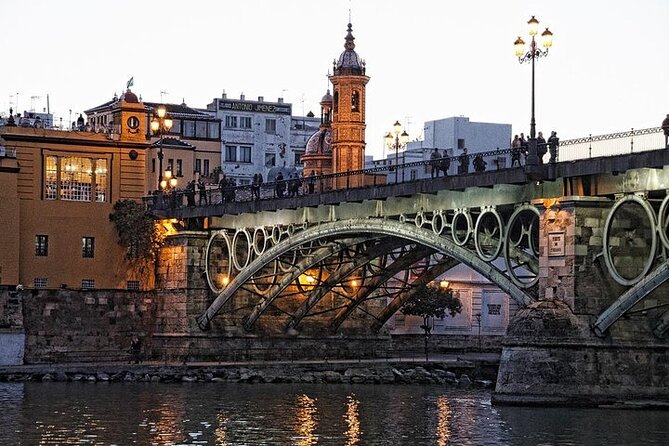
The meeting point is Puente de Isabel II, usually called Triana Bridge, on the Seville side of the river. This is a practical place to begin because the bridge itself gives you an immediate sense of Triana’s position and character.
As you cross, look toward the riverbanks and the rows of buildings along Calle Betis. The opening view helps explain why Triana has long been tied to river life, movement, trade, and working neighborhoods. The bridge is also near public transportation, so reaching the meeting point should be straightforward using Seville’s local network.
The walk ends back at the meeting point. That makes planning easier, especially if you have an evening reservation elsewhere or want to return to your hotel without guessing where the guide will leave you.
Calle Betis and the riverfront views

Calle Betis is one of the most photogenic parts of the route. Its colorful façades face the Guadalquivir, with Seville’s historic center visible across the water. The street gives you a good first look at Triana’s public face, but the guide adds the stories behind the view.
This is one place where the tour works better than a quick solo stroll. On your own, you will see attractive buildings and river scenery. With a guide, you get the anecdotes and local connections that make the street more than a line of restaurants and painted façades.
The riverbank section also gives the walk a little breathing room. Much of the tour takes place on cobblestones and in older streets, so the open views are a welcome change. Wear shoes with firm soles, and remember that the route lasts about two hours even though the advertised walking time is approximately one hour and 45 minutes.
The old navigators university
One of the stops is the old navigators university. This part of the route helps connect Triana to Seville’s wider relationship with river travel and navigation.
The supplied information does not specify how long the group spends at the site or whether you enter the building. Treat it as a storytelling stop rather than a guaranteed interior visit. The value is in the explanation, especially if you want more than a procession of façades and churches.
A guide who can place Triana within Seville’s past gives the neighborhood more shape. This is also where the Spanish language matters most. If you understand Spanish well, you can follow the historical details and wordplay more fully. If you do not, this tour may be difficult to enjoy, since the central product is spoken storytelling.
More Triana walks:
- Seville: Live Flamenco Show at “Teatro Flamenco Triana”
★ 4.6 · 3,290 reviews - Seville: Baraka Sala Flamenca Show with Drink in Triana
★ 4.8 · 1,761 reviews - Seville: Traditional Flamenco Show in Triana
★ 4.8 · 1,580 reviews - Spanish Cooking Class & Triana Market Tour in Sevilla
★ 5.0 · 760 reviews
Monipodio’s house and Triana’s legends
Monipodio’s house is another distinctive stop. Its name connects the walk with the literary and legendary side of Seville, where stories of characters, secret dealings, and neighborhood life have gathered over time.
The title Legends of Triana is important. This is not designed as a basic orientation walk that only lists dates and architectural facts. The guide tells anecdotes and mysteries connected with the quarter, often using details that are easy to miss when you walk alone.
That approach explains why guide quality matters so much here. Jesús has been praised for telling each legend with humor and detail, while Johanna has been noted for making the evening route enjoyable and full of information. Mari Paz has used historical images and videos on a tablet to add visual context. Those tools are not guaranteed with every guide, but they show the kind of storytelling style you might receive.
Santa Ana Church and the old pottery quarter
Santa Ana Church is one of Triana’s most important religious landmarks and a natural anchor for the route. Its tower helps you recognize the quarter from a distance, while the church gives the guide a chance to explain Triana’s religious traditions and local identity.
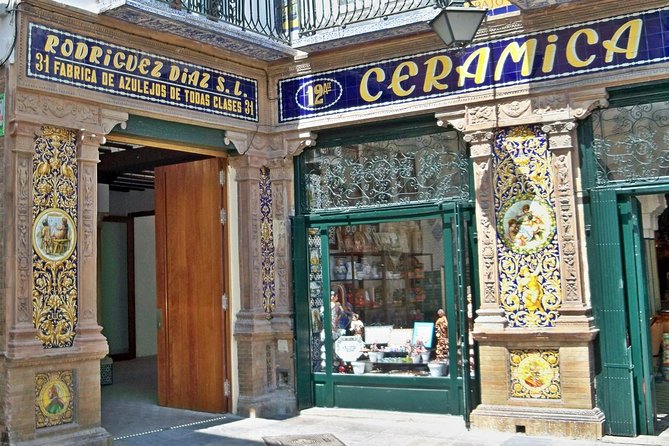
The walk then continues toward the old pottery quarter. Ceramics are central to the visual character of Triana, and tiled surfaces appear throughout Seville. Here, the craft is tied directly to the neighborhood rather than treated as a souvenir-shop theme.
You should not book this tour expecting a pottery class or a workshop visit. No hands-on craft activity is included. Instead, you get a walking explanation of the district and its connection to the tiles and ceramics that give Seville so much color.
This stop is particularly useful if you plan to buy ceramics later. The guide may help you notice the difference between a decorative tiled façade and the broader craft tradition behind it, although specific shopping advice is not promised.
The former Inquisition headquarters
The former headquarters of the Inquisition adds a darker note to the route. It shifts the story away from flamenco and colorful buildings and toward the institutions that shaped life in Seville.
That contrast is one of the route’s strengths. Triana is not presented as a single-theme neighborhood. Its past includes religion, craft, river activity, popular culture, and unsettling episodes. The stop gives the guide room to discuss fear, power, and the gap between the cheerful streets you see today and the events associated with them.
Because this is a legends and history walk, some stories may be more atmospheric than strictly academic. I would treat the guide’s tales as part of Seville’s storytelling tradition, while keeping in mind that a two-hour neighborhood walk cannot provide a full scholarly account of every subject.
What the guides add to the experience
The strongest part of this tour is the guide. The route itself is appealing, but the streets become much more memorable when someone can connect them with local anecdotes.
Several guides are singled out for different strengths. Johanna is described as friendly, entertaining, and easy to follow. Mari Paz has been praised for detailed explanations and for showing images and videos on her tablet. Jesús is described as cheerful and humorous, with a talent for explaining legends that you would not hear on a standard city tour.
Bárbara is associated with professional, engaging evening walks, including departures in the summer heat. Valentín is noted for experience, humor, and a close communication style. Grecia is described as enthusiastic and motivating, while Cristina is praised for staying attentive to the group’s enjoyment. Adrián is recognized for his polite manner and command of Triana’s lesser-known details.
Guide assignments can change, so you cannot book a particular personality unless the provider confirms it. Still, the range of positive comments suggests that the experience depends on a solid team rather than one exceptional individual.
Why the small group and price matter
At $14.23 per person, this is inexpensive for a guided two-hour walk in Seville. You are not paying for an attraction ticket or a meal. You are paying for access to a local guide’s narration and for a planned route through a quarter that can be hard to interpret on your own.
The value is strongest if you enjoy history through stories. A person who only wants major monuments may prefer a cathedral or palace visit. But if you want to understand why Triana feels different from the center, this is a cost-effective addition.
The group maximum is 15 people. That is not a private tour, but it is small enough for the guide to keep everyone close on narrow streets. It also helps when the guide uses a tablet or shows an image, since fewer people are competing for a view.
Group discounts are available, though the exact price reduction is not provided. The ticket is mobile, which means you can keep the booking on your phone rather than carry a printed document.
Timing, walking comfort, and practical details
The experience lasts about two hours and returns to the starting point. You should expect regular walking over older streets and cobblestones, so moderate physical fitness is required.
There is no stated food or drink provision. Bring what you need before the walk, especially if you are visiting during Seville’s warm season. Past evening departures have been appreciated as a more comfortable option in summer, but your exact start time should be checked when booking.
Service animals are allowed. The meeting point is near public transportation, and confirmation is received when you book. These are small details, but they make the tour easier to fit into a busy Seville schedule.
The free cancellation policy is useful if your plans may shift. Cancel at least 24 hours before the local start time for a full refund. Cancellations or changes made later are not accepted for a refund.
Who will get the most from this walk
I would recommend this tour to you if you have already seen Seville’s main center or want a neighborhood-based introduction beyond the cathedral area. It suits people who enjoy legends, local personalities, religious history, crafts, and small details that are easy to miss.
It is also a good choice for repeat visitors. One local participant described the route as valuable even for people from Seville who did not know Triana’s story. That says something about the tour’s focus: it is not limited to the first-time visitor’s checklist.
Families and mixed-age groups may appreciate the short length and storytelling format, provided everyone can manage the walking. Spanish speakers will get the full benefit. If you need an English-language tour, this is not the right booking.
Should you book Legends of Triana?
Book it if you want a low-cost, Spanish-language walk built around stories rather than entrance tickets. The route covers a rewarding mix of river views, flamenco connections, Santa Ana Church, pottery traditions, the old Inquisition headquarters, and Triana’s lesser-known corners.
Skip it if you want a museum-style tour, a pottery workshop, food tastings, or a guaranteed visit inside every building. You should also choose something else if spoken Spanish is not comfortable for you.
For the right visitor, $14.23 is a fair price for two hours of local context and a useful introduction to one of Seville’s most distinctive quarters. The return to the bridge makes it easy to continue your evening, and the 4.9 rating from 20 ratings, along with a 100 percent recommendation figure, reflects the tour’s clearest strength: engaging guides who know how to make Triana’s stories hold your attention.
FAQ
Where does the Legends of Triana Walking Tour begin?
The tour begins at Puente de Isabel II, also known as Triana Bridge, in Seville, Spain.
Where does the tour finish?
The walk ends back at the meeting point at Puente de Isabel II.
How long does the tour last?
The experience lasts approximately two hours. The route description lists about one hour and 45 minutes for the main visit.
Is the tour conducted in English?
No. This experience is specifically offered in Spanish.
What places are included on the route?
The walk includes Calle Betis, the old navigators university, Monipodio’s house, Santa Ana Church, the old pottery quarter, the former Inquisition headquarters, and the riverbank.
How many people can join the tour?
The tour has a maximum of 15 participants.
Can I cancel for a full refund?
Yes. You must cancel at least 24 hours before the local start time to receive a full refund. Later cancellations and changes are not accepted for a refund.
Just added around Seville
- Seville: Wine and Gourmet Tapas Tour★ 5.0 · 3 reviews
- Tapas Tour Cordoba & Wine Experience with chef and sommelier★ 4.8 · 3 reviews
- The most complete tour of Seville: All the highlights included★ 5.0 · 3 reviews
- Seville: Spritz Tasting Experience★ 4.8 · 3 reviews
- Ronda and White Villages Private Day Trip from Seville★ 5.0 · 3 reviews
- Jerez: Historic center of Jerez and horse show★ 5.0 · 3 reviews
- SEVILLE: REAL ALCÁZAR TOUR★ 5.0 · 3 reviews
- Royal Alcazar of Seville Guided Tour★ 5.0 · 3 reviews
Triana Tours, compared.
Live Flamenco Show at “Teatro Flamenco Triana”
Read our review →
Baraka Sala Flamenca Show with Drink in Triana
Read our review →

Spanish Cooking Class & Triana Market Tour in Sevilla
Read our review →
3.5-Hour Spanish Cooking Class & Triana Market Tour
Read our review →
Flamenco Show Tickets to the Triana Flamenco Theater
Read our review →
Browse the lists this tour appears in