Reviewed · TOURS
Seville: 3–Hour Sightseeing Tour
Seville’s story makes more sense from a bicycle. In about two and a half hours, you move from old civic squares and the Cathedral to the former tobacco factory, Plaza de España, the riverfront, bullring, and the modern Mushrooms. It is a quick way to see how many different Sevilles fit inside one city.
I like the wide sweep of the route and the fact that a guide connects each monument to its past instead of simply pointing at buildings. I also like the small practical extras, including a bike, water, map, and child helmet rental.
The main caution is the bicycles. Several recent bookings praised guides such as Sebastian and Alexandro but described the bikes as old, poorly maintained, or uncomfortable. One booking was canceled because two working bikes were not available, so equipment reliability is the key question here.
In This Review
- Key points to know before you book
- Starting in a Sevillian patio
- Plaza del Salvador and the city’s old civic heart
- Avenida de la Constitución and the Giralda
- The old Tobacco Factory and Seville’s changing fortunes
- Prado de San Sebastián and Plaza de España
- Maria Luisa Park and the New York dock
- Real Maestranza and the Torre del Oro
- Finishing at the Mushrooms of Plaza de la Encarnación
- What the guide adds to the ride
- The bicycle question deserves attention
- Is $35 a fair price?
- Who should book this Seville bike tour?
- Should you book it?
- FAQ
- How long does the Seville bike tour last?
- How much does the tour cost?
- Where does the tour start?
- What is included in the price?
- Which languages are available?
- Do I need to bring identification?
- Is the tour suitable for people with mobility impairments?
- Can I cancel the booking?
Key points to know before you book
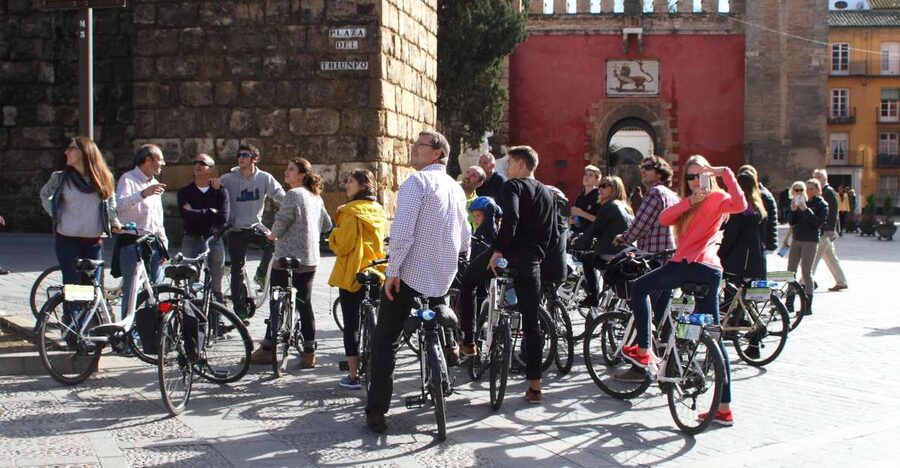
- A full city circuit in 2.5 hours: The route takes in central squares, major monuments, parks, the river, and the newest landmark in central Seville.
- A traditional starting point: You begin at a nineteenth-century house with a typical Sevillian patio, adding local character before the cycling starts.
- Guides make the difference: Sebastian and Alexandro have received especially warm praise for clear explanations, friendliness, and adapting the route to the group.
- Bike quality is uneven: Some bicycles work well enough, while others have been described as very old or unsafe.
- Good value at $35: The price includes the guide, bike, water, map, and child helmet rental, making it useful for first-time visitors who want orientation.
- Not suitable for limited mobility: This is an active cycling route, not a vehicle tour or a short walk between monuments.
Starting in a Sevillian patio
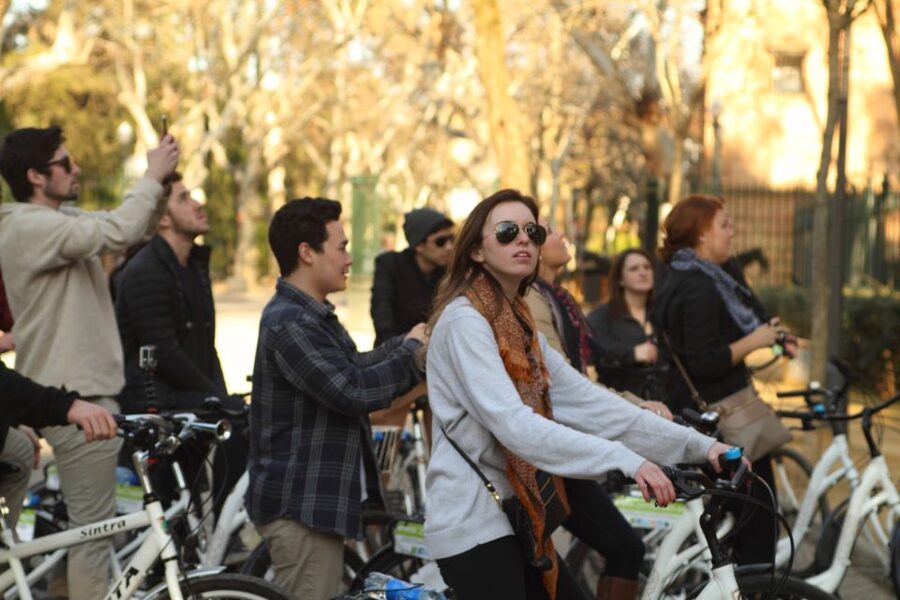
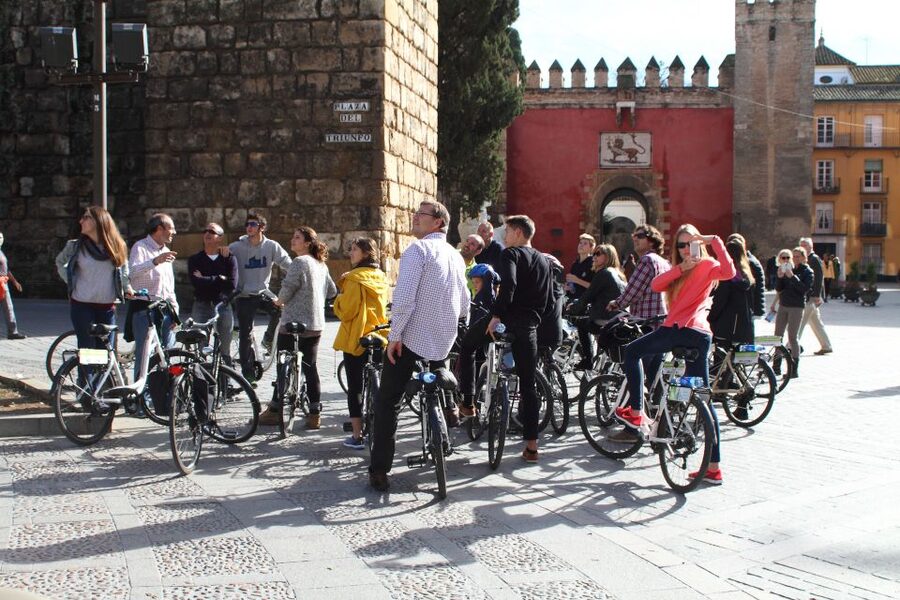
The tour begins at Centerbici, on C/ Espronceda, 5, in central Seville. The starting point is described as a nineteenth-century house that can be viewed in the style of a traditional Sevillian patio. That is a fitting introduction: Seville’s appeal often comes from the way grand public sights and modest everyday spaces sit close together.
You will meet the bilingual guide, collect your bicycle, and receive a water bottle and map. Child helmet rental is included, which is useful for families, though the activity is not suitable for people with mobility impairments.
The tour is advertised as three hours, while the stated duration is two and a half hours. I would plan around the shorter figure and allow extra time before and after for bike collection, questions, and getting back to your own plans. This is a sightseeing ride, not a stop-and-stare visit inside each monument.
That distinction matters. You will see many important places from the outside and hear their stories, but the activity is designed to give you a broad picture of Seville rather than provide long interior visits. If you want to tour the Cathedral, Royal Alcázar, or Plaza de España buildings in detail, you will need separate time.
A few more Seville tours worth comparing
- Seville: Royal Alcázar Entry Ticket
★ 4.6 · 28,378 reviews - Seville: Cathedral and La Giralda Entry Ticket
★ 4.5 · 24,592 reviews - Seville: Live Flamenco Dancing Show Ticket at the Theater
★ 4.7 · 16,396 reviews
Plaza del Salvador and the city’s old civic heart
The first part of the route moves through some of Seville’s most historic central squares. Plaza del Salvador is a good place to begin understanding the city’s public life. It is closely tied to the Church of El Salvador and the surrounding old quarter, where narrow streets open into lively gathering spaces.
Next come Plaza de San Francisco and Plaza Nueva. Plaza de San Francisco sits beside Seville’s City Hall and has long served as a major civic space. Plaza Nueva gives you a different view, with broad open ground and the City Hall forming a strong architectural backdrop.
From a bicycle, you get a useful sense of how these spaces connect. On foot, the old center can feel like a maze of lanes, courtyards, and small plazas. The bike helps you cover the gaps without losing the basic shape of the city.
You should also expect city traffic, pedestrians, and stops to affect the pace. The value here is not speed. It is the guide’s explanation of why these squares matter and how Seville’s religious, political, and commercial life gathered around them.
Avenida de la Constitución and the Giralda
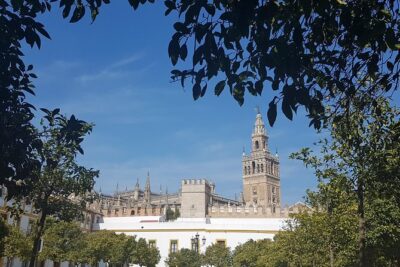
The route then reaches Avenida de la Constitución, the grand avenue beside Seville Cathedral. This is one of the city’s most impressive approaches to the Giralda, the former minaret turned bell tower that has become Seville’s best-known symbol.
The Cathedral is easy to admire from the outside, but the guide’s historical context adds more than a photograph does. The Giralda reflects Seville’s Islamic past and later Christian transformation, while the cathedral shows the scale and confidence of the city after the Christian conquest.
Do not confuse seeing the Cathedral with visiting it. This bike tour takes you to the area and explains the monument, but admission to the interior is not listed as part of the activity. If the cathedral is a top priority, book an entry time separately and avoid assuming this ride replaces that visit.
The advertised skip-the-ticket-line feature should be read carefully. It can be useful where a ticketed element applies, but the supplied details do not identify a specific included admission. Ask the provider what it covers if that point matters to your plans.
The old Tobacco Factory and Seville’s changing fortunes
The former tobacco factory is one of the most interesting stops because it takes you beyond the usual postcard sights. The building is associated with Seville’s tobacco trade and later became part of the city’s university life. Its large scale and institutional character give you a sense of how important manufacturing once was here.
This stop also helps connect Seville’s colonial-era wealth with its later identity as a modern university city. A guide can point out details that are easy to miss when you pass the building alone.
The route is especially useful for first-time visitors because it places the tobacco factory within a larger story. You are not just ticking off a monument. You are moving from religious power in the old center to commerce, industry, education, and public space.
The stop may be brief, so keep your expectations realistic. You are likely to hear the history and view the building rather than spend a long time inside. That is typical of a survey ride, and it leaves you with a clear idea of where to return later.
A completely different day out from Seville:
- Seville: Casa de la Memoria Flamenco Show
★ 4.8 · 12,964 reviews - Seville: 1-Hour Guadalquivir River Sightseeing Eco Cruise
★ 4.2 · 10,281 reviews - Córdoba: Skip-the-Ticket-Line Mosque-Cathedral Guided Tour
★ 4.6 · 9,634 reviews - Seville: Cathedral, Giralda, and Royal Alcázar Guided Tour
★ 4.7 · 9,165 reviews
Prado de San Sebastián and Plaza de España
Prado de San Sebastián marks a change in mood. The route leaves the tight old center and reaches a more open part of Seville, where roads, gardens, and major public spaces give the city room to breathe.
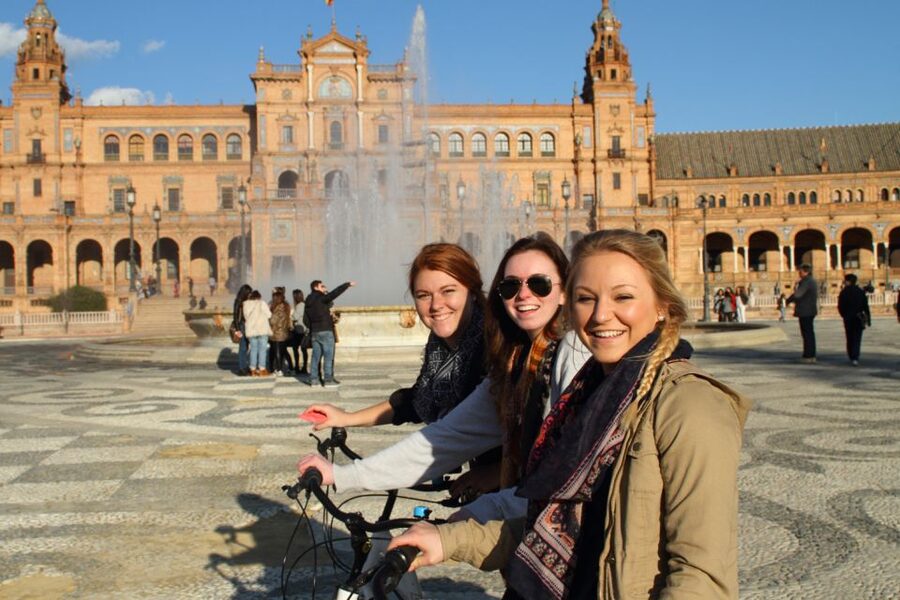
From there, the tour continues to Plaza de España, one of Seville’s most recognizable settings. Built for the Ibero-American Exposition of 1929, it curves around a large central space with tiled provincial alcoves, bridges, and water channels. It was designed to impress, and it still does.
A bicycle is handy here because the plaza is part of a wider area rather than an isolated sight. You can understand its relationship to the surrounding park and avenues instead of seeing it only as a single photo stop.
The guide’s stories are important at Plaza de España. Details about its construction, regional tile displays, and role in Seville’s public image give the place more meaning. Without context, it can seem like an oversized decorative square. With context, you see it as a carefully staged statement about Spain and its regions.
You should also expect other people, especially around the most photographed parts. The experience is better if you allow the guide to handle the explanation while you take in the overall design. If you want to examine every tile alcove or cross every bridge slowly, return later on foot.
Maria Luisa Park and the New York dock
Maria Luisa Park provides a greener section of the route. The park is closely linked to Plaza de España and offers a pleasant break from Seville’s stone streets and traffic.
The route then reaches the New York dock, a reminder that Seville’s riverfront was tied to long-distance shipping and overseas trade. The name points to the commercial links that once ran through the port and river, even though the city lies inland from the Atlantic coast.
This section gives the ride some variety. You are not spending the full tour among churches and government buildings. You are also seeing gardens, waterways, and the traces of Seville’s role in trade.
Do not expect a long riverside ride or a nature outing. The emphasis remains on the city’s history and monuments. The value is the contrast between the quiet park setting and the commercial story attached to the dock.
Real Maestranza and the Torre del Oro
The route continues toward the Real Maestranza, Seville’s famous bullring. Even if bullfighting is not part of your own travel interests, the building matters because it is tied to Andalusian tradition, public spectacle, and the city’s cultural identity.
The guide can give you the background needed to understand why the bullring occupies such an important place in Seville. You will see the exterior as part of the cycling route. A full bullring visit is not listed, so plan a separate stop if you want to go inside.
Nearby, the Torre del Oro brings the route back to the river. This medieval defensive tower is one of Seville’s most recognizable waterside landmarks. Its position makes sense once you understand its role in protecting the river approach and controlling movement along the Guadalquivir.
The combination of bullring and tower works well. One represents a later public tradition, while the other points to Seville’s medieval defenses and river-based power. I like this part of the itinerary because the monuments are close enough to connect but different enough to keep the ride from feeling repetitive.
The riverfront can also be one of the more exposed parts of the route. You may find the cycling easier here than in the old center, but road conditions, pedestrians, and stops still shape the pace. Follow the guide closely and take care around crossings.
Finishing at the Mushrooms of Plaza de la Encarnación
The final stop is the Mushrooms of Plaza de la Encarnación, officially known as Metropol Parasol. This modern wooden structure is a sharp contrast to the Cathedral, old squares, medieval tower, and nineteenth-century buildings seen earlier.
That contrast is the point. Seville is not a museum frozen in one period. The Mushrooms show a city willing to add bold contemporary architecture to a historic center, even when the result divides opinion.
Ending here gives the tour a clear visual conclusion. You begin with a traditional patio and finish beneath one of Seville’s most recognizable modern structures. In between, you see layers of Islamic, Christian, imperial, industrial, civic, and contemporary Spain.
The stop is also practical. Plaza de la Encarnación is central, so you can continue exploring, find food, or walk back toward other sights after the tour. Since the activity ends in a different part of the center from its starting point, confirm the final location and allow time to orient yourself.
What the guide adds to the ride
The guide is the strongest part of this experience when the equipment is in good condition. The listed languages are Spanish, English, French, Italian, and Dutch, and the tour is bilingual. That gives you a better chance of joining a language that suits you, though the exact language arrangement can depend on the group.
Sebastian has been singled out for being friendly, attentive, well informed about Seville, and willing to adjust the route to suit the group. Alexandro has also been praised as a pleasant guide. Those names are useful when you are comparing this activity, but guide assignments can change, so they should not be treated as a guarantee.
The best guides on a city ride do more than recite dates. They explain why a square was built, how a monument changed use, and what a modern structure says about Seville today. This route has enough variety for those connections to matter.
A flexible guide can also make the ride feel less rushed. One group reported covering a large circuit and not noticing the time pass. That is a good sign for anyone who prefers a conversational tour over a rigid checklist.
The bicycle question deserves attention
I would treat the bike condition as the main weakness. Several bookings praised the guide while criticizing the bicycles, describing them as old, poorly maintained, or close to unsafe. Another booking reported that the tour had to be canceled because the station did not have two intact bikes.
That is not a minor complaint. A sightseeing route is only good value if you feel secure and comfortable on the bicycle. At the same time, one French booking described the bikes as not new but functional, so the equipment may vary from bike to bike or from day to day.
When you arrive, check the brakes, tires, chain, saddle, and gears before leaving. If something feels wrong, say so immediately and ask for another bicycle. Bring your ID, as requested in the activity information, and wear practical clothing suitable for cycling.
This is also not the right choice if you have mobility limitations. The tour involves riding between several parts of the city, and no adapted format is offered in the details provided.
Is $35 a fair price?
At $35 per person, the tour is reasonably priced if you want a guide-led overview of Seville. The fee includes the bicycle, bilingual guide, water bottle, map, and child helmet rental. Comparable value depends less on the length than on how much you would otherwise spend arranging your own route and research.
You are paying for orientation and interpretation, not admission to every major monument. The Cathedral, bullring, and other sights are covered from the outside unless the provider specifies otherwise. If you want interiors, add those costs and time separately.
The price works best for a first day in Seville. You can see where the main areas sit, learn which places deserve a longer visit, and return later with a better plan. It is less useful if you already know the city well or prefer to spend an hour at each monument.
Free cancellation up to 24 hours before departure and the option to reserve without paying immediately make the booking easier to fit around changing plans. Check the available start times before committing, since the stated duration is two and a half hours even though the tour is presented as three hours.
Who should book this Seville bike tour?
I would recommend it to first-time visitors who want to cover a lot of ground without joining a large bus tour. It also suits you if you enjoy hearing the story behind a building while moving through the city rather than stopping for long formal talks.
It can work well for families if the children can ride comfortably, since child helmet rental is included. Couples and small groups may also appreciate the chance to ask for a route adjusted to their interests, though the exact amount of flexibility depends on the guide and group.
I would hesitate if you are very particular about bicycle quality, uncomfortable riding in city traffic, or mainly want interior visits. I would also avoid booking it as your only Seville activity. The route shows you the city’s shape, but the Cathedral, Plaza de España, and other major sights deserve slower time afterward.
Should you book it?
Book this tour if you want a brisk, story-filled introduction to Seville and you are comfortable checking your bicycle before setting off. At $35, the route offers a lot: historic squares, the Giralda, Tobacco Factory, Plaza de España, Maria Luisa Park, riverfront landmarks, the bullring, and the Mushrooms.
The guides, especially Sebastian and Alexandro, are a real reason to consider it. But ask about the bicycle at the start and do not accept a bike that feels unsafe. If the provider can supply a sound bike, this is a useful and well-priced way to get your bearings, then return to the places that deserve more time.
FAQ
How long does the Seville bike tour last?
The activity information gives a duration of two and a half hours, although it also describes the tour as three hours. Plan for about two and a half hours of touring and check the available start times when booking.
How much does the tour cost?
The listed price is $35 per person.
Where does the tour start?
The meeting point is the Centerbici store at C/ Espronceda, 5, 41004 Sevilla.
What is included in the price?
The price includes the guided Seville tour, bike rental, bilingual guide, a water bottle, and a map. Helmet rental for children is also included.
Which languages are available?
The live guide can operate in Spanish, English, French, Italian, or Dutch. The tour is described as bilingual.
Do I need to bring identification?
Yes. You should bring your ID with you.
Is the tour suitable for people with mobility impairments?
No. The activity is listed as unsuitable for people with mobility impairments.
Can I cancel the booking?
You can cancel up to 24 hours in advance for a full refund. You can also reserve now and pay later, which keeps your plans flexible.
Just added around Seville
- Seville: Wine and Gourmet Tapas Tour★ 5.0 · 3 reviews
- Tapas Tour Cordoba & Wine Experience with chef and sommelier★ 4.8 · 3 reviews
- The most complete tour of Seville: All the highlights included★ 5.0 · 3 reviews
- Seville: Spritz Tasting Experience★ 4.8 · 3 reviews
- Ronda and White Villages Private Day Trip from Seville★ 5.0 · 3 reviews
- Jerez: Historic center of Jerez and horse show★ 5.0 · 3 reviews
- SEVILLE: REAL ALCÁZAR TOUR★ 5.0 · 3 reviews
- Royal Alcazar of Seville Guided Tour★ 5.0 · 3 reviews
Tours, compared.
Skip-the-Ticket-Line Mosque-Cathedral Guided Tour
Read our review →
Cathedral, Giralda, and Royal Alcázar Guided Tour
Read our review →
Cathedral, Giralda & Alcazar Entry With Guided Tour
Read our review →
Priority Access Cathedral, Giralda & Alcázar Tour
Read our review →
Cordoba Mosque-Cathedral: Skip-the-Line Guided Tour
Read our review →
Alcázar and Cathedral Entry Ticket and Guided Tour
Read our review →