
Reviewed · CITY TOURS
Seville: Relaxing City Bike Tour with a Tour Guide
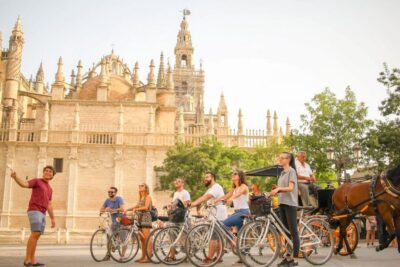
Seville is wonderfully suited to two wheels: much of the city is flat, the route covers a lot of ground, and the stops are frequent enough that you are not pedaling nonstop. This tour links Santa Cruz, María Luisa Park, Triana, and the river into one easy introduction, with guides such as Carmen, Juan, Pablo, and Daniel bringing the city’s history and culture to life.
I like the relaxed pace and the chance to see places that are spread too far apart for a short walking tour. I also like that the guide does more than point out monuments, adding practical tips about tapas, flamenco, restaurants, and what to see next.
The main consideration is city traffic. You will ride through busy areas, and even mostly good cycle routes require attention around pedestrians and crowded sights. Also, the published details vary slightly on duration, departure time, and language availability, so check the exact option when booking.
In This Review
- Key points before you book
- Why a bicycle works so well in Seville
- Starting in Plaza de Santa Cruz
- Orange trees and the Jardines de Murillo
- María Luisa Park and the tiles of Plaza de España
- The Guadalquivir and Torre del Oro
- Across to Triana
- The cathedral, Giralda, Alcázar, and Las Setas
- What the guides add to the ride
- Pace, bikes, and practical comfort
- Is $35 a fair price?
- Who should book this Seville bike tour?
- Should you book it?
- FAQ
- Where does the bike tour meet?
- How long does the tour last?
- How far do you cycle?
- Is the route flat?
- What sights does the tour include?
- Is bike rental included?
- Is wearing a helmet required?
- What languages are available?
- Can children join the tour?
- What happens if I need to cancel?
Key points before you book
- About 10 kilometers on mostly flat terrain: You cover Seville’s major districts without a hard workout.
- A strong first-day activity: The route gives you a useful map of the city before you explore individual sights.
- Frequent stops and an adjustable pace: Guides check that the group stays together, including through busier areas.
- A small-group format: The maximum group size is 15, though some departures may be much smaller.
- A guide-led view of Seville: Expect history, architecture, flamenco, politics, local customs, and food suggestions.
- Good value at $35: Bike hire, helmet, water, insurance, and guiding are included.
Why a bicycle works so well in Seville
Seville’s major sights are not packed into one small square. Santa Cruz sits near the cathedral and Alcázar, María Luisa Park lies farther south, Triana is across the Guadalquivir, and Las Setas is back toward the northern part of the old center.
On foot, you can cover these areas, but you will spend more time walking between them. A bicycle lets you connect the dots while still moving slowly enough to notice tiled courtyards, orange trees, old façades, and changing neighborhoods.
This is not a racing tour. The route covers roughly 10 kilometers, and guides adapt the speed to the group. You stop every few minutes in some sections, especially at major monuments, so the experience feels closer to a sightseeing ride than an exercise class.
That makes it useful for your first morning or afternoon in Seville. You get a broad sense of the city, then you can return later to the cathedral, Plaza de España, Triana, or a museum that caught your attention.
More bike days around Seville:
- Seville Highlights Bike Tour (English)
★ 5.0 · 2,225 reviews - Seville: Highlights City Bike Tour
★ 4.8 · 2,168 reviews - Seville: City Sightseeing and Local Culture Bike Tour
★ 4.9 · 1,120 reviews
Starting in Plaza de Santa Cruz
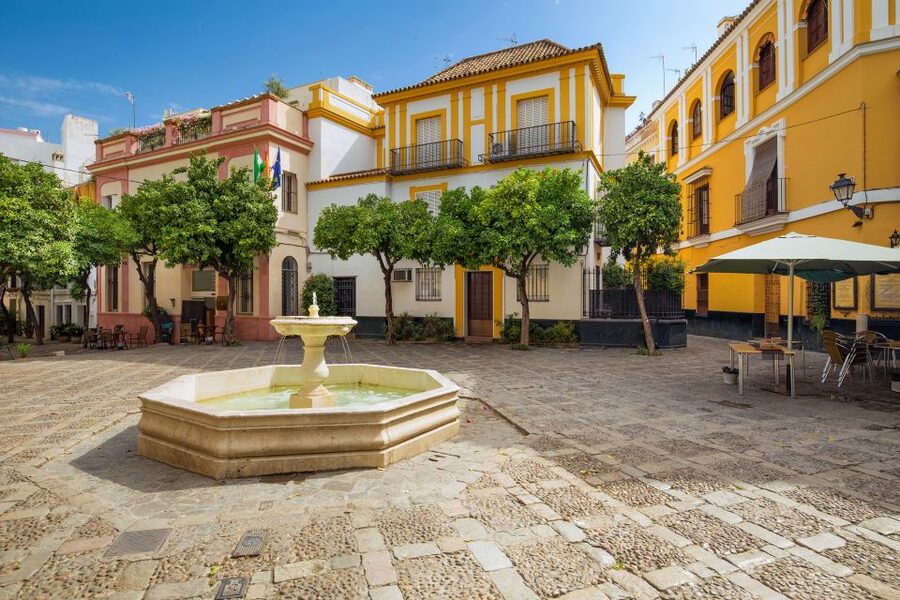
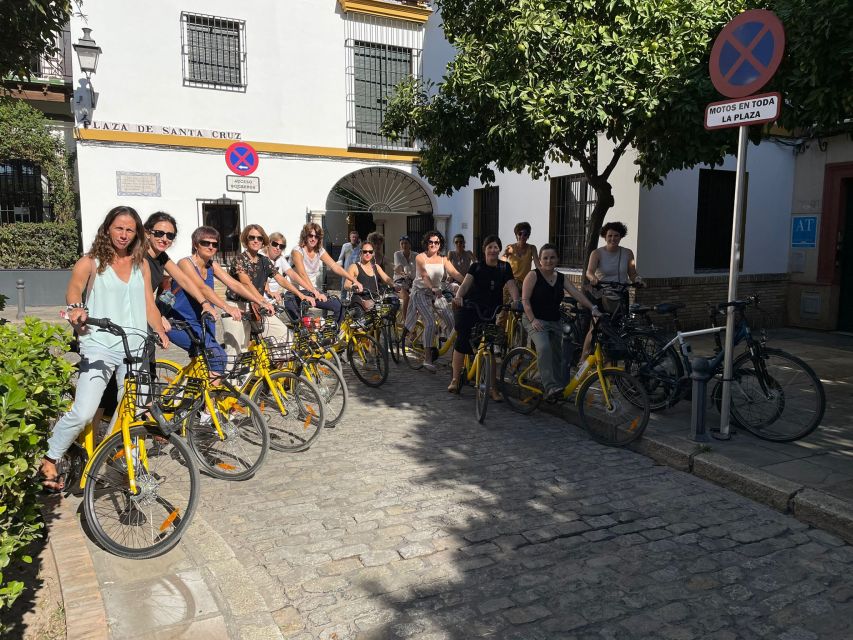
The meeting point is at Plaza de Santa Cruz 4, behind the Jardines de Murillo. This puts you in the heart of the old Jewish quarter, surrounded by narrow lanes, whitewashed buildings, flower-filled balconies, and small plazas.
The opening section through Barrio Santa Cruz sets the tone. You are close to some of Seville’s most famous monuments, but the streets are too narrow and uneven for fast riding. Expect to move carefully, with the guide leading the way and the group stopping to hear about the quarter.
This is one place where a bicycle is both useful and slightly awkward. You can reach corners that are inconvenient by car, but pedestrians have priority, and the streets can be crowded. Keep your eyes ahead, leave room for people on foot, and do not expect a smooth, uninterrupted ride.
A good guide makes this part work. Carmen has been praised for keeping people comfortable and checking the pace, while Juan and Daniel are known for mixing historical detail with humor and local suggestions. The guide on your departure may be someone else, but the format is designed to stay informal rather than lecture-like.
Orange trees and the Jardines de Murillo
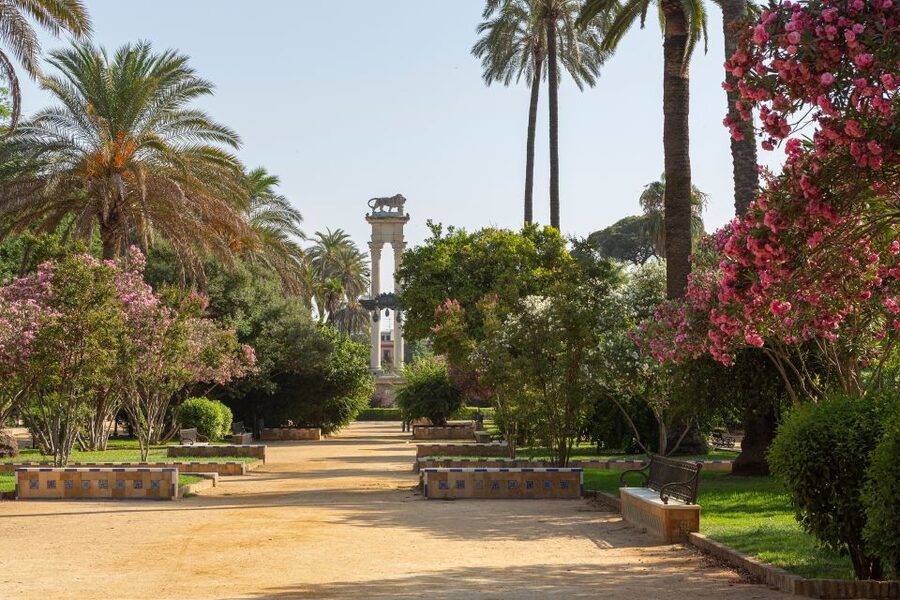
From Santa Cruz, the route moves into the Jardines de Murillo. This is a welcome change after the tight lanes of the old quarter, with more space, shade, palms, and orange trees.
The gardens offer a calmer stretch of cycling. You can settle into the bike, look around, and listen without dealing with as many turns or pedestrians. The stop also helps explain how Seville’s public spaces connect with its historic center.
I particularly like this part for people who want a gentle start. You do not have to arrive ready for a serious ride. Comfortable clothes, sunscreen, and water are sensible, especially in warm weather, but the route itself is not presented as strenuous.
The included bottled water is a small but useful touch. A helmet is included, though the information says wearing it is optional. You should still bring your passport or ID card, which is listed as required.
María Luisa Park and the tiles of Plaza de España
The route continues into Parque de María Luisa, one of Seville’s best places for a slower ride. Wide paths, gardens, palms, fountains, and shaded areas make this a pleasant contrast to the stone streets around Santa Cruz.
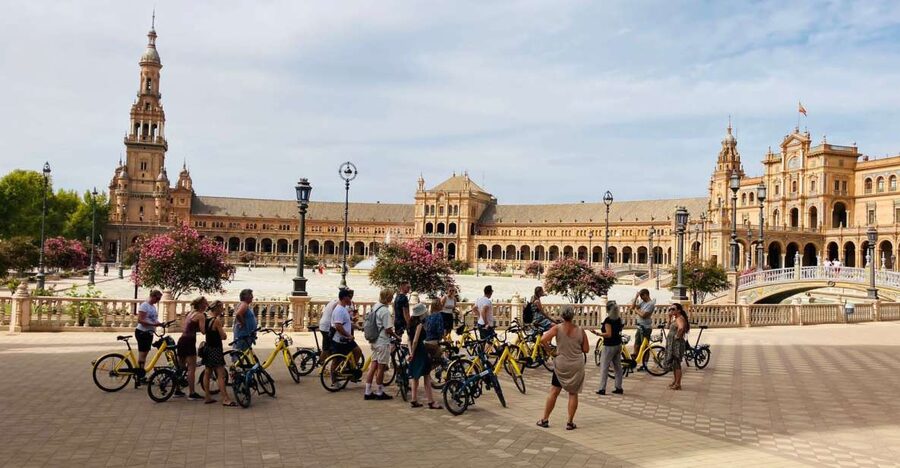
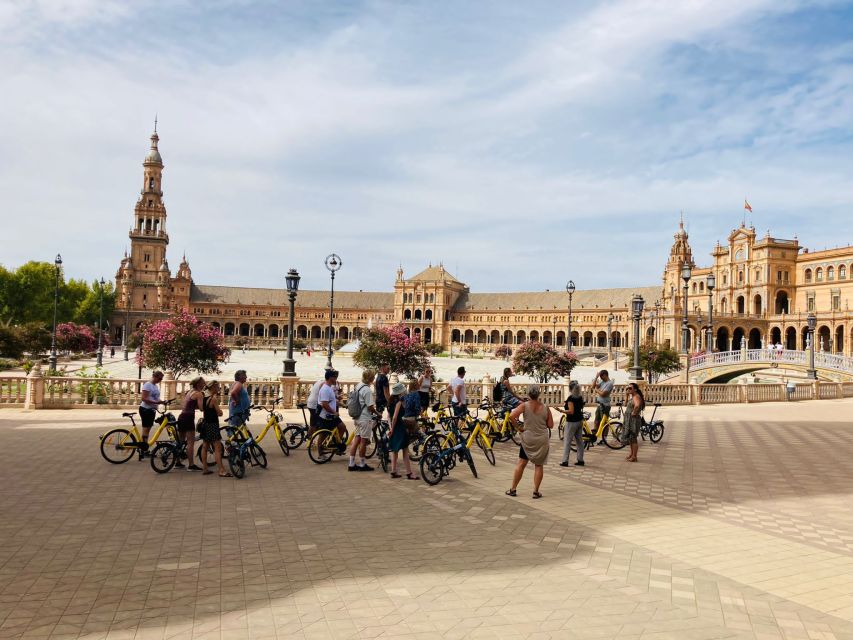
The big stop is Plaza de España, built for the 1929 Iberian-American Exposition. Its curved brick structure, towers, bridges, canal, and province-themed ceramic benches make it one of Seville’s most photographed sights.
The tiled displays are not just decoration. They offer a visual tour of Spain’s provinces, and the guide can help you understand why the square was built and how it fits into Seville’s modern history. You will have time to take photographs and look around, although this is a guided bike tour rather than a long architectural visit.
This distinction matters. If your main goal is to study every tile or spend an hour inside each monument, book separate visits. The bike tour gives you orientation and context, then moves on.
Several people who have used the tour with children found the pace manageable, and one guide, Alvarito Garsia, was singled out for being especially good with younger riders. Still, every cyclist must be able to control a bike, follow the group, and manage occasional crowded paths.
A few more Seville tours worth comparing
- Seville: Royal Alcázar Entry Ticket
★ 4.6 · 28,378 reviews - Seville: Cathedral and La Giralda Entry Ticket
★ 4.5 · 24,592 reviews - Seville: Live Flamenco Dancing Show Ticket at the Theater
★ 4.7 · 16,396 reviews - Seville: Casa de la Memoria Flamenco Show
★ 4.8 · 12,964 reviews
The Guadalquivir and Torre del Oro
After María Luisa Park, the route heads toward the Guadalquivir Riverside. The river gives you a different view of Seville, with open outlooks and a chance to see how the city grew around its waterway.
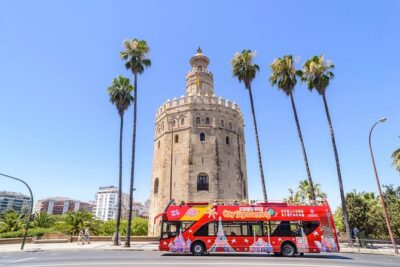
The Torre del Oro is the main landmark here. Its compact defensive form is easy to recognize, and its position beside the river makes it one of Seville’s most memorable views. The guide uses the stop to connect the tower with the city’s past as a major port and center of trade.
You may not enter the tower on this outing. The experience is about seeing the city from the outside and understanding how its monuments fit together. Plan a separate visit if you want an interior museum stop.
The riverside section can be one of the easiest places to ride, but do not assume every meter will be empty. The route crosses public areas used by walkers and other cyclists. One especially useful detail from the supplied information is that guides take care to keep the group together through busy sections.
Across to Triana
The ride into Triana adds a neighborhood feel to a route otherwise focused on headline sights. Across the Guadalquivir, Triana is associated with flamenco, traditional ceramics, and a strong local identity.
This is a valuable stop because it broadens your picture of Seville. The city is not only cathedrals, palaces, and grand plazas. Triana gives the tour a more everyday setting and helps explain the traditions that shape Seville’s music, crafts, and social life.
Guide quality matters most here. Juan has been praised for discussing flamenco, art, philosophy, and local history, while other guides have offered suggestions for flamenco shows and tapas bars. Those recommendations can be especially useful if this is your first day and you have not yet worked out your evening plans.
Do not expect a full flamenco performance or a ceramics workshop. You are seeing the district by bike, hearing its story, and gathering ideas for a later visit.
The cathedral, Giralda, Alcázar, and Las Setas
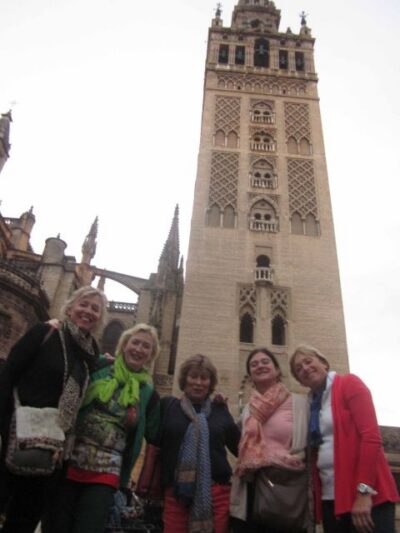
The route also passes Seville Cathedral, the Giralda, and the Metropol Parasol, commonly called Las Setas. Depending on the exact route and the guide’s timing, you may see some sights from nearby streets and stop for an explanation rather than enter them.
The cathedral and Giralda provide Seville’s most recognizable historic profile. The Alcázar area adds royal architecture and gardens, though the experience information does not include admission to the palace. Think of this section as a guided overview, not a substitute for your timed ticket to the cathedral or Alcázar.
Las Setas offers a sharp change in style. Its large wooden structure sits in a part of the city that feels different from the medieval quarter, making it a useful reminder that Seville is not frozen in the past.
The route’s strength is variety. In a few hours, you move from narrow old streets to gardens, an exposition square, the river, a traditional neighborhood, and modern architecture. That variety is hard to match on foot in the same time.
What the guides add to the ride
The guide is the heart of this activity. The bikes get you from one place to another, but the stories turn a pleasant ride into a useful city tour.
Carmen is repeatedly described as friendly, clear, and good at adjusting the pace. Juan appears often in the feedback, with praise for his history, flamenco knowledge, humor, and practical suggestions. Daniel is noted for an approachable manner, energy, and strong explanations of Seville’s archaeology and architecture.
Other named guides include Pablo, Paulo, Leo, Leon, Ally, Alvarito Garsia, Pierre, and Ale. The guide changes by departure, and you cannot assume you will receive a particular person. What you can expect is a live guide in Spanish, English, French, Italian, or Dutch according to the published activity details.
The language information is not fully consistent. One section also lists German, Russian, and Portuguese, while another lists only Spanish, English, French, Italian, and Dutch. Select your preferred language carefully and confirm the available option before paying.
The best guides keep explanations short enough to suit a bike stop. They also notice when someone is falling behind. This matters more than a memorized speech, especially in crowded areas or with a mixed-age group.
Pace, bikes, and practical comfort
The tour is suitable for all ability levels only if you can ride a bicycle. It is not suitable for someone who cannot cycle, and the group needs to manage public streets and paths.
The route is described as flat, though one family reported a few more challenging hills. That suggests you should expect an easy ride overall, not a perfectly level route from door to door.
A high-quality city bike, helmet, bottled water, and liability insurance are included. The bikes are described as comfortable and easy to handle, with frequent stops that let you get off rather than remain in the saddle for the full duration.
Wear ordinary walking clothes that allow easy movement. Sunscreen is important, and a passport or ID card is required. If you have not cycled for years, tell the guide at the start so the pace and positioning can be handled sensibly.
The stated duration appears in two forms: about 2.5 hours in the activity details and three hours in the fuller description. Departure information also varies, with 10:00, 10:30, and 14:00 listed in different places. Check your confirmation for the exact time and length.
Is $35 a fair price?
At $35 per person, this is a reasonable way to see Seville if you value time and orientation. You are paying for the bike, helmet, water, insurance, a live guide, and a route that covers several districts without arranging transport between them.
The value is strongest on a first visit. You can use the tour to decide where to return, which neighborhoods deserve a longer walk, and where to look for dinner or flamenco later.
The price is less compelling if you already know Seville well or plan to spend most of your time inside major monuments. Entry to the cathedral, Alcázar, Torre del Oro, and other attractions is not listed as included, so budget separately for those visits.
The small-group limit of 15 helps justify the cost. A very large cycling group can be difficult to manage, especially in Santa Cruz and around Plaza de España. Here, the guide can usually see who needs a slower pace, and some departures may be much smaller.
The activity offers free cancellation up to 24 hours before departure and a reserve-now, pay-later option. Those terms are useful if your plans are still moving, but always check the final booking conditions for your selected time.
Who should book this Seville bike tour?
I would choose this tour for a first or second day in Seville, especially if you want a broad view before committing time to individual attractions.
It suits:
- Couples who want an easy introduction without a formal bus tour
- Families with children who can ride confidently
- Older cyclists who prefer frequent stops and no major climbs
- Solo visitors who want local suggestions and a planned route
- Anyone with limited time in Seville
- People who enjoy history but do not want to spend every hour indoors
It is less suitable if you dislike cycling near pedestrians, want a silent sightseeing experience, or cannot ride comfortably in public areas. It is also not the right choice for a detailed visit inside the cathedral or Alcázar.
Should you book it?
Book it if you want to see a large slice of Seville in one gentle outing, with a guide who can explain the city and point you toward good next stops. The combination of flat riding, frequent pauses, major sights, Triana, and practical local advice gives you strong value for $35.
I would reserve an early departure if available. The route is likely to feel easier before the city fills up, and an early start leaves the afternoon for the cathedral, Alcázar, lunch, or a second walk through a neighborhood you liked.
Confirm the time, duration, language, and exact meeting instructions before booking because the published details vary. If you can ride a bike and accept a little city traffic, this is a smart, relaxed way to get your bearings fast.
FAQ
Where does the bike tour meet?
The meeting point is Plaza de Santa Cruz 4 in Barrio Santa Cruz, behind the Jardines de Murillo.
How long does the tour last?
The activity is listed as 2.5 hours in one section and three hours in another. Check the exact duration shown for your selected departure.
How far do you cycle?
The route is approximately 10 kilometers.
Is the route flat?
The route is described as flat and suitable for all levels, though one family noted a few more challenging hills.
What sights does the tour include?
You can expect Santa Cruz, the Jardines de Murillo, María Luisa Park, Plaza de España, the Guadalquivir Riverside, the Torre del Oro, Triana, Seville Cathedral, the Giralda, and Las Setas.
Is bike rental included?
Yes. A city bike, helmet, bottled water, and liability insurance are included.
Is wearing a helmet required?
A helmet is included, but the activity information says it is optional.
What languages are available?
Spanish, English, French, Italian, and Dutch are listed. Other published details also mention German, Russian, and Portuguese, so confirm the language offered for your chosen departure.
Can children join the tour?
Children who can ride a bike may be able to join. The tour information says it is not suitable for people who cannot ride, and guides adjust the pace to the group.
What happens if I need to cancel?
You can cancel up to 24 hours in advance for a full refund. A reserve-now, pay-later option is also offered.
Just added around Seville
- Seville: Wine and Gourmet Tapas Tour★ 5.0 · 3 reviews
- Tapas Tour Cordoba & Wine Experience with chef and sommelier★ 4.8 · 3 reviews
- The most complete tour of Seville: All the highlights included★ 5.0 · 3 reviews
- Seville: Spritz Tasting Experience★ 4.8 · 3 reviews
- Ronda and White Villages Private Day Trip from Seville★ 5.0 · 3 reviews
- SEVILLE: REAL ALCÁZAR TOUR★ 5.0 · 3 reviews
- Royal Alcazar of Seville Guided Tour★ 5.0 · 3 reviews
- Jerez: Historic center of Jerez and horse show★ 5.0 · 3 reviews
City Tours, compared.

City Sightseeing Seville Hop-On Hop-Off Bus Tour
Read our review →
Browse the lists this tour appears in