
Reviewed · WALKING TOURS
Seville Small-Group Monumental Highlights Walking Tour
Seville’s grandest sights make more sense when you see them as chapters in one story: mosque, cathedral, royal palace, Atlantic trade port, tobacco factory, and showcase square. This two-hour outdoor walk connects those chapters without asking you to spend the day inside a museum.
I like the small group of up to 10 people, which makes it easier to hear your guide and ask questions. I also like the route’s range, from the City Hall and Giralda to the Torre del Oro and Plaza de España. The main catch is clear: you do not enter the monuments, so you’ll need separate tickets and time if you want to tour the Cathedral or Alcázar inside.
In This Review
- Key points to know before booking
- Why this route works as a first look at Seville
- Plaza de San Francisco and the City Hall
- From mosque to cathedral: the Giralda story
- Seville as the Port of the Indies
- The Alcázar from the outside
- The Torre del Oro and Seville’s river gateway
- The old Tobacco Factory and industrial Seville
- Plaza de España and the 1929 city makeover
- What the small group changes
- Walking comfort, timing, and practical details
- Is $30.25 a fair price?
- Who should book this Seville walking tour?
- Should you book it?
- FAQ
- How long does the Seville Monumental Highlights Walking Tour last?
- What sights are included in the route?
- Do monument tickets come with the tour?
- How large is the group?
- Is the tour offered in English?
- Can Plaza de España be closed during the tour?
Key points to know before booking
- Seven major sights in one walk: The route links City Hall, the former mosque and Giralda, the Port of the Indies, the Alcázar, Torre del Oro, old Tobacco Factory, and Plaza de España.
- A genuinely small group: The maximum is 10 people, a useful size for hearing commentary in busy streets and asking questions.
- History told as a connected story: The walk explains how Muslim, Christian, royal, colonial, and industrial Seville shaped the city you see today.
- Outdoor sightseeing only: Monument entrances are not included, so treat this as an orientation walk rather than a full interior tour.
- Strong guide feedback: Carlos, Carmen, Laura, Miguel, Marta, Cristina, Manuel, Barbara, and Valentín are specifically praised for clear explanations, humor, patience, and good group rapport.
- A practical first-day choice: The route ends at Plaza de España, giving you a useful view of Seville’s historic center and later urban expansion.
Why this route works as a first look at Seville
The best feature here is the route itself. Seville can feel like a collection of beautiful but disconnected sights until someone explains the forces behind them. This walk gives you that framework in a short stretch of time.
You begin at Plaza de San Francisco, beside Seville’s City Hall, and finish at Plaza de España. That means the experience moves from the old civic and religious center toward the grand semicircular plaza built for the 1929 Ibero-American Exhibition. You see the city change in front of you, not just one monument after another.
The price is $30.25 per person, which is fair for a licensed English-speaking guide and a small group. It is especially good value if you have only a short stay or want help deciding which buildings deserve your paid entry time. It is less compelling if you already know Seville well or want a tour focused on interiors.
The walk is listed at about two hours, though one account describes a roughly two-and-a-half-hour outing. Plan for two hours at minimum and avoid scheduling a tight meal, train, or timed monument ticket immediately afterward.
More Walking Tours in Seville
- Seville: Small-Group City Highlights Walking Tour
★ 5.0 · 1,204 reviews - Cultural Walking Tour of Seville Monumental
★ 5.0 · 861 reviews - Seville: Tapas, Taverns, and History Walking Tour
★ 4.9 · 676 reviews
Plaza de San Francisco and the City Hall
The opening stop uses Seville’s City Hall to explain why the city mattered so much in the 1500s. That is a smart place to begin. Rather than starting with a quick photo of a famous tower, the guide first gives you the political and economic setting behind Seville’s grand buildings.
The City Hall area places you in the historic core, where civic power, commerce, and religious authority once crowded together. Your guide’s job here is less about pointing out a single decorative detail and more about helping you understand Seville as a major city during Spain’s imperial period.
This opening should suit you if you prefer context before detail. Guides such as Carlos and Barbara have been singled out for tying local events to wider Spanish and world history. If dates and dynasties tend to blur together, ask your guide to keep the story focused on the main turning points.
From mosque to cathedral: the Giralda story
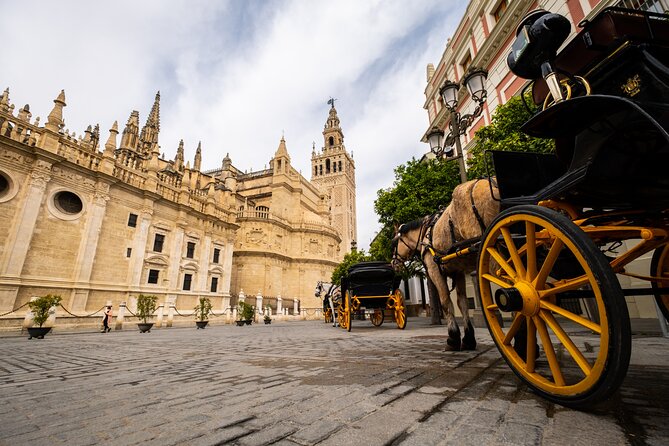
The next section explains the outdoor setting around Seville Cathedral, the earlier mosque, and the Giralda Tower. This is one of the most important parts of the walk because it shows how the city’s religious identity changed without erasing every earlier layer.
The Giralda began as a mosque minaret and later became the bell tower of the cathedral. From outside, you can grasp the basic transformation: Islamic architecture was adapted to a Christian building and a new religious purpose. The guide also explains how different cultures and faiths shaped present-day Seville.
You will not climb the Giralda or enter the Cathedral on this experience. That limitation matters, but the outside explanation can help you appreciate the building before a separate visit. If you plan to go inside later, this is a useful preview rather than a substitute.
The reviews repeatedly praise guides for making the story easy to follow. Cristina is noted for speaking clearly over street noise and choosing shady places when possible. That kind of practical care matters in Seville, where the sun can make a standing explanation feel longer than it is.
Seville as the Port of the Indies
The route then turns to Seville’s role as the Port of the Indies, the commercial center for trade with the New World. This is where the city’s monumental scale begins to feel logical.
Seville’s position along the Guadalquivir connected it to ocean-going trade, and its institutions handled commerce tied to Spain’s American empire. You are not simply looking at ornate facades. You are seeing a city shaped by money, shipping, administration, and royal control.
This part is valuable because it links the city’s 1500s importance to the buildings around you. It also gives you a better way to read the rest of the route. The Alcázar was not only a pretty palace, and the civic center was not merely a backdrop for photographs. Seville’s power paid for and gathered around these places.
A guide who enjoys broader context can make this section particularly rewarding. One account praised a guide for discussing Spanish politics and society beyond Seville itself. That wider view helps keep the tour from becoming a string of isolated facts.
A completely different day out from Seville:
- Seville: Royal Alcázar Entry Ticket
★ 4.6 · 28,378 reviews - Seville: Cathedral and La Giralda Entry Ticket
★ 4.5 · 24,592 reviews - Seville: Live Flamenco Dancing Show Ticket at the Theater
★ 4.7 · 16,396 reviews - Seville: Casa de la Memoria Flamenco Show
★ 4.8 · 12,964 reviews
The Alcázar from the outside
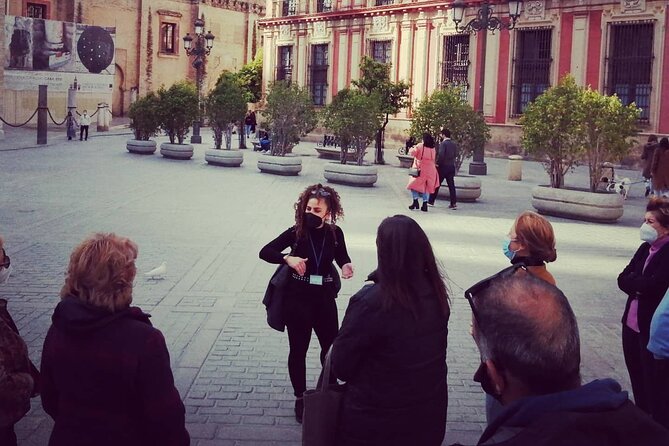
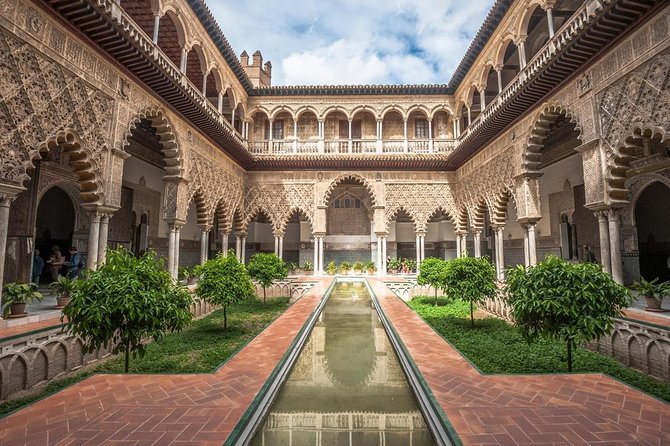
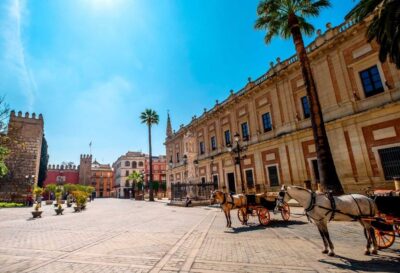
The walk next reaches the Real Alcázar, described as the oldest royal palace in Europe still in use. The tour stays outside, but the guide explains why the palace is unusual and why rulers have used the site since the 1000s.
This is a key distinction. The Alcázar deserves an interior visit if your schedule allows, especially because an exterior explanation cannot show its courtyards, rooms, gardens, and tilework. Still, the outdoor stop tells you what kind of place you are looking at: a royal complex shaped over centuries rather than a palace built in one clean burst.
I like this approach for a first day because it lets you see the Alcázar without using up your tour time in an entrance queue or interior route. You can then decide if you want a separate ticket and how much time to set aside.
If the palace is high on your list, do not assume this walk covers it. The guide provides orientation and background only. Monument tickets and interior visits are not included.
The Torre del Oro and Seville’s river gateway
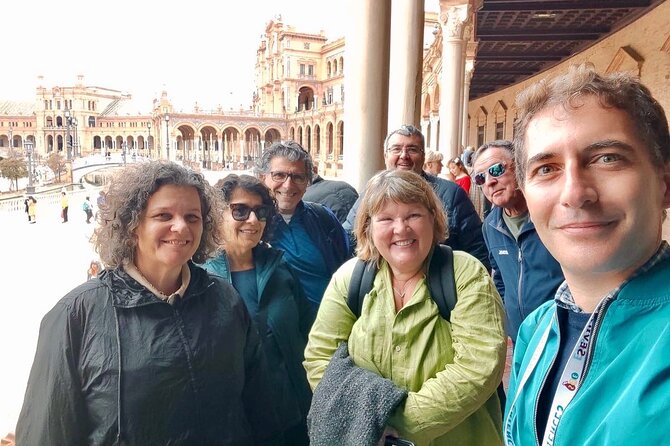
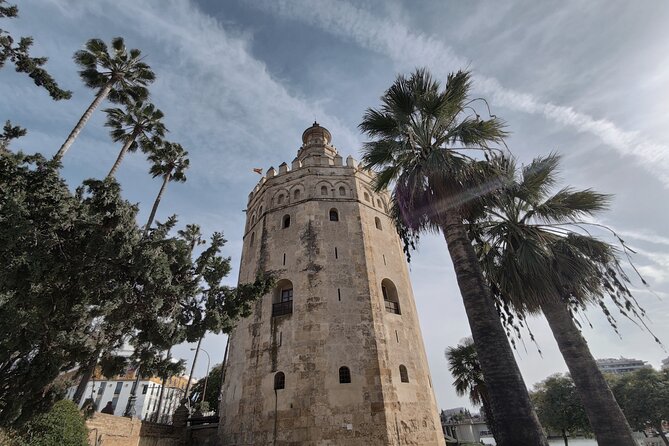
The next stop is the Torre del Oro, the last Muslim building of Seville. It was also a watchtower and an entry point to the city from the ocean. This gives the tower a practical role in the story, beyond its familiar golden appearance.
Its position by the river makes the connection easy to understand. The tower helped protect and monitor the waterway that linked Seville with wider trade routes. Here, the tour brings together the earlier discussion of the Port of the Indies, Muslim Seville, and the city’s defensive needs.
The Torre del Oro is another outside stop, so you will not see its interior displays. That is fine if your main goal is to understand the city’s layout. You get a clear sense of how the river supported Seville’s rise and why a watchtower belonged in this part of town.
The route’s variety helps keep the two hours moving. You shift from civic architecture to religious buildings, royal power, trade, and defense. That range is one reason this works better as an introduction than as a narrow monument tour.
The old Tobacco Factory and industrial Seville
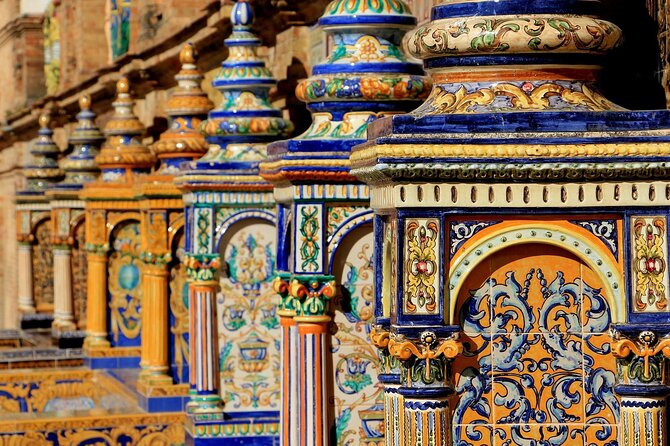
The old Tobacco Factory adds a later chapter. Built in the 1700s, it is presented as an example of industrial architecture in Seville. This stop broadens the tour beyond medieval and royal landmarks.
A former tobacco factory may not be the first building you associate with Seville, but it helps you see the city as a working place. Grand churches and palaces get most of the attention, yet trade and manufacturing also shaped the city’s growth.
Again, the value lies in the explanation. You see the building from outside while the guide places it within Seville’s economic development. If you enjoy architecture, this is a useful reminder that the city’s story did not end with the Middle Ages or the age of empire.
The stop also gives the route a welcome change of tone. After religious and royal monuments, the factory shows a more practical side of the city. You are still walking through monumental Seville, but the subject shifts from rulers to production and labor.
Plaza de España and the 1929 city makeover
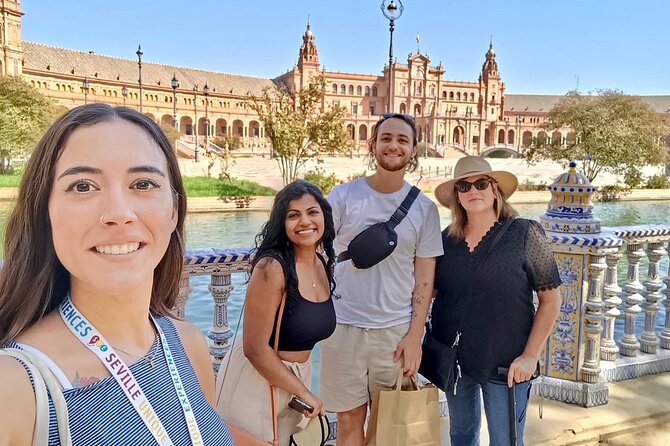
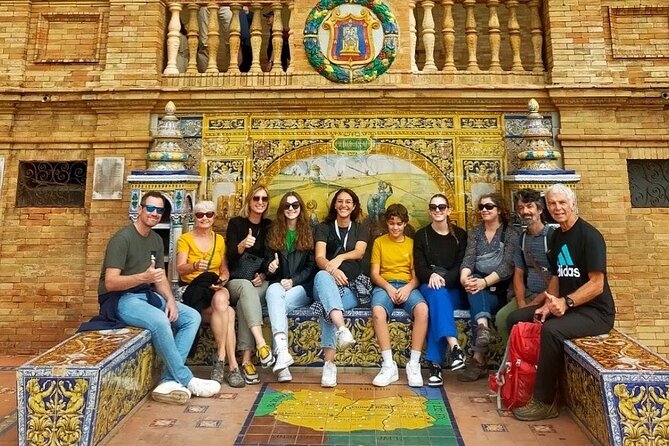
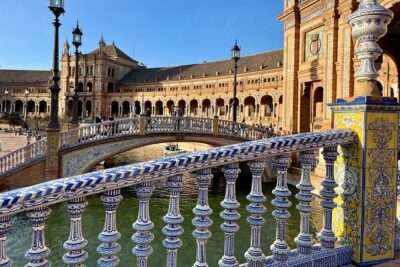
The walk ends at Plaza de España, the host country pavilion for the 1929 Ibero-American Exhibition. The exhibition brought major changes to Seville’s urban design, and the plaza remains the clearest example.
This is a strong finish because Plaza de España looks and feels different from the older city center. Its scale, layout, and decorative program reflect a modern event designed to present Spain to the wider Spanish-speaking world. Your guide explains how that exhibition changed the city and why this particular pavilion became its visual calling card.
Ending here is practical. You can continue exploring the plaza after the tour, take photographs, or use it as a starting point for nearby attractions. You also finish with a sense of Seville’s later identity, rather than stopping after another medieval monument.
One condition is worth noting: the city council may close Plaza de España during a heavy wind alert. If that happens, the final stop can be affected. This is a safety closure, not a flaw in the tour, but it is worth keeping in mind when planning your day.
What the small group changes
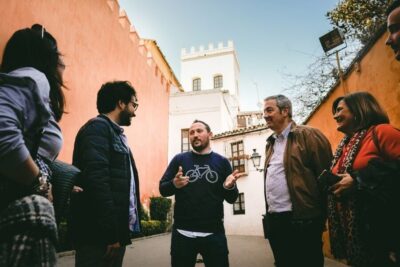
The maximum group size is 10, and that is more than a marketing detail. In central Seville, streets can be noisy and crowded. A small group makes it easier to stay close to the guide, hear explanations, and stop without forming a large block around a doorway.
The guide quality is the strongest theme in the feedback. Carlos is repeatedly praised for his command of the subject, friendly manner, and ability to engage the group. Carmen is described as adaptable and especially good at adjusting the walk to the people with her. Laura receives praise for clear communication and enthusiasm, while Valentín is noted for his engaging style and love of Seville.
Other named guides include Miguel, Marta, Cristina, Manuel, and Barbara. The precise guide depends on the departure, so you should not book on the assumption that one particular person will lead your walk. Still, the range of positive comments suggests a consistent focus on good English, clear storytelling, and questions.
There is one small caution. One guide is praised so warmly for loving history that the amount of detail became more than one person could easily remember. If you prefer a quick overview, say so. A good guide can usually adjust the level of detail, and the small group makes that request easier.
Walking comfort, timing, and practical details
This is an outdoor walking tour, so comfortable shoes and sun protection make sense. One account specifically notes that the pace was easy, while another describes the walk as closer to two and a half hours. Most people can participate, and the route is near public transportation.
The tour is offered in English and includes a licensed guide. Mobile tickets are accepted, and confirmation is provided at booking. Service animals are allowed.
The starting point is Plaza de San Francisco, 17, in the Casco Antiguo. The endpoint is Plaza de España on Avenida Isabel la Católica. Because the tour ends away from its starting point, you get useful geographic orientation instead of returning to the same square.
Free cancellation is available if you cancel at least 24 hours before the local start time. Changes or cancellations made inside that window are not accepted for a refund. That is worth checking before you book timed attractions around the walk.
Is $30.25 a fair price?
At $30.25, the tour is priced as a compact orientation rather than a full monument experience. You are paying for a licensed English-speaking guide, a maximum group of 10, and a route that covers a large part of Seville’s major historic story.
The value is strongest in three situations. First, you have only a short stay and want a clear introduction. Second, you plan to visit the Cathedral, Giralda, or Alcázar separately and want background first. Third, you enjoy asking questions and prefer a small group to a large city walk.
The value is weaker if you expect entry to several attractions. Tickets are not included, and every major monument on the route is seen from outside. Add this walk to a day of interior visits, not instead of them.
A two-hour private guide would cost more, while a large free-style walk may offer less personal attention. This sits in the middle: modestly priced, limited in scope, and strong on orientation.
Who should book this Seville walking tour?
I would recommend it to first-time visitors, people staying one or two days, and anyone who wants the city explained before tackling its major interiors. It is also a good fit if you like history but do not want a lecture delivered indoors.
Families and mixed-age groups may appreciate the manageable length and the ability to ask questions. Most people can participate, though you should be ready for sustained outdoor walking and standing.
I would skip it if you already know central Seville, dislike historical explanation, or want a tour built around entering the Cathedral and Alcázar. In that case, spend the money on an interior visit or a more specialized experience.
Should you book it?
Book this tour if you want to get your bearings fast and understand why Seville looks the way it does. The route is broad, the group is genuinely small, and the guides are repeatedly praised for clarity, humor, warmth, and care with pacing.
Just set the right expectation. This is an outdoor introduction, not a ticketed monument tour. For $30.25, it gives you a useful map of Seville’s past and helps you choose what to explore more fully afterward.
FAQ
How long does the Seville Monumental Highlights Walking Tour last?
The advertised duration is approximately two hours. One description of the experience places the walk at about two and a half hours, so leave some extra time in your schedule.
What sights are included in the route?
The route includes Seville’s City Hall, the outdoor area around the former mosque and Giralda Tower, the Port of the Indies, the Real Alcázar, Torre del Oro, the old Tobacco Factory, and Plaza de España.
Do monument tickets come with the tour?
No. The tour includes outdoor explanations, but tickets and interior visits to the monuments are not included.
How large is the group?
The tour has a maximum of 10 participants, allowing for a more personal experience and easier questions.
Is the tour offered in English?
Yes. It includes an English-speaking licensed guide.
Can Plaza de España be closed during the tour?
Yes. The city council can close Plaza de España during a heavy wind alert.
Just added around Seville
- Seville: Wine and Gourmet Tapas Tour★ 5.0 · 3 reviews
- Tapas Tour Cordoba & Wine Experience with chef and sommelier★ 4.8 · 3 reviews
- The most complete tour of Seville: All the highlights included★ 5.0 · 3 reviews
- Seville: Spritz Tasting Experience★ 4.8 · 3 reviews
- Ronda and White Villages Private Day Trip from Seville★ 5.0 · 3 reviews
- Jerez: Historic center of Jerez and horse show★ 5.0 · 3 reviews
- SEVILLE: REAL ALCÁZAR TOUR★ 5.0 · 3 reviews
- Royal Alcazar of Seville Guided Tour★ 5.0 · 3 reviews
Walking Tours, compared.
Walking Tour through Cádiz: Stories from the hand of a local guide
Read our review →
Small-Group Jewish Quarter Discovery Walking Tour
Read our review →
English Cádiz Tour: Walking Tour with Local Guide
Read our review →Browse the lists this tour appears in