
Reviewed · TRIANA TOURS
Seville Triana Quarter and River Small-Group Walking Tour
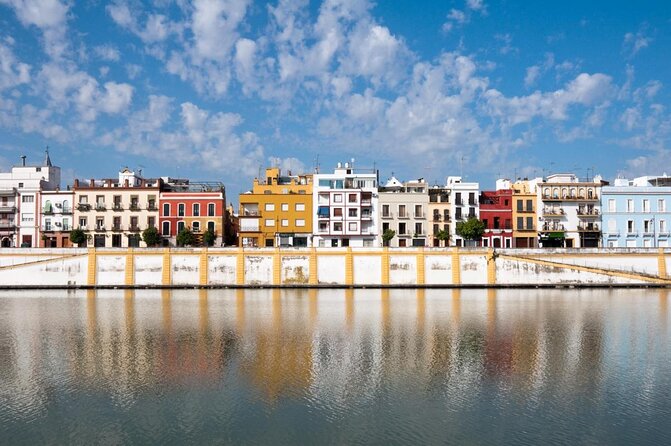
Seville’s Triana quarter feels most rewarding when you cross the Guadalquivir on foot and follow its story through markets, ceramics, churches, and old defensive sites. This 90-minute walking tour begins at the Golden Tower and ends at Santa Ana Church, giving you a compact introduction to the neighborhood across the river.
I like the small group limit of 10, which leaves room for questions and conversation. I also like the range of subjects: this is not just a bridge-and-photo walk, but a look at food, craft, religion, architecture, and the city’s complicated past. The main drawback is the short running time. You will see many important places, but some stops are explained from outside or covered briskly.
In This Review
- Key points at a glance
- From the Golden Tower to Triana in 90 minutes
- A modern monument and Seville’s many cultures
- Crossing the first fixed bridge into Triana
- The Triana market and the taste of the neighborhood
- Triana ceramics and the quarter’s working arts
- San Jorge Castle and Seville’s difficult past
- Holy Week at a beloved Triana chapel
- Santa Ana Church, the Cathedral of Triana
- What the $30.04 price buys you
- Who will get the most from this walk?
- Should you book the Triana walking tour?
- FAQ
- Where does the tour begin?
- Where does the tour end?
- How long does the experience last?
- How much does the tour cost?
- How many people can join the tour?
- Is the tour offered in English?
- Are there morning and afternoon departures?
- What places are covered?
- Is the route suitable for most people?
- What is the cancellation policy?
Key points at a glance
- Start at an 800-year-old watchtower: The Golden Tower gives the walk an immediate connection to Seville’s river defenses.
- Cross Seville’s first fixed bridge: Learn how the iron bridge replaced a floating link between the city and Triana.
- See Triana through its crafts: The traditional market and ceramic workshops explain why this quarter has its own character.
- Confront difficult history: San Jorge Castle introduces the former headquarters of the Inquisition.
- Finish at Santa Ana Church: The so-called Cathedral of Triana is the tour’s grand architectural finale.
- Small-group format for $30.04: Morning and afternoon departures make this an easy first-day or mid-stay activity.
From the Golden Tower to Triana in 90 minutes
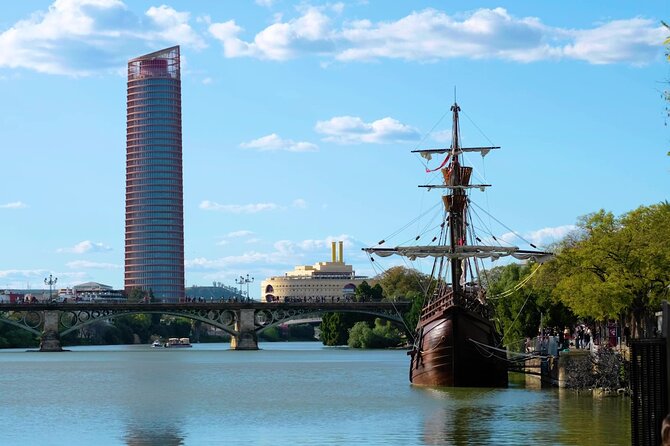
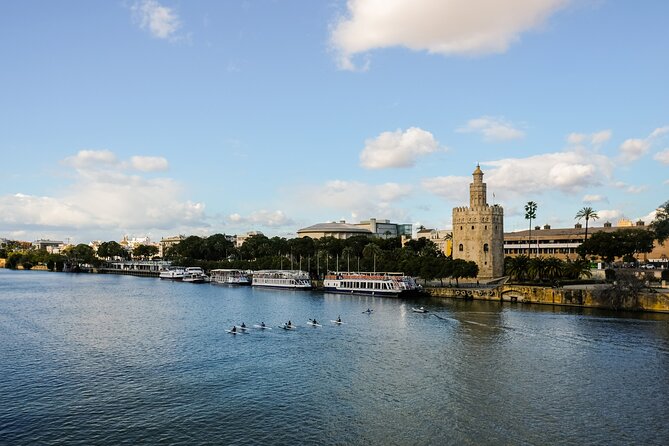
The meeting point is the Golden Tower, Torre del Oro, on Paseo de Cristóbal Colón. This watchtower was built more than 800 years ago to help defend Seville’s river access and control ships approaching the city.
That is a smart place to begin. Before you enter Triana, you get the basic fact that makes the whole outing work: the Guadalquivir was not merely scenery. It was a route for trade, a defensive barrier, and a reason Seville became so important.
The walk then follows the river toward the quarter. Since the route is flat and on foot, you do not need special fitness. Still, comfortable shoes are sensible. The experience is about moving through the streets rather than checking off indoor attractions, so much of its value comes from the guide explaining what you are seeing as you go.
The tour is offered in English, with morning and afternoon start times. Exact departure times are not provided, so check the available slot when booking. A morning walk can help you get your bearings early in a Seville stay, while an afternoon departure may work better if you want a slower start.
More Walking Tours in Seville
- Seville: Small-Group City Highlights Walking Tour
★ 5.0 · 1,204 reviews - Cultural Walking Tour of Seville Monumental
★ 5.0 · 861 reviews - Seville: Tapas, Taverns, and History Walking Tour
★ 4.9 · 676 reviews
A modern monument and Seville’s many cultures
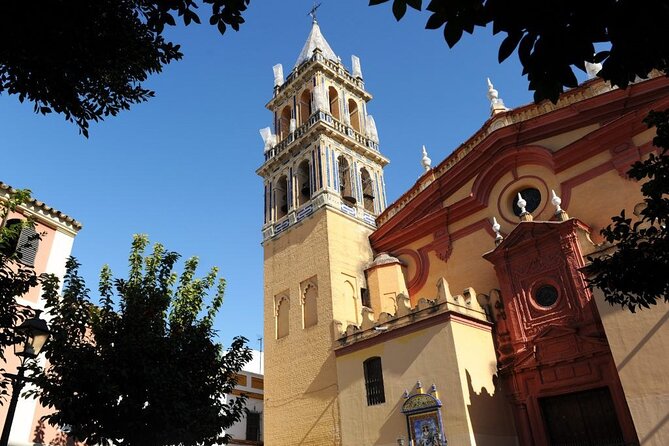
One stop is a modern monument representing the different cultures that have made Seville home and lived alongside one another over the centuries. The description is brief, but its place in the route matters.
Seville is often presented through grand Christian buildings and royal power. This stop widens the picture. It points you toward the city’s layered identity and the long contact between communities around the Guadalquivir.
Do not expect a long museum visit here. The attraction is used as a talking point during the walk, connecting a contemporary work of public art with older chapters of Seville’s past. If you like tours that link architecture to politics and society, this will likely be one of the more useful pauses.
Crossing the first fixed bridge into Triana
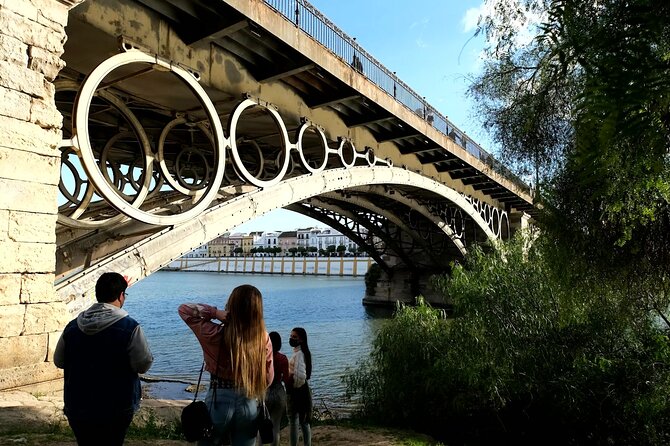
The route reaches Seville’s first permanent bridge, built in the 1800s to replace the earlier floating bridge linking the city with Triana. It is an important transition, both physically and historically.
The bridge is a good example of 19th-century iron architecture. More important for you, it explains why Triana could feel like a separate world even though it sits directly across the river from Seville’s central district. The bridge made movement more reliable, but the quarter kept its distinct working identity.
This is also one of the tour’s best photo stops, though the walk is not designed as a dedicated photography outing. You will get river views and a clear sense of the relationship between the old city and Triana. The guide’s explanation adds much more than a quick crossing on your own.
The Triana market and the taste of the neighborhood
The traditional market provides a useful change of pace. Instead of discussing only kings, churches, and military structures, the tour looks at products from the area and their role in Mediterranean cooking.
That everyday focus is one of the reasons I like the route. Markets show how a neighborhood functions, not just how it appeared in the past. You can connect local food to trade, household life, and the river’s role in moving goods.
The market stop is also practical for the rest of your stay. The tour does not promise tastings, meals, or shopping time, so think of it as an introduction rather than a food tour. If you want to return later for a closer look, the guide’s comments can help you understand what you are seeing.
Because the whole experience lasts only about an hour and a half, the market discussion may be fairly focused. That is useful if you want a clear overview, but less suitable if your main aim is to browse every stall at leisure.
More Triana walks:
- Seville: Live Flamenco Show at “Teatro Flamenco Triana”
★ 4.6 · 3,290 reviews - Seville: Baraka Sala Flamenca Show with Drink in Triana
★ 4.8 · 1,761 reviews - Seville: Traditional Flamenco Show in Triana
★ 4.8 · 1,580 reviews - Spanish Cooking Class & Triana Market Tour in Sevilla
★ 5.0 · 760 reviews
Triana ceramics and the quarter’s working arts
Triana is closely linked with ceramic production, and the tour gives this subject a proper place rather than treating it as a souvenir footnote. You learn about local crafts and how they contributed to the arts, with special attention to ceramics.
The route also points to traditional artisan workshops that continue to make Triana relevant for this craft. The details provided do not promise entry into a workshop or a hands-on demonstration, so you should not book it expecting a full studio visit. The value is in understanding why tiles and pottery are so closely tied to the quarter’s identity.
I find this kind of stop especially helpful because it connects what you see on buildings with the people who made it. Decorative tilework can look purely ornamental when you walk past it quickly. A guide can show you that it also reflects local skill, trade, and a long craft tradition.
The small group helps here. With no more than 10 people, it should be easier to pause for questions about the craft or ask for suggestions on where to look for ceramics afterward.
San Jorge Castle and Seville’s difficult past
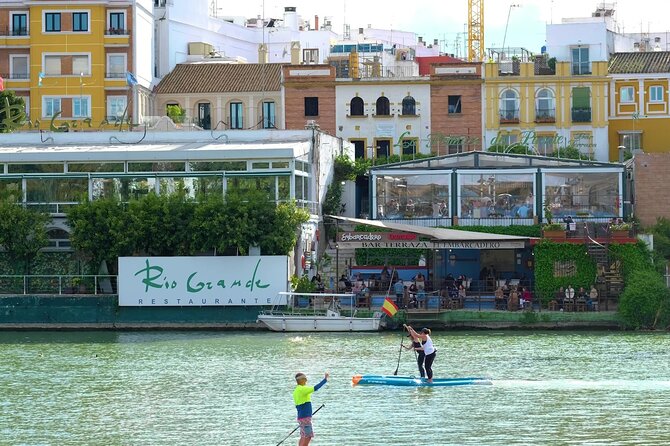
The most serious stop is San Jorge Castle. It was the only defensive structure in the area and later served as the headquarters of the Inquisition.
This part gives the tour more weight. You are not only hearing about pleasant river views and attractive tiles. You are also confronting the religious court’s role in local history and the fear attached to this site.
The stop is particularly useful for visitors who want to understand how religious authority shaped Seville. The castle’s defensive role also ties back to the Golden Tower, giving the walk a stronger structure: the river was protected, Triana had its own fortification, and both places were tied to the city’s power.
The tour does not list a separate entry fee or guarantee a lengthy indoor visit at the castle. It says you will get into San Jorge Castle, so access is part of the planned route, but the time available is still limited. Expect an informative visit rather than a full afternoon spent examining every feature.
This is a point where guide quality matters. Miguel, for example, has been praised for connecting Spanish and European history with current events. That approach can make a difficult subject easier to place in context, instead of leaving you with a list of dates and names.
Holy Week at a beloved Triana chapel
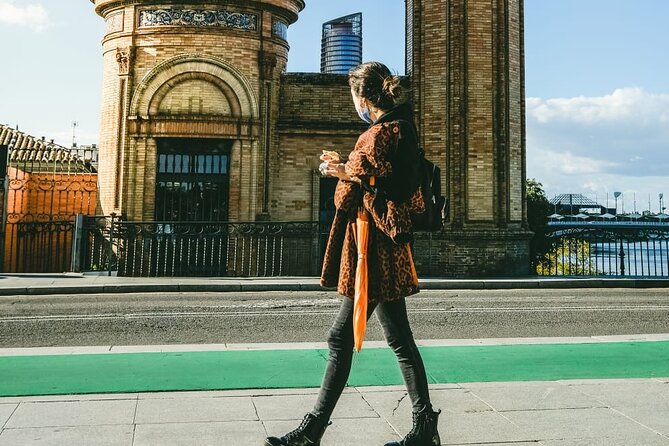
The next religious stop is a small church linked to Holy Week and some of Triana’s most loved brotherhoods. The chapel remains an important stop for people visiting the quarter.
Seville’s Holy Week is not a minor local custom. It is one of the city’s major religious and cultural events, and brotherhoods play a central role in its public life. The tour uses this small church to explain how faith, neighborhood identity, art, and procession traditions fit together.
You do not need to visit during Holy Week to benefit from this stop. In fact, learning the background at a quieter time may help you make sense of the processions if you later see them in Seville or encounter their images and symbols elsewhere.
As with the other religious sites, check your expectations. The tour description does not promise a special ceremony, reserved entry, or extended interior visit. The focus is interpretation and local meaning.
Santa Ana Church, the Cathedral of Triana
The tour ends at the Real Parroquia de Señora Santa Ana, on Párroco don Eugenio Street. This is described as the most important church in Triana and the first built there after the Christian conquest of 1248.
Its Mudéjar architecture makes it a fitting finale. Mudéjar design reflects the use of Islamic artistic forms and techniques under Christian rule, giving the building a visual link to the mixed cultural story introduced earlier in the walk.
Santa Ana is often called the Cathedral of Triana, a nickname that tells you how strongly the church belongs to the quarter’s identity. Ending here also gives the route a clear progression: river defense, urban connection, daily commerce, craft, religious control, Holy Week, and a major church.
The tour ends at the church rather than returning to the Golden Tower. That is useful if you plan to keep exploring Triana afterward. It is less convenient if you need to return immediately to the historic center, though the start and finish are both near public transportation.
What the $30.04 price buys you
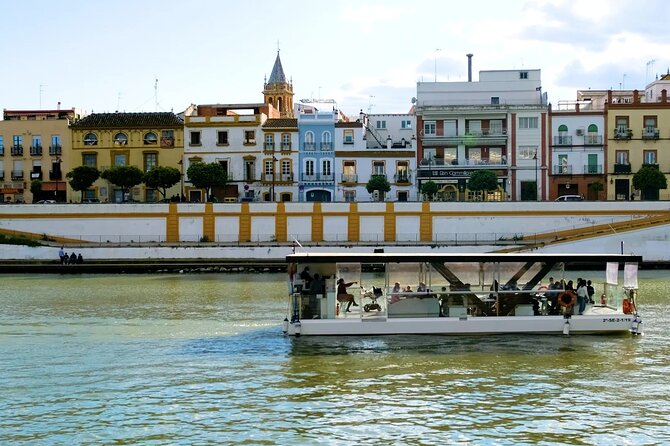
At $30.04 per person, this is priced as a short guided introduction rather than a full-day city tour. For 90 minutes, the value depends on what you want from Seville.
If you simply want to cross the bridge, see the market, and walk through Triana, you can do that without paying for a guide. The fee becomes more worthwhile if you want the connections explained: why the river mattered, how the bridge changed access, why ceramics became central, and how the Inquisition and Holy Week fit into the neighborhood’s story.
The group cap is important. A maximum of 10 is small enough to feel personal, but the actual group may be smaller. On one occasion, the scheduled small-group walk became a private one-person tour because only one person attended. You cannot count on that happening, but it shows why this format can sometimes offer unusually direct conversation.
The named guides associated with strong feedback include Marta, Miguel, and Clara. Marta is from Triana and brings particular enthusiasm for her neighborhood. Miguel is especially suited to people who enjoy broad historical and political context, while Clara has been praised for keeping the walk smooth, lively, and free from information overload.
The tour is booked, on average, 28 days ahead. That does not mean you must reserve that early, but it is a useful signal if your Seville dates are fixed. Booking ahead also makes sense if you want a particular morning or afternoon slot.
Who will get the most from this walk?
I would recommend this experience to you if you want a short introduction to Triana before exploring it on your own. It works well early in a Seville visit because the guide can give meaning to places you might otherwise pass without noticing.
History lovers are the clearest match. The route covers medieval defense, 19th-century engineering, religious authority, the Inquisition, Christian conquest, Mudéjar architecture, and Holy Week. It is a lot for 90 minutes, but the subjects are varied enough to keep the pace from feeling like a lecture.
It also suits people who prefer walking to bus tours. The route is flat and manageable, and you move through the neighborhood at street level. That lets you notice the changing feel between the riverfront, bridge, market, workshops, and churches.
Food and craft fans will find useful context, though this is not a tasting tour or a dedicated ceramics workshop visit. Likewise, architecture fans will enjoy the bridge and Santa Ana Church, but the tour is not built around detailed technical analysis.
You may want something else if you prefer long visits inside major monuments, a highly specialized art tour, or a relaxed half-day wander with lots of free time. The route covers many themes quickly, and that short format is both its strength and its limit.
Basic practical details are simple. Confirmation is provided at booking, service animals are allowed, public transportation is nearby, and most people can participate. The activity is offered in English. Free cancellation is available until 24 hours before the start time, while cancellations or changes made less than 24 hours ahead are not accepted for a refund.
Should you book the Triana walking tour?
Book it if you want context, local character, and a compact route rather than a long museum visit. The mix of market life, ceramics, river engineering, San Jorge Castle, Holy Week, and Santa Ana Church gives you a broader picture of Triana than a casual stroll alone.
The strongest reason to choose it is the guide. Marta, Miguel, and Clara each bring a different kind of value, from neighborhood pride to wide historical context and a lighter conversational pace. Since guides can vary, the experience may feel more personal for some groups than others.
Skip it if you have already spent substantial time in Triana and prefer to set your own pace. But for $30.04, a 90-minute walk capped at 10 people is a fair way to get oriented, especially if you are visiting Seville for the first time or want to understand the quarter beyond its postcard views.
FAQ
Where does the tour begin?
It begins at the Golden Tower, Torre del Oro, on Paseo de Cristóbal Colón in Seville’s old city.
Where does the tour end?
The walk ends at the Real Parroquia de Señora Santa Ana on Párroco don Eugenio Street in Triana.
How long does the experience last?
The tour lasts approximately 1 hour and 30 minutes.
How much does the tour cost?
The listed price is $30.04 per person.
How many people can join the tour?
The group has a maximum of 10 participants.
Is the tour offered in English?
Yes. English is the listed language for the experience.
Are there morning and afternoon departures?
Yes. You can choose between morning and afternoon start times. Exact times depend on the available booking options.
What places are covered?
The route includes the Golden Tower, a modern cultural monument, Seville’s first fixed bridge, the traditional Triana market, local ceramic craft sites, San Jorge Castle, a chapel linked to Holy Week, and Santa Ana Church.
Is the route suitable for most people?
Most people can participate, and the route is described as flat and easy to navigate on foot. Public transportation is nearby, and service animals are allowed.
What is the cancellation policy?
You can cancel up to 24 hours before the start time for a full refund. Cancellations or changes made less than 24 hours before the experience are not accepted for a refund.
Just added around Seville
- Seville: Wine and Gourmet Tapas Tour★ 5.0 · 3 reviews
- Tapas Tour Cordoba & Wine Experience with chef and sommelier★ 4.8 · 3 reviews
- The most complete tour of Seville: All the highlights included★ 5.0 · 3 reviews
- Seville: Spritz Tasting Experience★ 4.8 · 3 reviews
- Ronda and White Villages Private Day Trip from Seville★ 5.0 · 3 reviews
- Jerez: Historic center of Jerez and horse show★ 5.0 · 3 reviews
- SEVILLE: REAL ALCÁZAR TOUR★ 5.0 · 3 reviews
- Royal Alcazar of Seville Guided Tour★ 5.0 · 3 reviews
Triana Tours, compared.
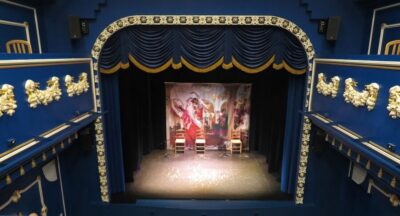
Live Flamenco Show at “Teatro Flamenco Triana”
Read our review →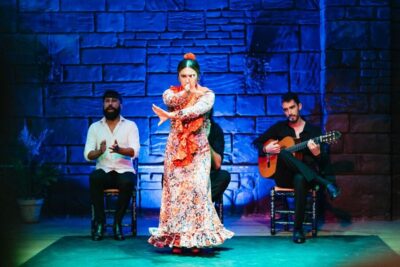
Baraka Sala Flamenca Show with Drink in Triana
Read our review →

Spanish Cooking Class & Triana Market Tour in Sevilla
Read our review →
3.5-Hour Spanish Cooking Class & Triana Market Tour
Read our review →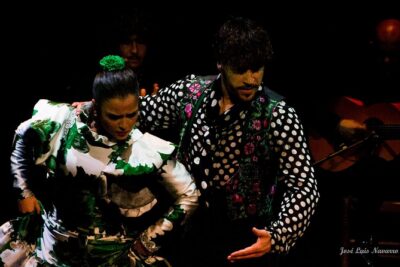
Flamenco Show Tickets to the Triana Flamenco Theater
Read our review →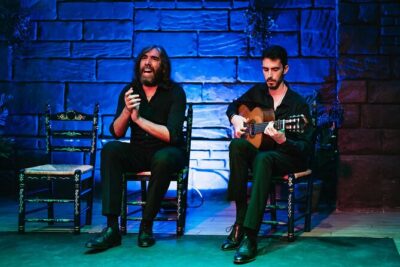
Browse the lists this tour appears in