
Reviewed · ALCAZAR TOURS
Cordoba: 2.5-Hour Guided Jewish Quarter and Alcazar Tour
Córdoba’s past comes into sharp focus on this walk through the Jewish Quarter, where narrow Arabic-era lanes lead to a medieval synagogue, a craft souk, and the unusual Mudejar Chapel of San Bartolomé. The tour finishes at the Alcázar complex, but restoration work currently limits the visit to the gardens and Arab Baths.
I like the monolingual guide format, since you hear the explanation in one language rather than waiting for repeated translations. I also like the mix of major sights and smaller details, including the statue of eye doctor Algafequi and the story of a Jewish convert who built a Christian chapel.
The main caution is the Alcázar change. You do not currently get the usual full palace visit, and the gardens may close in poor weather. At $34, the tour can still be good value for its guide, entrance fees, and compact route, but book it mainly for the Jewish Quarter rather than the palace rooms.
In This Review
- Key points to know before you book
- Starting by the Mezquita-Catedral and Calleja de la Hoguera
- Plaza Cardenal Salazar and the story of Algafequi
- San Bartolomé Chapel and its unusual builder
- Córdoba’s souk and the craft side of the old quarter
- The medieval synagogue and Córdoba’s Jewish legacy
- What you will actually see at the Alcázar
- Why the one-language guide format matters
- Is $34 good value for this Córdoba walk?
- Who should take this tour?
- Should you book the Jewish Quarter and Alcázar tour?
- FAQ
- How long does the tour last?
- Where is the meeting point?
- What languages are available?
- Is the Alcázar fully open during the tour?
- Are the Alcázar towers included?
- Does the price include entrance fees?
- Is the tour suitable for people with limited mobility?
- Can I bring a baby stroller?
- Can I cancel the booking?
Key points to know before you book
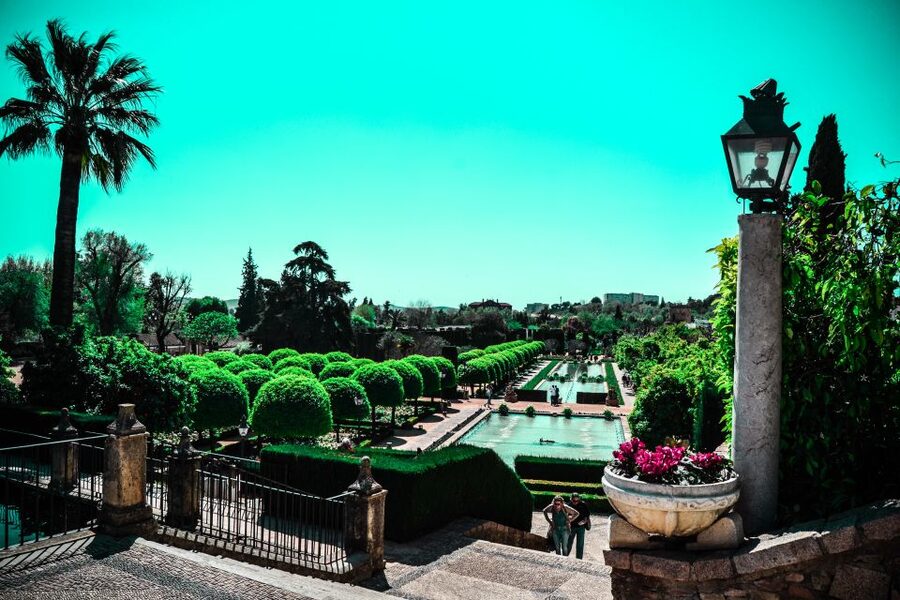
- The Alcázar visit is currently partial: You can enter the Alcázar Gardens and Arab Baths, but restoration work prevents the usual interior visit.
- The medieval synagogue is a major stop: It is one of Córdoba’s few surviving Jewish monuments from the 14th century.
- The route begins by the Mezquita-Catedral: Meet at Puerta del Perdón and look for the orange umbrella.
- The guide keeps to one language: Tours are offered in English or Spanish, rather than switching between languages.
- The walk includes stairs: Comfortable shoes matter, and the tour is not suited to people with mobility limits or back problems.
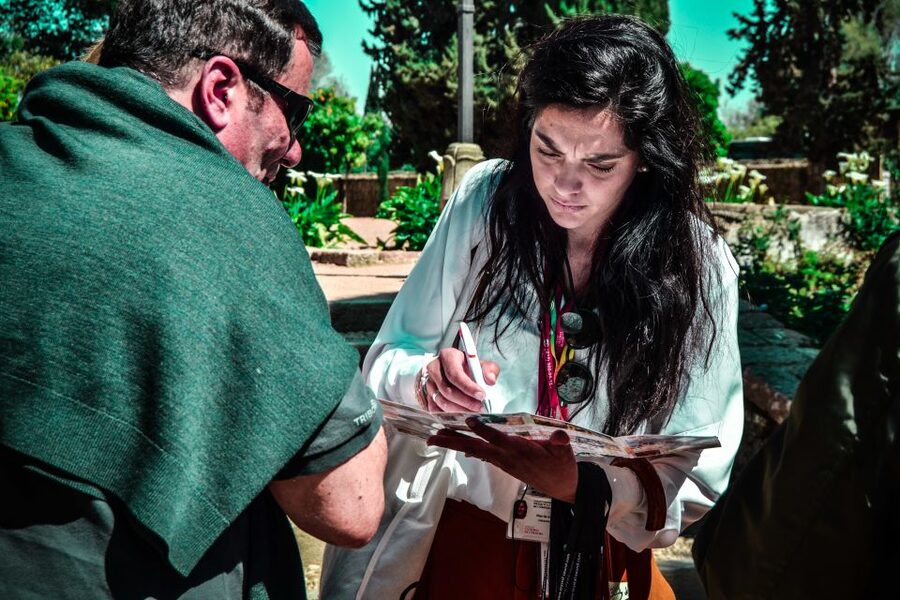
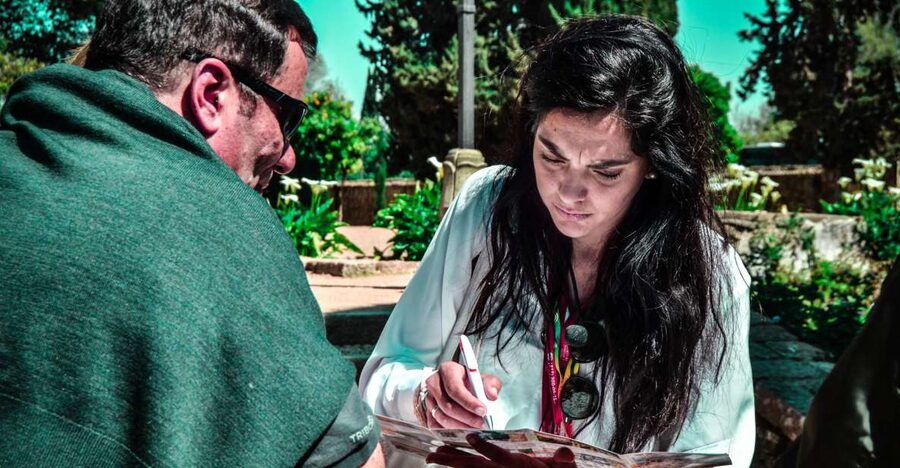
- Guide quality can shape the experience: Patricia has been praised for balancing history and anecdotes for adults and younger visitors, while Raphael has adapted well when Alcázar access was restricted.
Starting by the Mezquita-Catedral and Calleja de la Hoguera
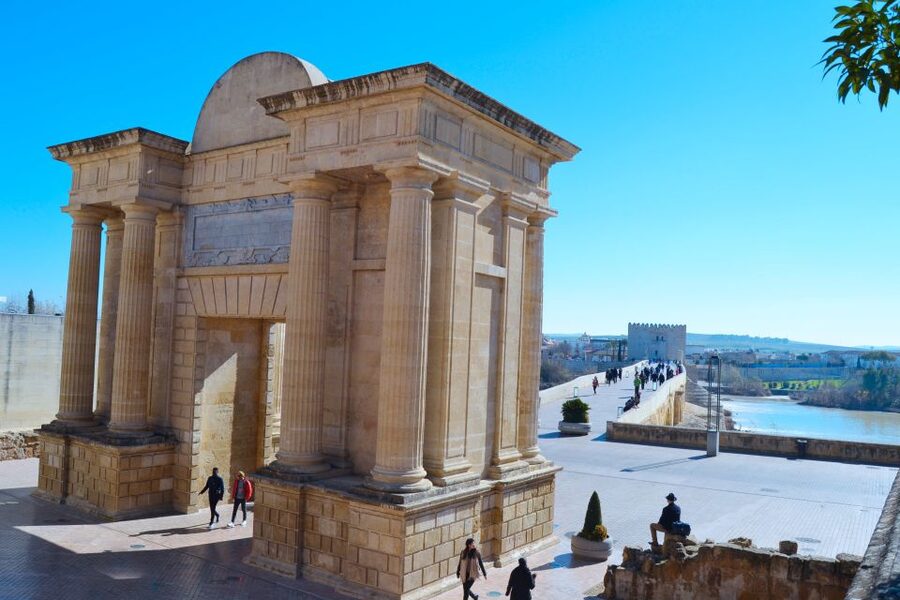
Your meeting point is Puerta del Perdón at the Mezquita-Catedral, on Calle Cardenal Herrero 1. Look for the orange umbrella. This is a useful starting place because you are already beside one of Córdoba’s essential monuments, even though the cathedral-mosque itself is not included in this tour.
From there, the group heads toward Calleja de la Hoguera, a narrow street with Arabic-era roots. The lane gives you an early feel for how Córdoba’s old quarters were shaped: tight passages, stone walls, and layers of Islamic, Jewish, and Christian life packed into a small area.
The guide also points out a historic mosque. Córdoba is said to have had more than a thousand mosques in the 10th century, when it was a major center of Islamic Spain. That figure helps explain why even a modest lane can carry a large historical story. You are not simply walking between attractions. You are moving through a city where religious buildings and neighborhoods changed use as power changed hands.
The opening section is especially helpful if you want context before reaching the better-known Jewish Quarter. The downside is that some of the early sights are viewed from streets or exterior areas rather than explored as full museum visits. This is a walking history tour, not a sequence of long interior admissions.
More Jewish Quarter Tours in Cordoba
- Córdoba: Jewish Quarter, Mosque, and Alcázar Tour
★ 4.7 · 4,279 reviews - Cordoba Mosque & Jewish Quarter Tour with Tickets
★ 4.6 · 1,996 reviews - Córdoba: Mosque-Cathedral, Jewish Quarter and Alcázar Tour
★ 4.7 · 1,426 reviews
Plaza Cardenal Salazar and the story of Algafequi
The route continues into Plaza Cardenal Salazar. Here you see a statue of Algafequi, described as the first doctor to perform eye surgery in Europe in the 12th century. It is the kind of small detail that can be missed when you walk the area alone, especially with your attention fixed on the grand monuments.
An old hospital from the 18th century now serves as a university. That change of use gives the square another layer. Córdoba’s buildings have not merely survived as frozen museum pieces. Many have been altered, reused, and folded into present-day life.
I find this stop valuable because it broadens the tour beyond the standard story of Roman, Islamic, Jewish, and Christian monuments. Medicine, education, and daily life also belong in Córdoba’s past. A guide can connect those subjects quickly, while a self-guided walk might leave you wondering why a statue or old façade matters.
The tour is advertised at 2.5 hours, but allow for some variation. One recent experience finished shorter than expected, while another became longer when the Alcázar gardens were closed. The exact pace can depend on the group, access conditions, and how much time the guide spends explaining each stop.
San Bartolomé Chapel and its unusual builder
One of the more distinctive stops is Capilla Mudejar de San Bartolomé. This old Christian chapel uses an Arabesque style and was built by a Jewish convert. Its design and backstory show how easily architectural ideas crossed religious boundaries in medieval Córdoba.
This is a good example of why a local guide adds value. From the outside, the chapel might look like one more old building in a quarter full of them. With an explanation, its design becomes evidence of cultural contact, personal change, and the complicated identity of the city.
The guide shares the chapel’s less obvious details and its hidden story. Exact access inside the chapel is not specified, so you should not assume a long interior visit. The useful part is the interpretation, especially if you enjoy buildings that reveal mixed influences rather than fitting neatly into one category.
The route contains stairs, uneven walking, and narrow streets. That makes the chapel section difficult for anyone with limited mobility. Strollers must be left at the entrance, so families with babies should plan around that restriction.
Córdoba’s souk and the craft side of the old quarter
After San Bartolomé, you visit the souk, a craft market selling local products typical of Córdoba. This is a welcome change of pace after the historical explanations. You get a look at the city’s continuing craft traditions rather than only its archaeological past.
The stop also gives you a little breathing room. A 2.5-hour walking tour can feel dense if every minute is spent listening. Time in the souk lets you look at local goods and get a sense of the commercial life of the quarter.
Do not expect food to be included. The tour price covers the guided visit and entrance fees, but not meals or purchases. If you want to buy something, treat it as extra rather than part of the tour.
The souk is also a reminder to keep your expectations in check. This is not presented as a dedicated shopping tour, and no detailed list of products or shopping time is provided. Think of it as one stop within a broader walk.
More ways into the Alcazar:
- Cordoba: Alcazar Guided Tour and Skip-the-Line Ticket
★ 4.2 · 1,792 reviews - Mosque-Cathedral, Alcazar & Jewish Quarter with Tickets
★ 4.5 · 793 reviews - Córdoba: Mosque-Cathedral and Alcazar Tour
★ 4.5 · 637 reviews - Cordoba: Alcazar of Christian Monarchs 1–Hour Guided Tour
★ 4.3 · 583 reviews
The medieval synagogue and Córdoba’s Jewish legacy
The medieval synagogue is one of the strongest reasons to choose this route. Built in the 14th century, it is one of the few Jewish monuments in Córdoba to survive the city’s long and often troubled history.
Its importance is not only architectural. The synagogue helps you understand that Jewish life was a real part of Córdoba’s urban fabric, not a footnote added after the better-known Islamic and Christian periods. The Jewish Quarter becomes more than a pretty collection of lanes. It becomes a place shaped by changing communities, laws, faiths, and power.
The stop is particularly useful for first-time visitors who want a clear introduction to the quarter. You get a monument with a specific date, purpose, and survival story, rather than a general walk through streets labeled historic.
Access conditions can change, and the supplied information does not promise a set amount of time inside the synagogue. Your guide should explain the building and its place in the city’s past, but the tour remains subject to the opening conditions of the monuments.
The quarter itself is compact, but do not mistake compact for effortless. Narrow streets, stairs, and standing for long periods can make the route tiring. Wear shoes with good support. This is not the day for thin sandals or footwear that you already know causes trouble.
What you will actually see at the Alcázar
The tour ends at the Alcázar of the Catholic Monarchs, a major palace complex tied to the history of Ferdinand and Isabella and to Córdoba’s role in the later Christian period.
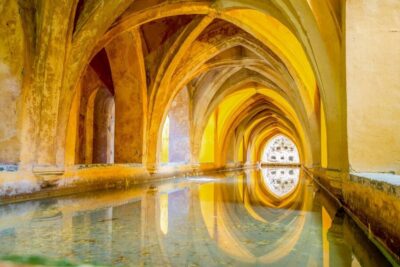
There is an important limitation. Restoration work means the usual guided visit inside the Alcázar cannot currently take place. The open areas are the Alcázar Gardens and the Arab Baths of the Caliphal Alcázar, both within the same monumental complex.
That changes the balance of the tour. You will learn about the Catholic Monarchs and the Alcázar’s place in Córdoba’s history, but you should not expect to walk through all the palace rooms, towers, or the complete monument. The tour also does not include visits to the towers.
The gardens may be the visual highlight of the final section when they are open. The Arab Baths provide a different kind of interest, connecting the complex to an earlier Islamic phase. Together, these areas still show why the site mattered, but they cannot replace the full palace experience for someone whose main goal is the Alcázar interior.
Weather is another practical concern. When the gardens were closed because of bad weather and the palace buildings were inaccessible due to restoration, the guide extended the Jewish Quarter portion instead. That was a sensible adjustment, but it did not provide the visit originally expected. If the Alcázar is high on your Córdoba wish list, check its current access separately before booking this tour.
Why the one-language guide format matters
The tour is offered in English or Spanish, with a live guide who keeps to the selected language. That sounds like a small feature, but it affects the pace and clarity of the walk.
A guide who does not repeat every explanation in several languages can spend more time on the city itself. You are less likely to feel that the group is stopping every few minutes for translation. This format is especially useful when a guide is explaining a complicated building history, such as the Christian chapel built by a Jewish convert.
Guide quality is naturally important on a history-heavy route. Patricia has been noted for making explanations work for both adults and younger people, linking dates to anecdotes. Raphael has also shown flexibility when weather and restoration work affected the Alcázar portion. Those examples suggest that the guide’s ability to adjust matters as much as the printed route.
Group size is not fixed in the information provided. One small group had five people, which made the activity feel more personal. You should not assume every departure will be that intimate, but a small group can make it easier to ask questions and hear the guide in narrow lanes.
Is $34 good value for this Córdoba walk?
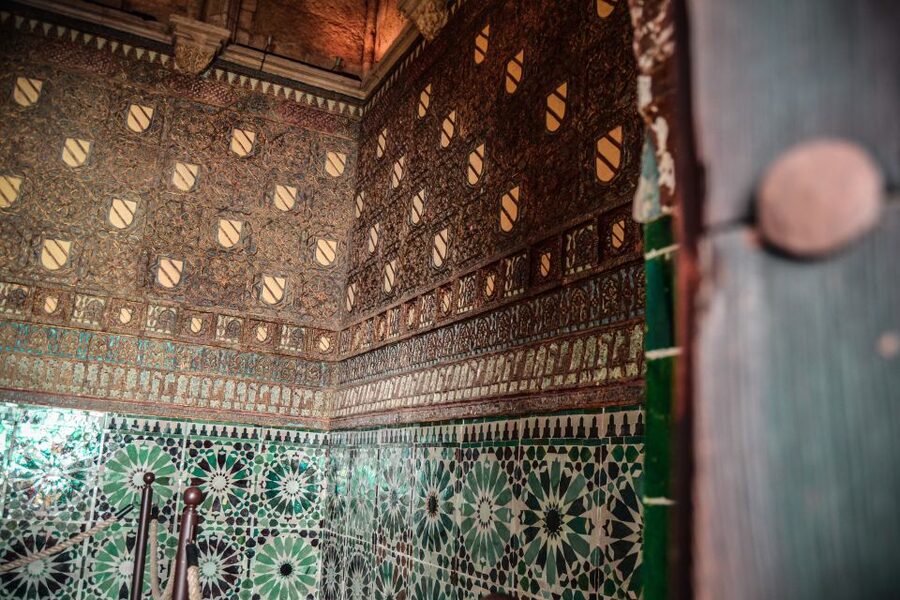
At $34 per person, the price is reasonable if you want a guided introduction to two important parts of Córdoba. Entrance fees are included, and you receive live commentary in English or Spanish. You also get a route that links the Jewish Quarter, synagogue, chapel, souk, and Alcázar complex without having to plan the order yourself.
The value is strongest when the monuments are open as expected and you care about context. A guide can point out details you might pass, explain the overlap of religious traditions, and help you understand why Córdoba’s old streets look the way they do.
The value is weaker if you are paying mainly for full access to the Alcázar. Restoration currently removes the usual palace interiors from the visit. The gardens and Arab Baths remain worthwhile, but they are a reduced version of the advertised palace experience.
I would also compare this tour with the cost of visiting the sights independently. The included admissions and the convenience of a single route help justify the price, but the tour is not a substitute for a full visit to every Córdoba monument. You may still want separate time for the Mezquita-Catedral, which is only the meeting-point landmark here.
Free cancellation up to 24 hours before the start gives you some flexibility, and you can reserve without paying immediately. Check the available starting times before you commit, since the duration is listed as 2.5 hours but actual timing may shift.
Who should take this tour?
I would choose this experience if you want a guided first look at Córdoba’s old center and prefer stories to a stack of plaques. It suits visitors who enjoy architecture, religious history, old neighborhoods, and a clear route through several monuments.
It is also a good fit if you want to see the Jewish Quarter but do not know which details deserve your attention. The synagogue, San Bartolomé Chapel, Algafequi statue, old hospital, and souk give the walk more variety than a simple street stroll.
Families may appreciate a guide who can connect history with anecdotes, especially if the children can manage the walking and stairs. The route is not suitable for people with back problems or mobility impairments. Strollers must be left at the entrance, so that point matters for families with babies.
You should be cautious if you need a fully accessible tour, a fixed schedule, or a complete Alcázar visit. The route can change when gardens close or restoration limits access, and the tour does not include the towers.
Should you book the Jewish Quarter and Alcázar tour?
Book it if your priority is a well-organized introduction to Córdoba’s Jewish Quarter, led by a single-language guide and supported by included entrance fees. The medieval synagogue and San Bartolomé Chapel give the route real substance, while the Alcázar Gardens and Arab Baths add a useful final chapter when open.
Skip it if you mainly want the Alcázar palace interiors. Restoration work currently makes that impossible, and weather can close the gardens as well. For most other visitors, $34 is a fair price for the historical context and compact route, provided you arrive expecting a partial Alcázar visit rather than the full palace.
FAQ
How long does the tour last?
The scheduled duration is 2.5 hours. Actual timing can vary, since one departure finished shorter than expected and another was extended when the Alcázar gardens were closed.
Where is the meeting point?
Meet at Puerta del Perdón beside the Mezquita-Catedral, at Calle Cardenal Herrero 1. Look for the orange umbrella.
What languages are available?
The live tour is available in English or Spanish. The guide uses one selected language rather than switching between languages during the tour.
Is the Alcázar fully open during the tour?
No. Restoration work currently limits access to the Alcázar Gardens and the Arab Baths of the Caliphal Alcázar. The usual palace interiors are not available.
Are the Alcázar towers included?
No. The tour does not include visits to the towers.
Does the price include entrance fees?
Yes. The guided tour and entrance fees are included. Food and hotel pickup are not included.
Is the tour suitable for people with limited mobility?
No. The route includes many stairs and is not recommended for people with mobility impairments or back problems.
Can I bring a baby stroller?
Babies’ strollers must be left at the entrance. The tour is therefore not ideal if you need to use a stroller throughout the route.
Can I cancel the booking?
You can cancel up to 24 hours in advance for a full refund. The reserve-now, pay-later option lets you hold a place without paying immediately.
More Jewish Quarter Walks
- Cordoba: Jewish Quarter and Mosque-Cathedral Guided Tour
★ 4.6 · 996 reviews - Mosque-Cathedral of Cordoba and Jewish Quarter Tour
★ 4.6 · 692 reviews - Córdoba: Mosque, Jewish Quarter & Tour with Ticket
★ 4.6 · 558 reviews - Córdoba Guided Tour of the Mosque, Jewish Quarter & Alcazar
★ 4.5 · 495 reviews
Just added around Cordoba
- Tapas Tour Cordoba & Wine Experience with chef and sommelier★ 4.8 · 3 reviews
- O75 . The Oliva experience that you deserve★ 5.0 · 3 reviews
- Private Tour of Cordoba Week Days 2 Hours Tickets included★ 5.0 · 3 reviews
- Private Tour: Mezquita-Catedral from Cordoba★ 5.0 · 3 reviews
- Córdoba: Private Mosque-Cathedral and City Tour★ 5.0 · 3 reviews
- Cordoba: Jewish History Private Tour★ 4.0 · 3 reviews
- Cordoba private tour from Seville including the great Mosque for up to 8 persons★ 4.0 · 3 reviews
- Cordoba Highlights: Guided Day Tour from Seville★ 4.5 · 3 reviews
Alcazar Tours, compared.
Cathedral, Giralda, and Royal Alcázar Guided Tour
Read our review →
Cathedral, Giralda & Alcazar Entry With Guided Tour
Read our review →
Priority Access Cathedral, Giralda & Alcázar Tour
Read our review →
Alcázar and Cathedral Entry Ticket and Guided Tour
Read our review →
Alcazar and Cathedral of Seville Tour with Skip the Line Tickets
Read our review →
Alcázar of Seville Skip-the-Line Tickets and Guided Tour
Read our review →Browse the lists this tour appears in