
Reviewed · CYCLING TOURS
Seville: Historic Center Bike Tour
Seville’s old defensive route gives this bike tour a clear purpose. Instead of simply pedaling between famous buildings, you follow the city’s former walls and gates, tracing how Seville grew from Roman beginnings into one of Spain’s major cities. I like the way the route connects architecture with events, from the Almoravid fortifications to the riots of 1868.
I also like the $35 price, which includes the bicycle, a map, and a water bottle for a 2.5-hour guided ride. The guides are another strong point. Luca is praised for his French, Italian, and Spanish, while Daniel and Sébastien are also singled out as friendly, helpful leaders. The main caution is practical: one rider found the bicycles near the end of their working life, so you should expect serviceable rather than premium equipment.
In This Review
- Key points to know before you ride
- Why Seville’s defensive walls make a good bike route
- Starting at Centerbici on Calle Espronceda
- From Roman Seville to the Almoravid walls
- Macarena and Puerta de Córdoba
- Puerta Carmona, Puerta Osario, and Puerta Triana
- The Alcázar and the changes of 1868
- What the 2.5-hour pace feels like
- How much value do you get for $35?
- Who will enjoy this ride most?
- Booking details worth keeping in mind
- Should you book the Seville Historic Center Bike Tour?
- FAQ
- Where does the Seville bike tour meet?
- How long does the tour last?
- What is included in the price?
- What languages are available?
- What places are included on the route?
- What history does the guide explain?
- Is the tour suitable for people with mobility impairments?
- Can I cancel the booking?
Key points to know before you ride
- The old walls are the main thread: The route links surviving sections of Seville’s defenses with important gates and city landmarks.
- The history covers a wide span: You hear about the Tartessians, Carthaginians, Romans, Almoravids, and the 1868 Glorious Revolution.
- Several gates make the past easy to picture: Puerta de Córdoba, Puerta Carmona, Puerta Osario, and Puerta Triana each add a different piece to the story.
- The guides are a major strength: Tours are offered in English, Spanish, and French, with Luca, Daniel, and Sébastien receiving especially warm praise.
- The ride is short but useful: In 2.5 hours, you get an overview of central Seville that can help you plan the rest of your stay.
- It is not suited to limited mobility: You need to be comfortable riding a bicycle for the full outing.
Why Seville’s defensive walls make a good bike route
Seville’s historic center can feel like a large puzzle. Grand squares, narrow lanes, old gates, palaces, churches, and remnants of fortifications appear in different parts of town. A bike gives you a way to connect those pieces without spending the whole morning walking from one end of the center to another.
The old defensive route is especially useful because walls are easy to understand when you see them in sections. Your guide points out what remains around the Macarena area, near Puerta de Córdoba, and around the Alcázar. You can then picture the much larger fortified city that once protected Seville.
I like this approach better than a tour that simply races past a list of monuments. The walls explain why gates mattered, why carriages stopped at certain points, and how movement into and out of Seville was controlled. The buildings are not just pretty backdrops. They become evidence of the city’s changing role.
The bike also lets you cover more ground than a walking tour in the same general time. You still stop for explanations, but the spaces between those stops become part of the experience. That makes this a good first activity if you want an overview before visiting major interiors on your own.
More History Tours in Seville
- Sevilla Food Tour: Tapas, Wine, History & Traditions
★ 5.0 · 3,468 reviews - Ultimate Seville Tapas, Wine & History Small Group Tour
★ 5.0 · 1,766 reviews - Seville: Tapas, Taverns, and History Walking Tour
★ 4.9 · 676 reviews
Starting at Centerbici on Calle Espronceda
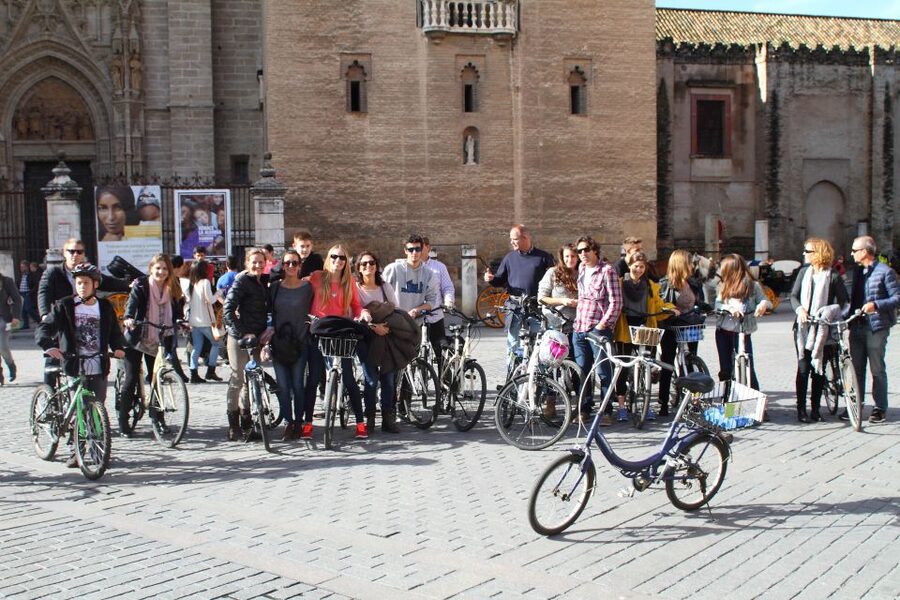
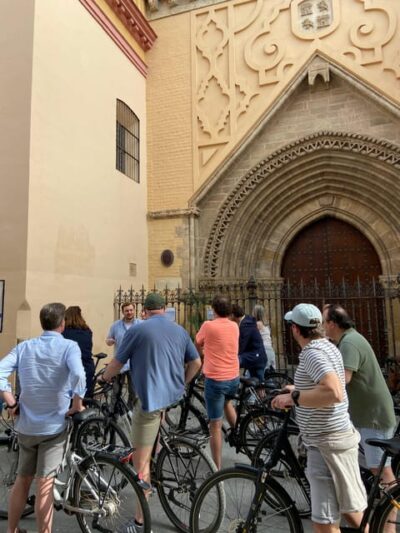
The meeting point is Centerbici Store at C/ Espronceda, 5, in Seville’s 41004 postal area. You meet the guide there, receive the bicycle, and begin the ride through the historic center.
The tour includes bicycle rental, a water bottle, and a map. Those small extras matter on a warm day, especially because the ride lasts two and a half hours. The map is also useful after the tour, since you can mark the places you want to revisit.
A bilingual guide leads the outing, with English, Spanish, and French available. The language arrangement may vary by departure, so choose carefully when booking. One French-speaking couple had an English-led visit when French was not available, but the guide worked hard to explain points and use phone translation when needed. That is a useful sign of goodwill, but fluent French is a better fit if you want every historical detail without language gaps.
Children can receive a helmet rental. The supplied information does not specify a helmet arrangement for adults, so ask Centerbici if that matters to you.
From Roman Seville to the Almoravid walls
The historical introduction reaches well beyond the usual Roman chapter. You hear about the Tartessians and Carthaginians, then the Roman settlement that helped establish Seville’s importance. These early layers explain why this spot on the Guadalquivir River became so valuable.
The story then moves to the Almoravids, who made Seville one of Europe’s best-walled cities. That claim gives the tour its central image: a powerful city enclosed by defenses, entered through controlled gates, and shaped by trade, government, and military concerns.
You do not need to memorize every dynasty to benefit from this section. The point is to see Seville as a city that kept changing hands and roles. Roman foundations, Islamic defenses, royal buildings, and later urban changes all sit close together.
This broad time span is one reason I would take the tour early in a Seville visit. Once you understand the basic sequence, the Alcázar and other historic sites make more sense. You start noticing that Seville’s architecture is not one single style. It reflects many periods layered in a compact area.
Macarena and Puerta de Córdoba
The route includes surviving sections of the walls around Macarena and the Puerta de Córdoba area. These are important stops because they make the defensive system visible rather than abstract.
At the walls, your guide can explain how the fortifications shaped the edge of the old city. You get a sense of scale and of the effort required to protect Seville. The remains are not a complete medieval circuit, so do not expect an intact wall walk. Their value comes from connecting the fragments to the wider route.
Puerta de Córdoba adds another point of entry to the story. Gates were working parts of the city, not merely decorative features. They directed people, animals, goods, and carriages through specific openings, and they helped define where the settled city began and ended.
This is also where a guide’s storytelling makes a difference. A bare wall can be easy to overlook when you are on your own. With a clear explanation, the same stones show how Seville was organized and defended.
More bike days around Seville:
- Seville Highlights Bike Tour (English)
★ 5.0 · 2,225 reviews - Seville: Highlights City Bike Tour
★ 4.8 · 2,168 reviews - Seville: Relaxing City Bike Tour with a Tour Guide
★ 4.8 · 1,588 reviews - Seville: City Sightseeing and Local Culture Bike Tour
★ 4.9 · 1,120 reviews
Puerta Carmona, Puerta Osario, and Puerta Triana
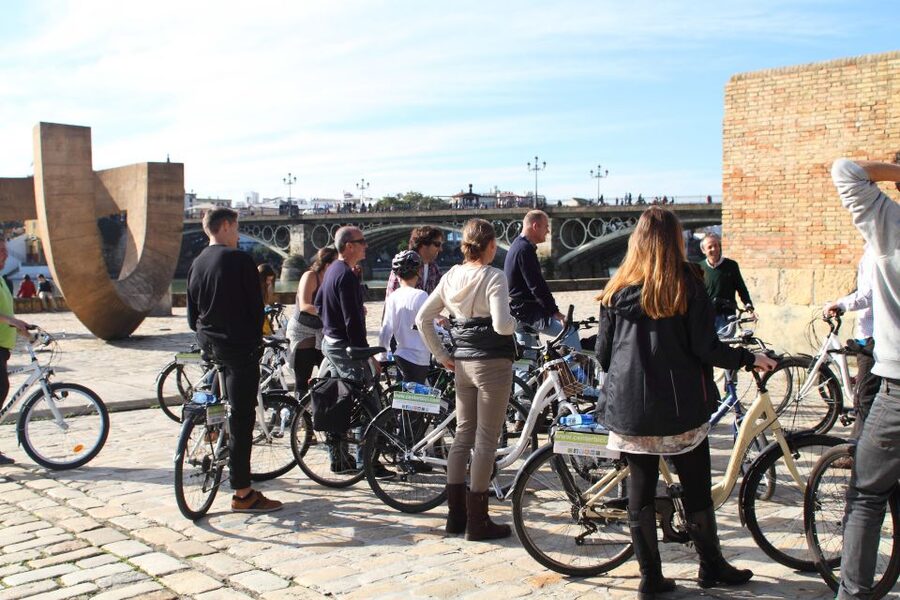
The ride continues through several historic gates, including Puerta Carmona, Puerta Osario, and Puerta Triana. Each stop gives you another chance to understand how people entered Seville and how the city managed traffic before modern streets and transport.
Puerta Carmona is tied to carriages and the movement of people into the city. The gate’s role helps you picture Seville as a place where arrivals were noticed and passage could be checked.
Puerta Osario adds another part of the defensive route. The name and location help show how the old city was divided into entry points rather than open access from every direction.
Puerta Triana brings the route toward one of Seville’s best-known areas. The tour uses these gates to tell stories about mysteries, movement, and everyday city life. You are not just stopping for photographs. You are learning why each opening mattered.
The quality of this part depends heavily on the guide. Luca is praised for being attentive and exceptionally comfortable in French, Italian, and Spanish. Daniel is also described as a strong guide, and Sébastien is recommended for his friendly approach. The supplied details do not guarantee a particular guide, but Centerbici’s multilingual team is clearly an important part of the experience.
The Alcázar and the changes of 1868
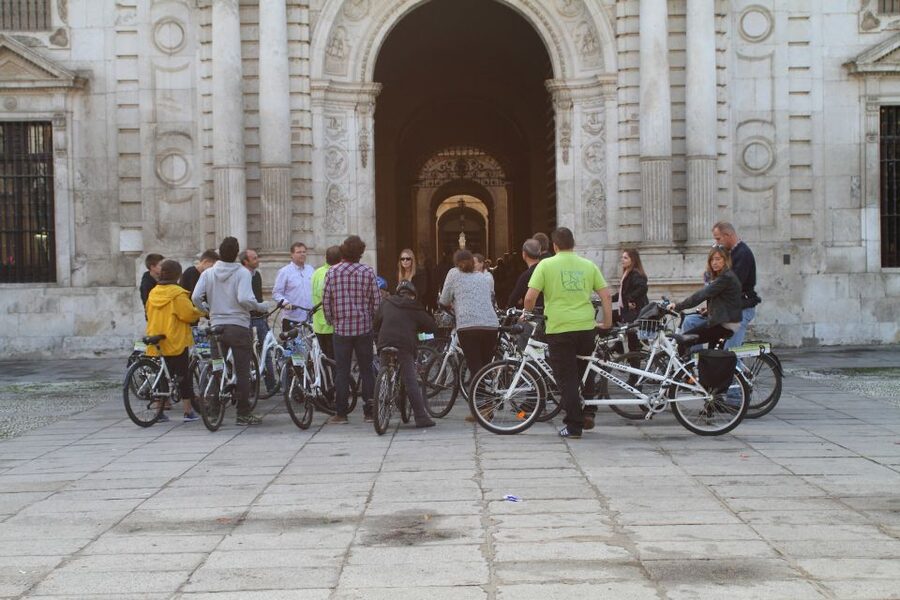
The route also passes by the Alcázar and explains what remained after the riots of 1868 and the Glorious Revolution. This gives the tour a useful modern turning point.
Seville’s historic center can look frozen in time, but the 1868 events remind you that cities change through conflict, political upheaval, and redevelopment. Parts of the old walls and gates survived, while other sections disappeared or were altered as Seville expanded.
The Alcázar is a particularly strong place to hear this story. It is one of the city’s key historic structures, and its architecture reflects the mixture of royal, Islamic, and later Spanish influences that defines much of central Seville. This bike tour does not replace an interior visit to the Alcázar. Instead, it gives you an outside framework for understanding why the building matters.
If you plan to visit the Alcázar separately, take note of the guide’s comments and return with enough time for the palace and gardens. The bike tour is an overview, not a full monument visit.
What the 2.5-hour pace feels like
Two and a half hours is long enough to build a real story but short enough to fit beside other Seville plans. The tour is not designed as a full-day ride. It focuses on the historic center, major gates, defensive remains, and important architecture.
You should expect a mix of cycling and stops. The exact balance is not specified, but the itinerary includes several places where the guide explains the history, so the pace is not nonstop pedaling.
That makes this a good choice for someone who wants orientation rather than exercise. You cover ground, but the historical explanations are the main event. If you want a fast, athletic ride, this may feel too slow. If you want a walking tour but prefer to reduce the distance between sights, the format should work well.
The tour is also a useful option on a first day in Seville. You learn where the old city’s edges were, see several gates, and gain a sense of how the neighborhoods relate to one another. Later, you can return on foot to the places that caught your interest.
How much value do you get for $35?
At $35 per person, this is a fair price for a guided 2.5-hour city tour that includes the bicycle, water bottle, and map. You are paying for more than the rental bike. The real value is the route design and the guide’s ability to connect scattered remains into one understandable story.
A self-guided ride would cost less if you already had a bicycle and knew where to go. But you would need to research the Tartessians, Roman Seville, Almoravid defenses, the city gates, and the 1868 upheaval yourself. You might also pass the walls and gates without recognizing their importance.
The price becomes even more reasonable if you use the tour to plan the rest of your visit. It can help you decide which areas deserve a second look and provide context before you spend money on major attractions.
The limitation is the equipment. One rider found the bicycles worn, though not unusable. That means you should book for the history and route, not because you expect a high-end cycling experience. If a top-quality bike is essential, confirm the available equipment before paying.
Who will enjoy this ride most?
I would recommend this tour to first-time visitors who want a clear introduction to Seville’s historic center. It suits people who enjoy architecture, city history, and stories tied to physical places.
It is also a good fit for riders who prefer a moderate outing. The duration is manageable, and the route lets you see more than a short walk while still stopping for explanations.
French speakers should pay attention to the guide language at booking. The team includes guides who speak French very well, but a particular departure may operate in another language. English and Spanish are also offered.
Families may appreciate the shorter format and the availability of a child’s helmet rental, though the tour is not suitable for people with mobility impairments. You need to be able to ride and handle a bicycle throughout the activity.
I would skip it if you have very little interest in history or if you want long visits inside monuments. The tour focuses on the city from the street, with explanations at gates, walls, and historic structures.
Booking details worth keeping in mind
The tour lasts 2.5 hours, and starting times vary by availability. It begins at Centerbici Store, C/ Espronceda, 5, Seville.
You can cancel up to 24 hours before the activity for a full refund. A reserve-now, pay-later option is also available, which helps if your Seville schedule is still shifting.
The listed tour language options are Spanish, English, and French. A live guide leads the ride, rather than an audio recording or printed route.
Because mobility impairments are listed as a restriction, ask before booking if you have any concern about cycling for the full duration. Also consider the weather and your comfort on a bicycle, since the tour takes place outdoors.
Should you book the Seville Historic Center Bike Tour?
Book it if you want Seville’s walls and gates to make sense, not just appear as disconnected old stones. The route gives you a useful historical map of the center, and the multilingual guides are a real asset. At $35, it offers solid value for a short, guided introduction.
I would especially choose it near the start of a Seville stay, before visiting the Alcázar or exploring the old center on foot. Just keep your equipment expectations modest, check the guide language, and make sure you are comfortable riding for two and a half hours.
If that sounds right, this is a practical way to meet Seville through its defenses, doorways, and many layers of the past.
FAQ
Where does the Seville bike tour meet?
The meeting point is Centerbici Store at C/ Espronceda, 5, 41004 Sevilla.
How long does the tour last?
The tour lasts 2.5 hours.
What is included in the price?
The experience includes the guided Seville tour, bicycle rental, a bilingual guide, a water bottle, and a map. Helmet rental is listed for children.
What languages are available?
The live tour guide options are Spanish, English, and French.
What places are included on the route?
The route includes sections of Seville’s old defensive walls, the Macarena area, Puerta de Córdoba, the Alcázar, Puerta Carmona, Puerta Osario, and Puerta Triana.
What history does the guide explain?
The tour covers Seville’s Roman origins, the Tartessians and Carthaginians, Almoravid fortifications, the city’s historic gates, and the riots of 1868 and the Glorious Revolution.
Is the tour suitable for people with mobility impairments?
No. People with mobility impairments are listed as not suitable for this activity.
Can I cancel the booking?
Yes. You can cancel up to 24 hours in advance for a full refund. A reserve-now, pay-later option is also available.
Just added around Seville
- Seville: Wine and Gourmet Tapas Tour★ 5.0 · 3 reviews
- Tapas Tour Cordoba & Wine Experience with chef and sommelier★ 4.8 · 3 reviews
- The most complete tour of Seville: All the highlights included★ 5.0 · 3 reviews
- Seville: Spritz Tasting Experience★ 4.8 · 3 reviews
- Ronda and White Villages Private Day Trip from Seville★ 5.0 · 3 reviews
- Jerez: Historic center of Jerez and horse show★ 5.0 · 3 reviews
- SEVILLE: REAL ALCÁZAR TOUR★ 5.0 · 3 reviews
- Royal Alcazar of Seville Guided Tour★ 5.0 · 3 reviews
Cycling Tours, compared.
Browse the lists this tour appears in