
Reviewed · JEWISH QUARTER TOURS
Seville Jewish Quarter Small-Group Walking Tour: History & Gems
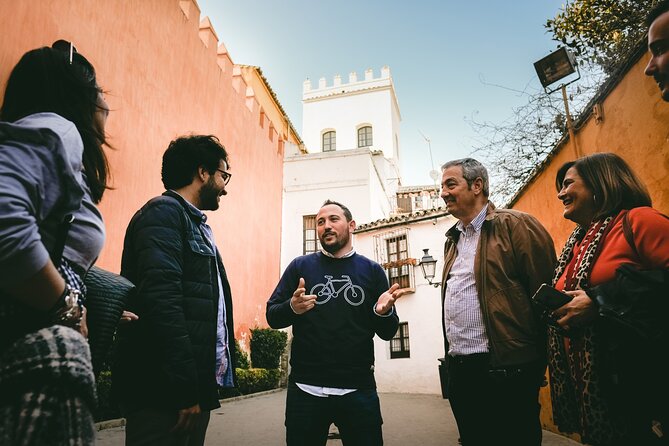
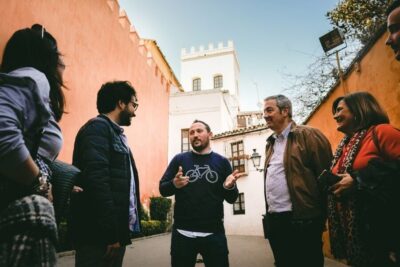
Seville’s Jewish Quarter is a place you mostly have to imagine. Centuries of change erased much of the old community, so this 90-minute walk uses streets, squares, archaeology, and sharp storytelling to bring the past back into view. I like the small group, limited to 10 people, and the way guides such as Miguel, Marta, Barbara, Clara, José, and Valentín make room for questions.
I also like the route’s quiet corners, especially the little plazas and the archaeological remains beneath Calle Cano y Cueto. The main thing to consider is that this is a history tour about a community whose buildings and records were largely destroyed or altered. If you want grand interiors or a long list of preserved monuments, you may leave wishing for more.
In This Review
- Key details at a glance
- Why Seville’s Jewish Quarter requires a guide
- Starting beside the Alcázar at Patio de Banderas
- Plaza de Doña Elvira and the people behind the walls
- Santa Cruz and the lost synagogues
- Murillo Gardens and the shape of the old neighborhood
- The archaeological remains beneath Calle Cano y Cueto
- Finishing at Santa María la Blanca
- What the small group changes
- Is $32.65 good value?
- Who should book this walk?
- My verdict on Seville Jewish Quarter Small-Group Walking Tour
- FAQ
- How long does the Seville Jewish Quarter tour last?
- How many people can join the tour?
- What language is the tour offered in?
- Where does the tour begin?
- Where does the tour end?
- Which places are included on the walking route?
- Are admission tickets included?
- Can I cancel for a full refund?
Key details at a glance
- Small groups of up to 10: You can hear the guide clearly and ask questions without shouting across a crowd.
- A story-led route: The walk explains Jewish life in Seville, the 1492 expulsion, and the city’s changing religious rule.
- Six compact stops: You visit Patio de Banderas, Santa Cruz, Murillo Gardens, Calle Cano y Cueto, and Santa María la Blanca.
- Rare surviving remains: The archaeological site beneath an underground car park is one of the few physical traces of the medieval Jewish quarter.
- Guides with different strengths: Miguel, Marta, Barbara, Clara, Guillermo, José, Carmen, and Valentín have all led this experience, with particular praise for clear explanations and warm presentation.
- Good first-day orientation: The route gives you a useful sense of Santa Cruz and the streets around the Alcázar before you explore alone.
Why Seville’s Jewish Quarter requires a guide
The old Jewish quarter in Seville is not a preserved district in the way you might expect. You will not walk through a complete medieval neighborhood with rows of original houses and clearly marked synagogues. Much of the evidence has disappeared, and later buildings now occupy the same ground.
That absence is the central challenge, but it is also why a guide helps. A good explanation can connect a modern street corner to the community that once lived there. You begin to notice how the shape of the old quarter, its narrow lanes, courtyards, churches, gardens, and surviving archaeological traces fit together.
The tour also places Seville’s Jewish story within the wider history of Spain. You hear about Jewish life under different rulers, the relationship between Jewish, Christian, and Muslim communities, and the expulsion of 1492. Valentín has also brought in Ladino expressions while discussing the diaspora, a small detail that adds a human voice to an otherwise painful subject.
The strongest guides do not present the past as a simple tale of one group replacing another. Clara, described as a historian who speaks excellent English, was praised for linking Seville’s local events to wider European history. That sort of context matters. It helps you understand not only what happened, but also why the city changed so sharply.
More History Tours in Seville
- Sevilla Food Tour: Tapas, Wine, History & Traditions
★ 5.0 · 3,468 reviews - Ultimate Seville Tapas, Wine & History Small Group Tour
★ 5.0 · 1,766 reviews - Seville: Tapas, Taverns, and History Walking Tour
★ 4.9 · 676 reviews
Starting beside the Alcázar at Patio de Banderas
The meeting point is by the Monumento a la Inmaculada Concepción, near the Alcázar, at C. Joaquín Romero Murube in Seville’s old town. Look for the surroundings of the royal palace rather than expecting a separate tour office or ticket booth.
The first 15 minutes take place at Plaza Patio de Banderas. This is a sensible starting point because the Alcázar carries layers of Seville’s medieval story, from Moorish rule onward. Before discussing the Jewish quarter, the guide sets the political and religious scene around the palace.
I like this opening because it prevents the Jewish community from being treated as an isolated footnote. The city’s rulers, borders, faiths, and neighborhoods affected daily life. Starting at the Alcázar gives you a framework before you enter Santa Cruz.
There is no admission charge for this stop, and the walking route does not include entry into the Alcázar. If you want to tour the palace itself, plan that separately. The tour works best as a companion to a visit there, not as a substitute for it.
Plaza de Doña Elvira and the people behind the walls
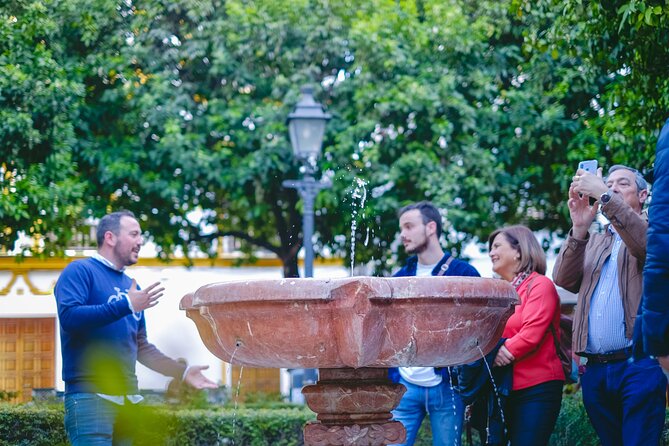
The next 15 minutes bring you to Plaza de Doña Elvira, one of the small squares that gives Santa Cruz its charm. Here, the focus shifts from broad political history to the communities that lived in this part of Seville.
The value of this stop is not a single famous monument. It is the chance to picture an inhabited neighborhood rather than a collection of pretty facades. Your guide explains who lived in the area and how the quarter developed over time.
This is where a small group earns its keep. The square is compact, and the guide can pause without losing half the group around a corner. You can ask how Jewish residents interacted with Christian and Muslim neighbors, a subject one participant specifically wanted to hear about in greater detail.
That request points to a fair limitation. Surviving records often preserve conflict, persecution, legal restrictions, and expulsion more clearly than ordinary domestic life. The tour does address Jewish life in Seville, but the evidence can make the darker events feel more prominent than the community’s everyday work, customs, and relationships.
Santa Cruz and the lost synagogues
At Plaza de Santa Cruz, another 15-minute stop, the guide discusses the former synagogues of the city. This is one of the most important moments in the walk, but also one that requires imagination.
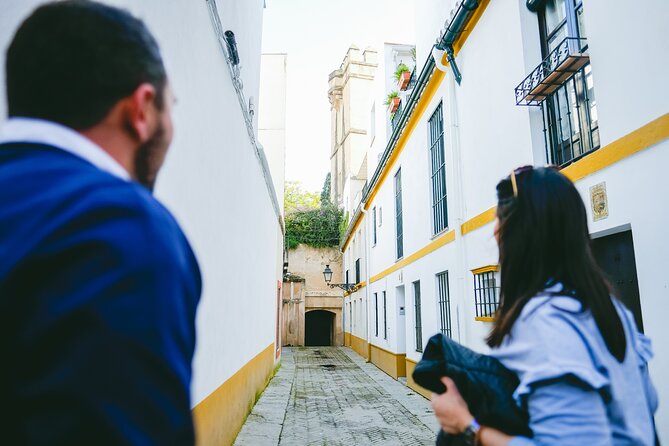
There are not many intact Jewish buildings left to inspect. The guide has to explain what once occupied the area and how later religious and civic changes altered it. You may find the contrast striking: the square looks picturesque today, while the story beneath it is marked by disappearance and forced change.
A clear guide makes this more than a list of dates. Marta has been praised for bringing old lives into focus while walking through Santa Cruz, and Barbara for explaining difficult history in a way that makes it feel present. The best version of this stop helps you picture a working community, not just a vanished label on a map.
Still, you should come prepared for a tour in which physical evidence is limited. If your main interest is architecture, you may find the stop less satisfying than a preserved synagogue elsewhere in Spain. If you enjoy connecting present-day places with lost stories, it can be one of the most thoughtful parts of the route.
More Jewish Quarter Tours in Seville
- Seville: Small-Group Jewish Quarter Discovery Walking Tour
★ 4.9 · 499 reviews - Seville: 1-Hour Walking Tour Barrio de Santa Cruz
★ 4.5 · 131 reviews - Private Tour Jewish Quarter, center and Plaza de España
★ 5.0 · 127 reviews - Seville: Small Group Jewish Quarter Tour with Tapas & Drinks
★ 5.0 · 119 reviews
Murillo Gardens and the shape of the old neighborhood
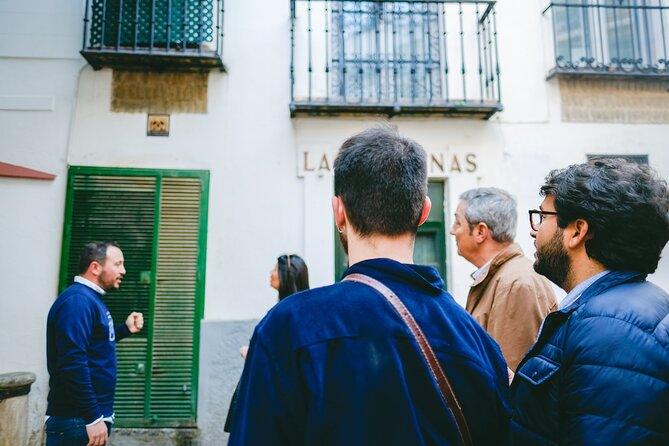
The walk continues through Jardines de Murillo for about 15 minutes. The gardens offer a change of pace after the close streets and plazas of Santa Cruz, while the guide continues explaining the neighborhood’s past.
This section appears to work as a bridge between individual sites. You are still learning about the Jewish quarter, but you are also getting a feel for how the district fits into Seville’s larger old town. The route is not a museum corridor. You keep moving through public spaces, with the city functioning around you.
Several participants praised the pace as relaxed but steady. That matters in Seville, where a short walk can become tiring in heat or on uneven historic streets. The tour lasts about an hour and a half, so it gives you useful context without taking up an entire morning or afternoon.
The gardens are also a good reminder that the tour is partly about orientation. By the end, you should have a clearer sense of where Santa Cruz sits in relation to the Alcázar and the streets leading toward Santa María la Blanca.
The archaeological remains beneath Calle Cano y Cueto
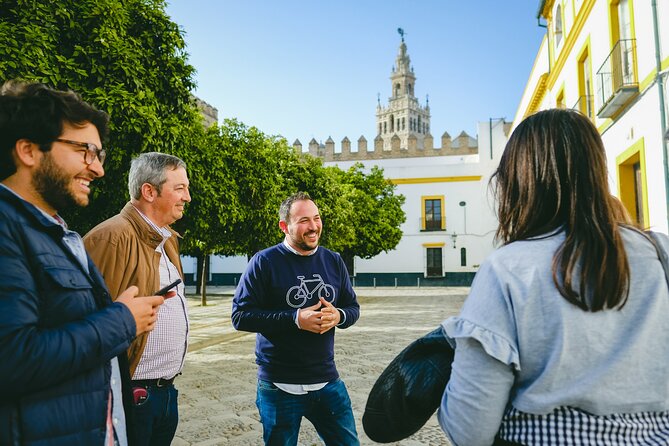
The most unusual stop comes at Calle Cano y Cueto. Here, you see the only physical remains of the medieval Jewish quarter identified in the route, located at an archaeological site inside an underground car park.
That setting is not romantic, and it is precisely why the site is memorable. Instead of a polished monument with a grand entrance, you encounter evidence in an everyday modern space. It shows how much of old Seville survives in fragments, sometimes under buildings and roadways rather than behind museum glass.
This is a key reason to choose the tour. You are not simply being led to the most famous sights in Santa Cruz. You are shown a place many people would pass without understanding what lies below it.
The stop also gives the guide a chance to deal honestly with the limits of what remains. The Jewish presence is not easy to read from the streets alone. You need explanation, patience, and a willingness to build a picture from partial traces.
If you have mobility concerns, keep in mind that this is a walking tour through the old town, and the archaeological site is inside an underground car park. The supplied details say most people can participate, and service animals are allowed, but no specific accessibility design for the archaeological area is provided.
Finishing at Santa María la Blanca
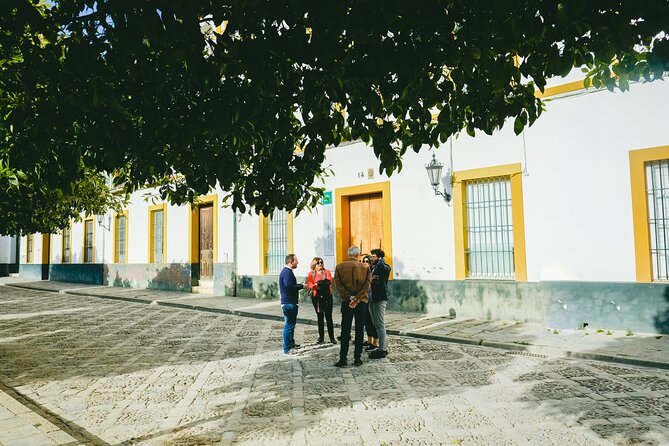
The tour ends outside Iglesia de Santa María la Blanca, at C. Santa María la Blanca, 5. The church is connected to the history of the former Jewish quarter and provides a fitting final point for a route about changing communities and religious spaces.
Because the tour ends outside the church, admission is not included as part of this experience. You can treat the finish as a useful location for continuing your own sightseeing, but the walk itself does not promise an interior visit.
Ending here is practical. You finish in the heart of Santa Cruz, close to the streets you have just learned to read. Rather than being dropped at an isolated meeting point, you can continue on foot through the old town, visit nearby sights, or stop for a meal.
The precise guide may vary. Names associated with this walk include Miguel, Marta, José, Guillermo, Valentín, Clara, Barbara, Carmen, and others. Their individual styles differ, but the strongest pattern is clear English, solid command of the subject, an easy pace, and a willingness to answer questions.
What the small group changes

The maximum group size is 10 people, including the guide. That is small enough to feel personal without turning the activity into a private tour.
I would pay attention to this if you dislike large city walks. You should be able to hear the explanation at each stop, and there is a better chance to ask about details that catch your interest. Clara was specifically praised for taking questions throughout the route, while Miguel was praised for answering many questions without losing the thread of the story.
The group format also keeps the price reasonable. A private guide would cost more, while a large free walk may offer less consistency and less time for discussion. At $32.65 per person, this sits in a sensible middle ground for a focused 90-minute history walk.
The tradeoff is that you are still joining a scheduled group. The pace and subject matter are shared, so you cannot reshape the route around one personal interest. If you want extensive time inside churches, archaeology, or the Alcázar, book separate visits.
Is $32.65 good value?
At $32.65, the price makes sense if you value interpretation more than admission tickets. There are no paid entries listed, so you are paying for the guide’s preparation, storytelling, route planning, and ability to make scarce remains meaningful.
The tour is especially good value on your first day in Seville. One participant used it to get oriented, and that is a smart approach. You learn the layout of Santa Cruz while picking up stories that can give later walks through the quarter more meaning.
It is less compelling if you only want to photograph historic buildings. The route cannot manufacture monuments that no longer exist. Its value lies in explaining absence, connecting scattered traces, and helping you see the city with more historical care.
The 99 percent recommendation rate and 4.9 rating from 96 ratings suggest a strong track record, but I would still match your expectations to the subject. This is a serious history walk with moments of loss and persecution. It is informative and often warm, but it is not designed as a light sightseeing stroll.
Who should book this walk?
I would choose this tour if you have an interest in Jewish history, medieval Spain, religious change, or the way cities preserve memory after buildings disappear. It also suits anyone who wants a compact introduction to Seville’s old town from a perspective beyond the usual cathedral and palace highlights.
It is a good fit for solo visitors and couples who prefer a small social setting. Families and older participants may also find the 90-minute length manageable, since most people can participate and the route moves at a steady pace.
You may want something else if you need a fully preserved Jewish quarter, extensive interior access, or a strong focus on food, architecture, or modern Jewish Seville. The tour offers context and fragments, not a complete physical district.
I would also book early if your dates are fixed. This experience is booked, on average, 17 days ahead, and the group limit is only 10 people. Confirmation arrives at booking, the ticket is mobile, and the route is near public transportation, so the practical side is straightforward.
My verdict on Seville Jewish Quarter Small-Group Walking Tour
Book it if you want the past explained by someone who can connect the dots. The small group, careful pace, central route, and strong guide reports make this a useful choice for a first or second day in Seville.
Go in knowing that the Jewish quarter is more a historical footprint than a preserved attraction. You will see a few physical traces, including the archaeological site on Calle Cano y Cueto, but much of the experience depends on the guide and your imagination.
For that reason, I would favor a guide such as Miguel, Marta, Barbara, Clara, Guillermo, José, Carmen, or Valentín if available, since each has been praised for clear, engaging presentation. Cancel at least 24 hours before the start time if plans change for a full refund. At this price, the walk offers a thoughtful way to understand a part of Seville that the city’s beautiful streets do not explain on their own.
FAQ
How long does the Seville Jewish Quarter tour last?
The tour lasts approximately 1 hour and 30 minutes.
How many people can join the tour?
The activity has a maximum of 10 participants.
What language is the tour offered in?
The tour is offered in English.
Where does the tour begin?
It begins near the Alcázar at the Monumento a la Inmaculada Concepción, C. Joaquín Romero Murube, Casco Antiguo, 41004 Sevilla, Spain.
Where does the tour end?
It ends outside Iglesia de Santa María la Blanca at C. Santa María la Blanca, 5, Casco Antiguo, 41004 Sevilla, Spain.
Which places are included on the walking route?
The route includes Plaza Patio de Banderas, Plaza de Doña Elvira, Plaza de Santa Cruz, Jardines de Murillo, Calle Cano y Cueto, and Iglesia de Santa María la Blanca.
Are admission tickets included?
Each listed stop has no admission ticket included or required for the walking portion. The tour finishes outside Santa María la Blanca and does not list interior admission.
Can I cancel for a full refund?
Yes. You can cancel at least 24 hours before the experience start time for a full refund. Cancellations or changes made less than 24 hours before the start time are not accepted for a refund.
More Jewish Quarter Walks
- Córdoba: Jewish Quarter, Mosque, and Alcázar Tour
★ 4.7 · 4,279 reviews - Cordoba Mosque & Jewish Quarter Tour with Tickets
★ 4.6 · 1,996 reviews - Córdoba: Mosque-Cathedral, Jewish Quarter and Alcázar Tour
★ 4.7 · 1,426 reviews - Cordoba: Jewish Quarter and Mosque-Cathedral Guided Tour
★ 4.6 · 996 reviews
More Walking Tours in Seville
- Seville: Small-Group City Highlights Walking Tour
★ 5.0 · 1,204 reviews - Cultural Walking Tour of Seville Monumental
★ 5.0 · 861 reviews - Seville: Tapas, Taverns and History Guided Walking Tour
★ 4.9 · 515 reviews - Seville Guided Small-Group Walking Tour
★ 5.0 · 435 reviews
Just added around Seville
- Seville: Wine and Gourmet Tapas Tour★ 5.0 · 3 reviews
- Tapas Tour Cordoba & Wine Experience with chef and sommelier★ 4.8 · 3 reviews
- The most complete tour of Seville: All the highlights included★ 5.0 · 3 reviews
- Seville: Spritz Tasting Experience★ 4.8 · 3 reviews
- Ronda and White Villages Private Day Trip from Seville★ 5.0 · 3 reviews
- Jerez: Historic center of Jerez and horse show★ 5.0 · 3 reviews
- SEVILLE: REAL ALCÁZAR TOUR★ 5.0 · 3 reviews
- Royal Alcazar of Seville Guided Tour★ 5.0 · 3 reviews
Jewish Quarter Tours, compared.
Cordoba Mosque & Jewish Quarter Tour with Tickets
Read our review →
Mosque-Cathedral, Jewish Quarter and Alcázar Tour
Read our review →
Jewish Quarter and Mosque-Cathedral Guided Tour
Read our review →
Mosque-Cathedral, Alcazar & Jewish Quarter with Tickets
Read our review →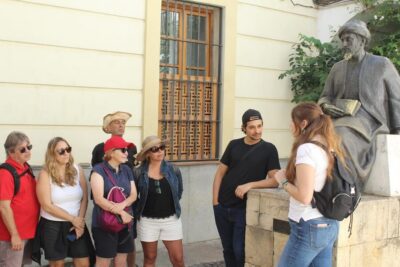
Mosque-Cathedral of Cordoba and Jewish Quarter Tour
Read our review →
Small-Group Jewish Quarter Discovery Walking Tour
Read our review →Browse the lists this tour appears in