
Reviewed · HORSES
Andalusian Horses Dance Show
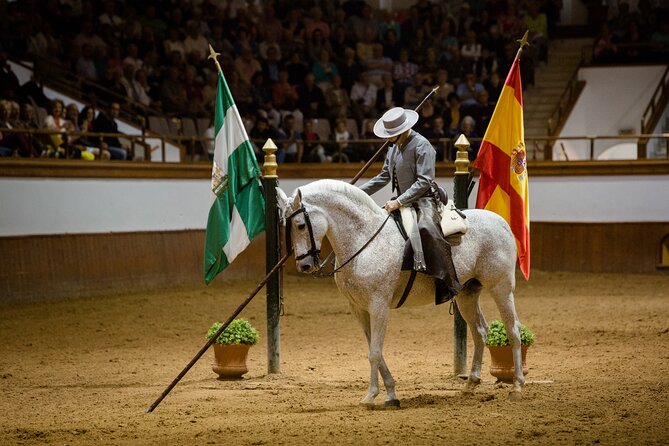
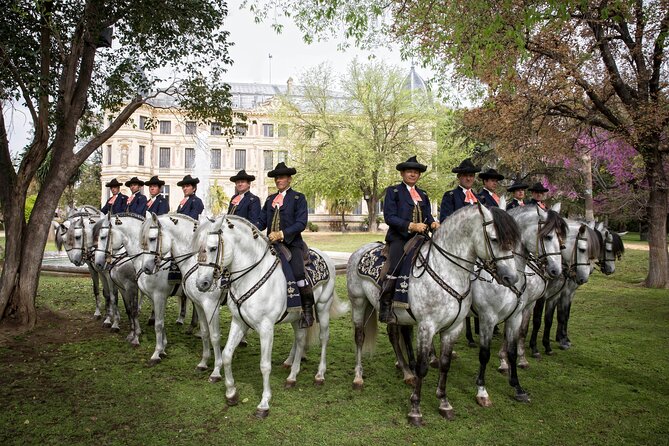
The remarkable part of this Andalusian horse show is its control. Horses move through classical dressage, Spanish cattle-herding techniques, carriage work, and high-level exercises while riders give commands so quietly that the animals seem to perform on their own. The final carrousel brings several horse-and-rider pairs into one precise pattern.
I like two things here. First, the show gives you more than pretty horses: it presents distinct parts of Spanish riding, from doma vaquera to formal Haute École work. Second, the 90-minute length is just right for families and for anyone fitting Jerez into a day trip from Cádiz or Seville.
The main consideration is seating. You buy a price category, not a chosen row or seat, and some positions may have a restricted view. Summer heat inside the arena and Spanish-only commentary can also affect your experience, so plan with those details in mind.
In This Review
- Key points before you book
- Why the Andalusian horses are the main event
- The 90-minute program changes by day
- Doma vaquera shows Andalusian working skills
- Classical dressage turns training into choreography
- Carriage driving adds old-fashioned spectacle
- Work in hand reveals the horse’s training
- The carrousel brings riders together
- Choosing seats without controlling the exact row
- Getting to the school from Cádiz, Seville, or the port
- Heat, language, and the small details that matter
- Is $33.43 a fair price?
- Who will enjoy this Jerez horse show most?
- Should you book the Andalusian Horses Dance Show?
- FAQ
- Where does the Andalusian horse show take place?
- What time does the experience start?
- How long does the performance last?
- What types of riding are included?
- Can I choose my exact seat?
- Do I need a printed ticket or receipt?
- Is photography allowed during the show?
- Can I cancel for a full refund?
Key points before you book
- Six to eight choreographies: The exact mix changes by day, but each performance draws from the school’s established repertoire.
- Doma vaquera: See a rider handle a horse with one hand using skills linked to traditional cattle herding.
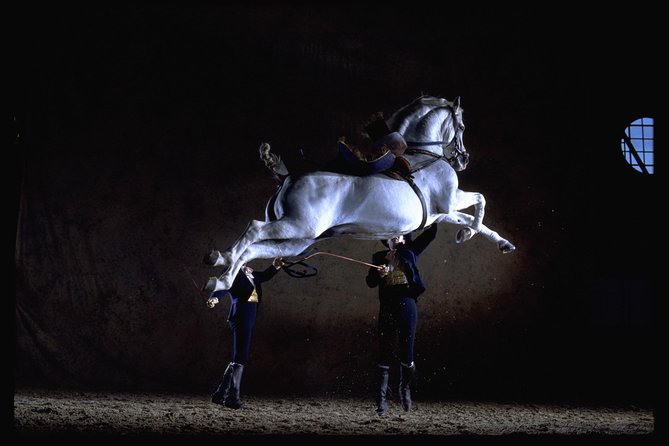
- Classical dressage: Look for passage, piaffe, pirouettes, airs above the ground, and other demanding movements.
- Carriage driving: Horses pull traditional carriages in classical harness while coachmen guide them around the arena.
- Best view strategy: Higher seats can show the full patterns clearly, while front seats bring you close to the horses but may not reveal every formation.
- Jerez location: The Royal Andalusian School is close to the city center, historic sights, cafés, and other stops for the rest of your day.
Why the Andalusian horses are the main event
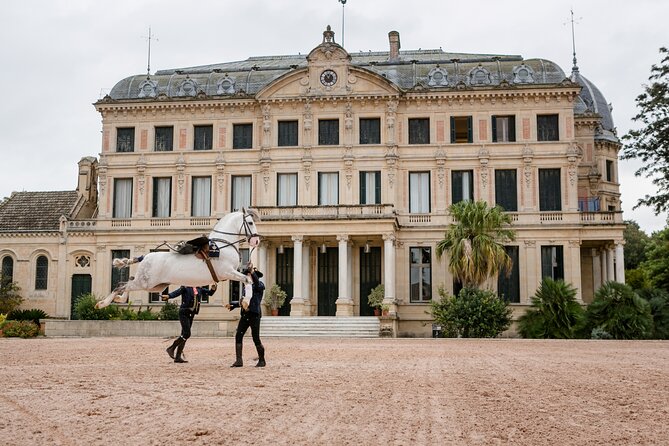
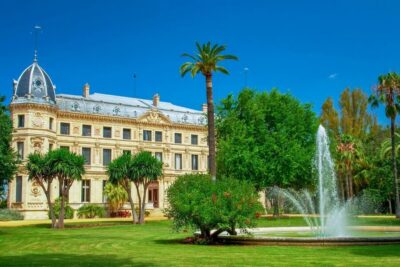
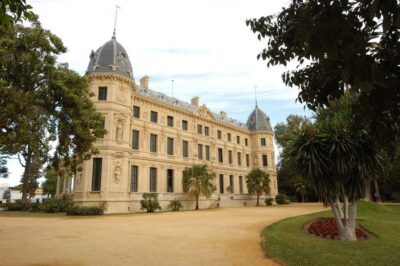
The show takes place at the Royal Andalusian School of Equestrian Art in Jerez de la Frontera, a city closely tied to Andalusia’s horse culture. You are not simply watching animals walk in circles. The program shows how horses respond to small signals, changes in rhythm, leg commands, reins, voice, and position.
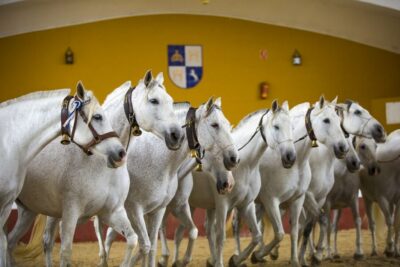
The horses are trained for precision, but the appeal is not only technical. Their posture, controlled steps, and calm partnership with the riders give the performance a ballet-like quality. Classical music adds to that effect without turning the show into a simple novelty act.
I especially like that the program moves between different riding traditions. A formal dressage sequence can feel polished and almost weightless. Doma vaquera has a more practical character, recalling the work of horsemen who handled cattle. The contrast helps you understand that Andalusian horsemanship is not one single style.
You may already love horses, but you do not need an expert’s eye to enjoy this. Watch how little the riders appear to move. Then notice the horse’s feet, rhythm, and balance. The pleasure comes from seeing a large, powerful animal respond with such fine control.
More Horse Experiences in Cadiz
- Cadiz: Andalusian Horses and Bulls Country Show
★ 4.6 · 189 reviews - From Seville: Jerez, Cádiz and Andalusian Horses
★ 4.4 · 143 reviews - Jerez & Cadiz Winery with Tasting & Opt Horse Show from Seville
★ 4.0 · 142 reviews
The 90-minute program changes by day
The performance lasts about one hour and 30 minutes. Each show includes six to eight choreographies, selected by the school from its regular repertoire. That means you should not expect an identical program at every performance.
This variation is useful if you are planning several days in Jerez, but it also means you cannot choose the exact exercises you will see. The school keeps the same general standard of skill and entertainment across its selections, while the order and combination may change.
The show is scheduled for 12:00 p.m. You should arrive with enough time to reach the ticket office, present your printed receipt, and find your seat without rushing. The grounds also deserve extra time. Several people have found it worthwhile to arrive 30 to 45 minutes early to look around and watch activity near the arena before the performance.
The show itself is not an all-day commitment. That makes it easy to pair with lunch, a sherry stop, or a walk through Jerez after the horses finish. Once you leave, you are close to historic parts of the city, cafés, and other destinations.
Doma vaquera shows Andalusian working skills
Doma vaquera is one of the most distinctive parts of the program. This Spanish riding discipline comes from traditional cattle work, and the rider handles the horse with one hand.
The sequence begins with controlled trotting and can build into a gallop. The rider changes the rhythm, guides the horse through pirouettes, and performs arreones, sudden breaks into a faster gallop. The movements have a practical origin, but in the arena they become a tightly rehearsed display.
This section may appeal most to you if you want something specifically Spanish rather than a generic dressage exhibition. It has a different feel from the classical sequences, with sharper changes of speed and a more direct connection to working horsemanship.
The one-hand riding is worth watching closely. It gives you a clear sense of the rider’s balance and timing. The horse must remain attentive while the rider manages direction and pace with limited visible movement.
Classical dressage turns training into choreography
The classical dressage section supplies the graceful centerpiece. The repertoire can include The Colts, Airs on Horseback, Pas de Deux, passage and piaffe, Domino on Horseback, airs above the ground, and Fantasy.
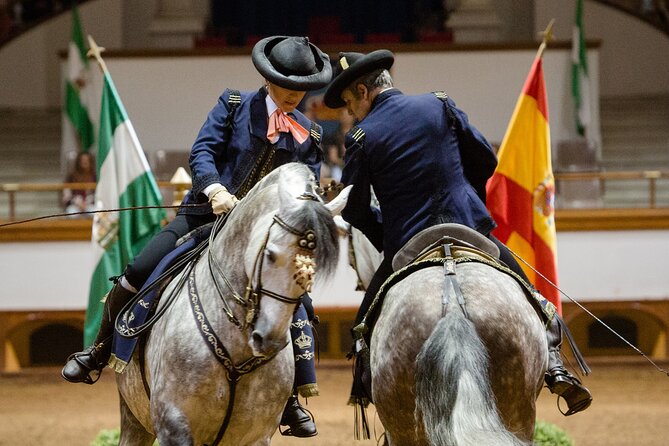
You may see a pair of horses working together in a pas de deux, with both animals matching their movements to the music. Passage and piaffe demand balance and control as the horse performs elevated, highly collected steps. Other exercises add jumps or dramatic changes in posture.
The names of the movements can sound technical, but you can enjoy them without memorizing the vocabulary. Look for moments when the horse appears to move in place, rises into a powerful jump, or matches another horse’s timing. The difficult part is often the restraint. A good performance can look effortless precisely because the training is so exact.
Some sections are introduced in Spanish only. Announcements may be available in several languages, but the explanations before each part may not be. You can still follow the action, though an English explanation would help if you want to understand the purpose of each exercise.
If you care about the story behind the riding, read about the listed repertoire before you go or ask at the venue about available information. The performance works visually, but a little context makes the differences between the movements easier to spot.
A completely different day out from Cadiz:
- Cadiz: City Sightseeing Hop-On Hop-Off Bus Tour
★ 4.1 · 753 reviews - From Seville: Cadiz and Jerez de la Frontera Day Trip
★ 4.2 · 595 reviews - Walking Tour through Cádiz: Stories from the hand of a local guide
★ 5.0 · 532 reviews - Cádiz: Sunset Catamaran Cruise Tours
★ 4.6 · 498 reviews
Carriage driving adds old-fashioned spectacle
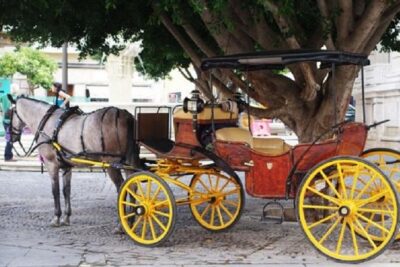
The horses do not spend the entire show under saddle. In the carriage-driving segment, they wear classical harness and pull carriages around the arena.
This section changes the scale of the performance. Instead of focusing on the subtle contact between one rider and one horse, you watch the coachmen guide a team and carriage as a single unit. The skill lies in timing, direction, pace, and the ability to keep the formation controlled.
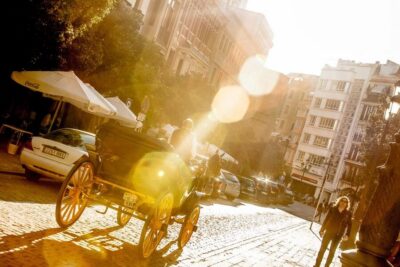
The carriages recall an earlier form of transportation, but here they are used for sport and exhibition. That gives the segment a strong visual appeal, especially when the harness and carriages move in step with the music.
For families, this variety matters. Younger children may respond to the carriages and larger formations, while adults interested in riding technique can focus on the dressage and doma vaquera. The program keeps changing enough to avoid becoming one long repetition of the same movement.
Work in hand reveals the horse’s training
Work in hand is perhaps the most surprising section for people who have not seen advanced dressage. The horse follows commands even when the rider is not in the saddle.
The exercises can include levades, caprioles, courbettes, piaffe between pillars, the Spanish walk, and work on long reins. These movements require the horse to stay attentive without a rider’s weight providing the usual balance and direction.
This is a good moment to watch the relationship between horse and handler. The cues may be difficult to see from a distance, but the response is unmistakable. The horse remains focused and carries out movements that look far removed from ordinary riding.
The section can also help you appreciate the training behind the more theatrical parts of the show. What looks like a single magical trick is the result of repetition, trust, physical conditioning, and precise communication.
The carrousel brings riders together
The carrousel is designed as the finale. Several horses and riders work in unison, combining advanced exercises in the center of the arena.
A solo movement gives you a close look at one horse. The carrousel gives you a wider view of timing and spacing. Each rider must maintain position while matching the group, and each horse must respond without breaking the pattern.
This is where seat choice matters most. A front position can make individual horses feel impressively close, but a higher seat may let you see the entire design more clearly. Since you cannot select a specific row or seat number, your allocated position may determine how much of the final formation you see.
Choosing seats without controlling the exact row
Tickets are sold by category, with seats assigned according to the purchase or booking order. You do not select a particular row or seat number.
That arrangement keeps booking simple, but it removes your ability to plan around a preferred view. Some people have found front-row seats excellent for seeing the horses’ expressions and footwork. Others prefer being higher up, where the complete arena and group patterns are easier to follow.
The safest advice is to understand the tradeoff. If you want closeness, a front section may suit you. If you want to study the carrousel and large formations, a higher position may be better. Ask what your category includes when collecting your ticket, but do not assume you can change seats.
A restricted view is possible, and this has affected some visits. If seeing the full arena is essential to you, treat the seating category as an important part of the purchase rather than a minor detail.
Getting to the school from Cádiz, Seville, or the port
The ticket redemption point is the Royal Andalusian School of Equestrian Art, on Avenida Duque de Abrantes in Jerez de la Frontera. The venue is near public transportation, and most people can take part without special physical requirements noted in the booking information.
From Cádiz, the experience works well as a half-day outing. You can attend the noon performance, then spend the afternoon in Jerez. From Seville, taking the train independently is also possible, but check your stop carefully. Confusion between towns with similar names has led to costly taxi rides for some people.
If you arrive by car, parking near the school can be manageable, though conditions vary. Nearby street parking has been found, and some people report that parking close to the venue is free. Be wary of anyone who approaches you and insists on arranging or charging for a space. Do not hand over money simply because someone is directing cars.
A taxi from a cruise port can cost more than expected, especially if you ask the driver to wait during the show. Confirm the fare before leaving and consider available ride-hailing options. A return taxi may also be difficult to find immediately after the performance, so plan that part before you sit down.
Heat, language, and the small details that matter
The arena can become warm in summer. Bring a fan and prepare for heat, especially if you are sensitive to high temperatures. The performance is not very long, but 90 minutes in a warm arena can feel longer than expected.
You must present a printed receipt at the ticket office. If you purchase a discounted ticket, bring proof that you qualify. Without the required documentation, you may have to pay the difference to the standard price, if full-price tickets remain available.
Photography, filming, and recording are not allowed unless you are an authorized professional. Bottles, cans, animals, and other objects the management considers unsuitable are also not permitted inside the grounds.
There is a café and shop at the venue, useful if you arrive early or want a drink before the show. The grounds themselves are worth allowing extra time to see. Just remember that admission to the performance does not include entry to other facilities unless specifically stated.
Is $33.43 a fair price?
At $33.43 per person, I consider this a reasonable price for a specialized 90-minute performance, especially if horses, dressage, or Andalusian culture are high on your list. You are paying for a formal production by the Royal Andalusian School, not a short tourist demonstration.
The value improves because the show combines several disciplines. You get classical riding, working horsemanship, carriage driving, unmounted exercises, and a group finale in one sitting. A family can share the experience without needing to commit to a full day or a long guided tour.
The value is less certain if you need English commentary, a guaranteed seat with a complete view, or a highly flexible schedule. The program changes by day, narration is mainly in Spanish, and the ticket category does not let you choose a precise seat.
Free cancellation is available if you cancel at least 24 hours before the local start time. Changes or cancellations made inside that window are not accepted for a refund, so keep the timing in mind when building your day around trains or port transfers.
Who will enjoy this Jerez horse show most?
I would choose this for horse lovers, families, classical music fans, and anyone looking for a distinctly Andalusian activity. It also suits people who appreciate skilled performance even if they know little about equestrian sport.
The show is a good fit for a first visit to Jerez because it offers a clear cultural experience in a manageable format. You can enjoy the beauty first, then learn the names and purpose of the movements as you watch.
I would hesitate if your schedule is so tight that a delayed train or taxi could ruin the day. I would also think twice if you strongly dislike warm indoor venues or need a guaranteed unobstructed view. Those are not reasons to reject the show, but they are reasons to plan carefully.
Should you book the Andalusian Horses Dance Show?
Book it if you want to see the connection between Andalusia, horses, music, and formal riding in one polished performance. The strongest parts are the variety of techniques, the calm precision of the horses, and the final group carrousel.
Choose your date with transport in mind, arrive early, bring the printed receipt, and prepare for Spanish commentary and possible seat limitations. If you can accept those practical points, this is one of the more memorable ways to spend 90 minutes in Jerez.
FAQ
Where does the Andalusian horse show take place?
The show takes place at the Royal Andalusian School of Equestrian Art, Avenida Duque de Abrantes, s/n, 11407 Jerez de la Frontera, Cádiz, Spain.
What time does the experience start?
The listed start time is 12:00 p.m.
How long does the performance last?
The performance lasts approximately one hour and 30 minutes.
What types of riding are included?
The repertoire includes doma vaquera, classical dressage, carriage driving, work in hand, and a final carrousel. Each show uses six to eight choreographies selected from this repertoire.
Can I choose my exact seat?
No. Tickets are sold by price category, and the row and seat are allocated according to the order of purchase or booking.
Do I need a printed ticket or receipt?
Yes. You must present your printed receipt at the ticket office to collect admission.
Is photography allowed during the show?
No. Photography, filming, and recording are prohibited unless you are an authorized professional.
Can I cancel for a full refund?
Yes, if you cancel at least 24 hours before the experience’s local start time. Cancellations or changes made less than 24 hours in advance are not accepted for a refund.
More Show in Cadiz
- Seville: Jerez, Cadiz Wine Tasting with Optional Horse Show
★ 4.4 · 88 reviews - Jerez Historic Guided Tour with Horse Show
★ 5.0 · 4 reviews - Seville: Live Flamenco Dancing Show Ticket at the Theater
★ 4.7 · 16,396 reviews - Seville: Casa de la Memoria Flamenco Show
★ 4.8 · 12,964 reviews
Just added around Cadiz
- From Cadiz: Private Seville Day Trip, Cathedral & Alcazar★ 5.0 · 3 reviews
- Cadiz Full-Day Guided Excursion from Seville★ 5.0 · 3 reviews
- Visit Cádiz as if You Lived There★ 5.0 · 3 reviews
- Vejer de la Frontera & Bolonia Beach Private Tour from Cadiz★ 5.0 · 3 reviews
- Spend a day in the White Villages from Cadiz★ 5.0 · 3 reviews
- From Seville: Private Day Trip to Cádiz with Guide★ 5.0 · 3 reviews
- Cadiz capital:Catamarán Experience paseo con baño y almuerzo★ 4.0 · 3 reviews
- *Private Day Trip* Gibraltar & Bolonia from Cádiz★ 4.5 · 3 reviews
Horses, compared.
Jerez & Cadiz Winery with Tasting & Opt Horse Show from Seville
Read our review →Browse the lists this tour appears in