
Reviewed · HORSES
Jerez de la Frontera: How the Andalusian Horses Dance
The horses do not simply walk in circles. They pirouette, piaffe, rear, leap, and move in exact formation, guided by riders whose control is easy to admire even if you know little about dressage. This is Andalusia’s famous equestrian tradition presented as a polished ballet in Jerez de la Frontera.
I like the blend of classical dressage and Doma Vaquera, the Spanish cattle-herding style that gives the show a local character. I also like the variety: carriage driving, work in hand, pairs, solo horses, and a final carrousel keep the 90-minute to two-hour performance from feeling repetitive. The main consideration is that the program and seating assignment are set by the school, so you cannot choose a particular row or seat number.
In This Review
- Key points before you book
- Why the Andalusian horse show is worth your time
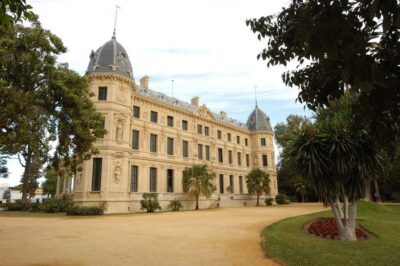
- Entering the Royal Andalusian School in Jerez
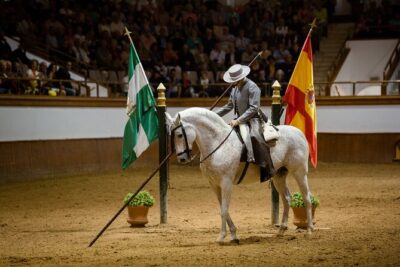
- Doma Vaquera brings Spanish country riding to the arena
- Classical dressage turns movement into music
- Work in hand shows obedience without a rider in the saddle
- Carriage driving adds speed, wheels, and old-world style
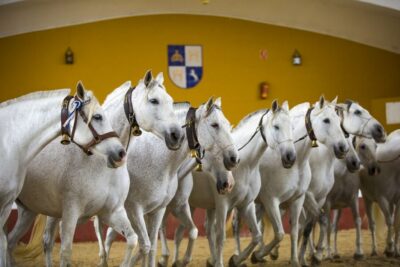
- The final carrousel brings the riders together
- Costumes and music make this more than a riding lesson
- Timing, tickets, and useful practical details
- How this compares with other Andalusian activities
- Should you book the Andalusian horse ballet?
- FAQ
- Where does the Andalusian horse show take place?
- How long does the show last?
- How much does admission cost?
- What is included in the ticket?
- How many choreographies are performed?
- What types of riding can I see?
- Do I choose my exact seat?
- What should I bring?
- Can I take photographs or record the performance?
- Is the show wheelchair accessible?
Key points before you book
- Six to eight choreographies: The program combines classical dressage, Spanish country riding, carriage driving, and group routines.
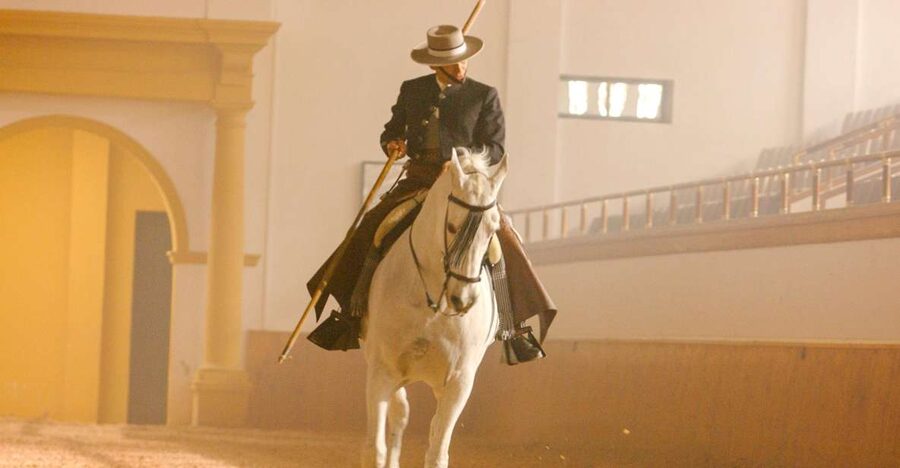
- A historic-looking presentation: Traditional 18th-century costumes and Spanish music give the performance its formal Andalusian character.
- The famous Royal School: The show takes place at the Fundación Real Escuela Andaluza del Arte Ecuestre in Jerez.
- More than a horse dance: Watch piaffe, passage, pirouettes, Spanish walk, levades, caprioles, courbettes, and carriage handling.
- Good value at $31: The price covers admission to the show and is reasonable for a carefully produced performance of this length.
- Plan for the ticket office: Bring your printed voucher and passport or ID card, and arrive ready to collect your assigned category seating.
Why the Andalusian horse show is worth your time
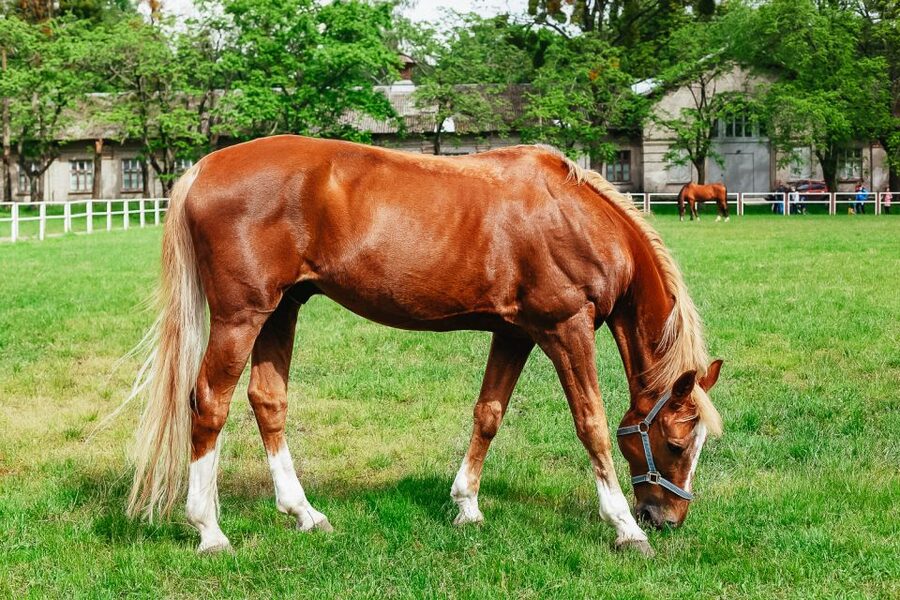
Jerez is known for sherry, flamenco, and horses. This performance brings the third part of that trio to life in a way that is easy to understand from the seats. You do not need to be a dressage expert. The movements are visual, the music sets a clear rhythm, and the riders’ traditional clothing makes the whole production feel more like a formal Spanish ceremony than a standard riding demonstration.
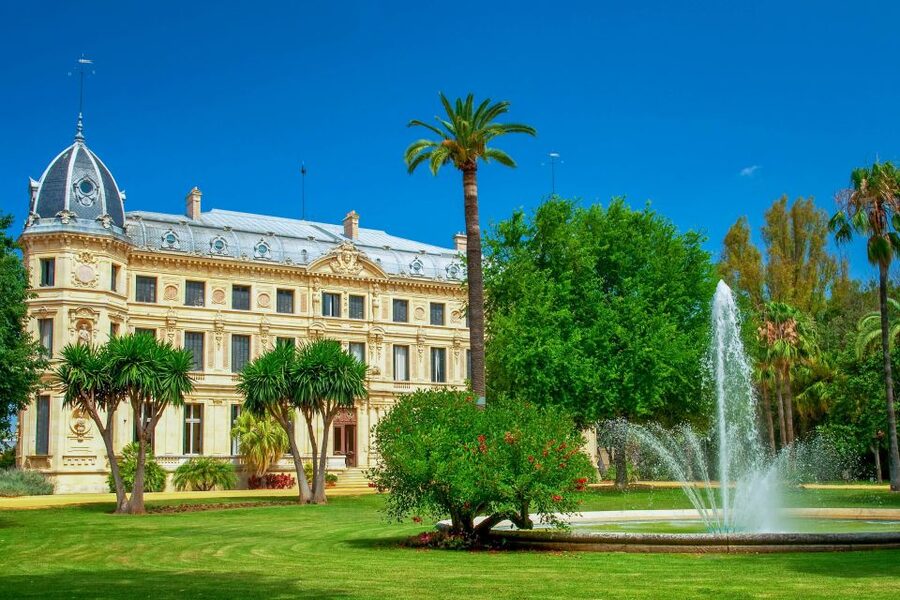
The school’s full name is the Foundation Royal Andalusian School of Equestrian Art. That matters because this is not an improvised tourist show in a temporary ring. You are visiting an established equestrian institution devoted to preserving and presenting Spanish riding traditions.
The presentation usually contains six to eight separate numbers. The exact selection can change because the management may alter the program. That is a minor uncertainty, but it also means the show is not simply one long routine repeated without variation.
At $31 per person, I consider this a strong cultural buy in Andalusia. The ticket gives you a performance lasting roughly 90 minutes to two hours, with several distinct riding styles and a purpose-built venue. Prices can vary by category or special event, but the standard experience offers a lot of visual skill for the money.
More Horse Experiences in Jerez
- Jerez de la Frontera: Andalusian Horse Dance and Museums
★ 4.7 · 1,289 reviews - Jerez: Yeguada de la Cartuja Carthusian Horses Tour
★ 4.8 · 970 reviews - From Seville: Jerez, Cádiz and Andalusian Horses
★ 4.4 · 143 reviews
Entering the Royal Andalusian School in Jerez
Your first task is practical: go to the reservation box office at the Royal Andalusian School of Equestrian Art Foundation. You must present a printed voucher when collecting your ticket. Bring your passport or ID card as well, particularly if the booking uses a discounted price.
The school assigns seats by ticket category and booking order. You do not select an exact row or seat number. That may bother visitors who like to plan every detail, but the available information indicates that all seats provide a view of the arena. If sitting near the center matters greatly to you, this is worth knowing before you pay.
The venue itself forms part of the experience. The formal setting, the riding arena, and the school’s equestrian identity prepare you for a performance that values tradition and precision. Some performances may also let you see riders and horses training before or after the main event, but you should not assume that this is included every time unless the booking specifically says so.
The show is wheelchair accessible. Pets are not allowed, and you should leave bottles, cans, glass objects, weapons, and sharp items at home. Flash photography and audio recording are also forbidden.
Doma Vaquera brings Spanish country riding to the arena
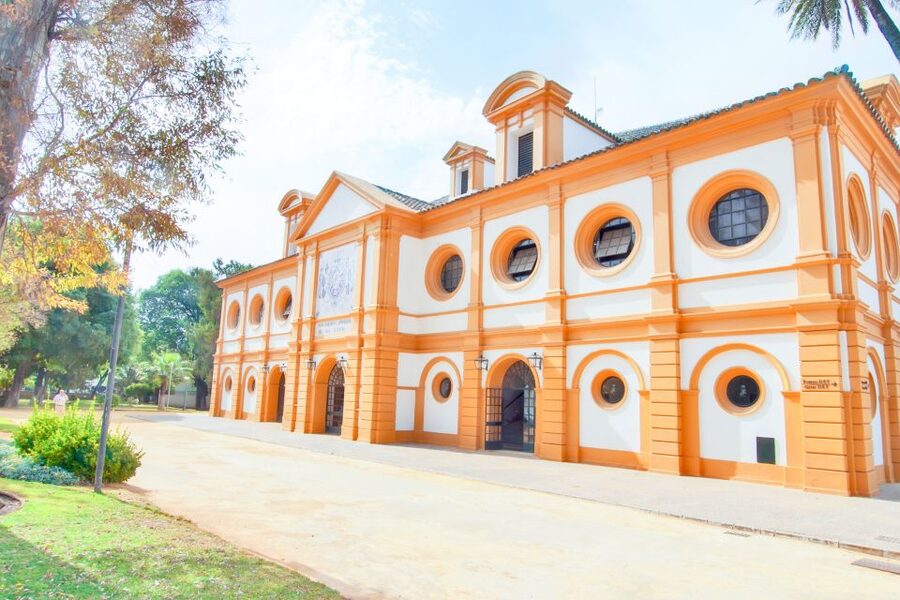
One of the most distinctive sections is Doma Vaquera. This riding discipline grew from the practical work of herding cattle, so it feels less like a ballroom routine and more like a demonstration of a working horse’s speed, obedience, and sudden changes of direction.
The rider generally works with one hand while the horse trots and then gallops around the arena. The pace changes sharply, and the horse may perform a pirouette or an arreón, breaking quickly into a gallop.
This is an important contrast with the more measured classical dressage numbers. In dressage, you watch control expressed through small, refined movements. In Doma Vaquera, the same control appears through acceleration, turns, and quick reactions.
For you, the fun is in seeing how a tradition rooted in daily ranch work has become a disciplined public performance. The movements are not there only for decoration. They show why a Spanish horse needed to be responsive, balanced, and confident in a demanding working environment.
Classical dressage turns movement into music
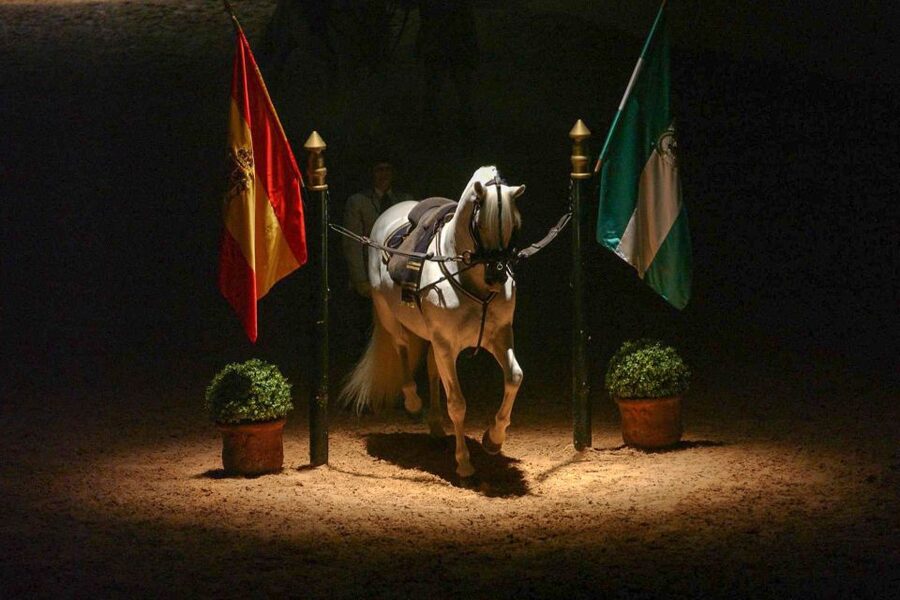
The classical dressage portion is the heart of the show. Here, the horse’s posture, rhythm, and obedience take center stage. The program can include several named choreographies, such as The Colts, Airs on Horseback, Pas de Deux, Passage and Piaffer, Domino on Horseback, Airs Above the Ground, and Fantasy.
You may see one horse and rider working alone, or two horses matching one another in a Pas de Deux. The paired routine is especially appealing because you can watch the riders maintain distance and timing while each horse performs precise steps.
The passage is a controlled, elevated trot with a clear rhythm. The piaffe is performed with the horse nearly in place, lifting its legs with concentration and balance. To a casual observer, these can look like a horse dancing to the music. In fact, they demand careful training and constant communication between rider and horse.
Classical music supports the movement without overpowering it. The show also uses quintessential Spanish music, so the atmosphere remains tied to the country rather than becoming a generic European riding display.
If you have watched competitive dressage, you may focus on the technical quality of each movement. If you have not, simply watch the horse’s head, back, and legs. The best moments come when the animal appears calm and willing, even while carrying out a difficult series of commands.
A completely different day out from Jerez:
- Jerez: Royal Andalusian School of Equestrian Art Admission
★ 4.6 · 882 reviews - Jerez: Bodegas Fundador Guided Tour with Tasting Session
★ 4.8 · 714 reviews - Jerez: Guided Winery Tour with Wine Tasting
★ 4.4 · 636 reviews - From Seville: Cadiz and Jerez de la Frontera Day Trip
★ 4.2 · 595 reviews
Work in hand shows obedience without a rider in the saddle
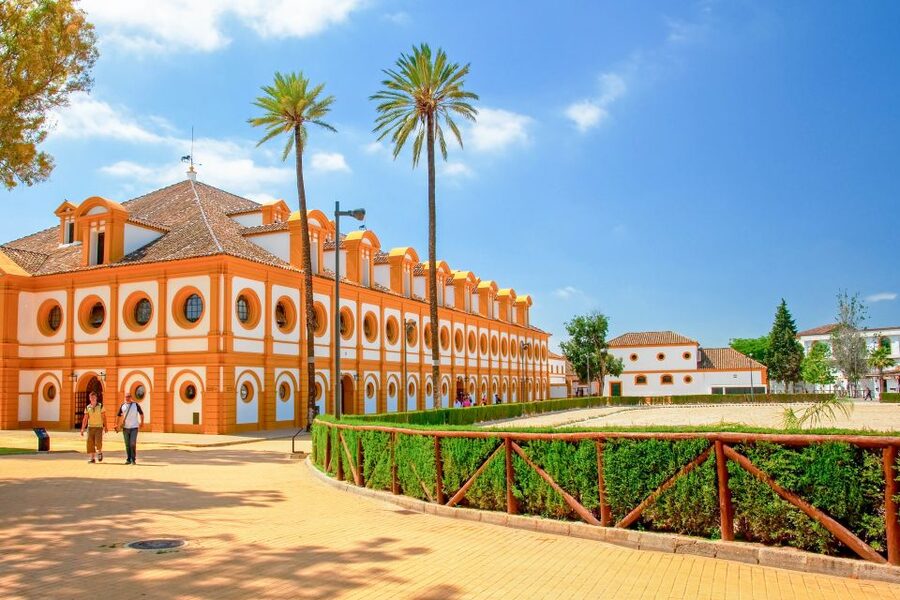
Work in hand offers a different view of training. The horse follows instructions while the horseman is on the ground rather than seated in the saddle. This makes the connection between voice, gesture, equipment, and response easier to see.
The school may present Haute École exercises such as levades, caprioles, courbettes, piaffe between pillars, and the Spanish walk. These are advanced movements, and some are physically demanding for the horse.
The Spanish walk is perhaps the easiest to recognize. The horse raises its front legs in a high, deliberate step. The levade involves a controlled lift of the front of the body, while the courbette and capriole require more explosive power.
This section helps you understand that the show is built on training, not tricks. The horse is not merely reacting to a rider’s weight. It has learned to respond to subtle signals from the ground, too.
Carriage driving adds speed, wheels, and old-world style
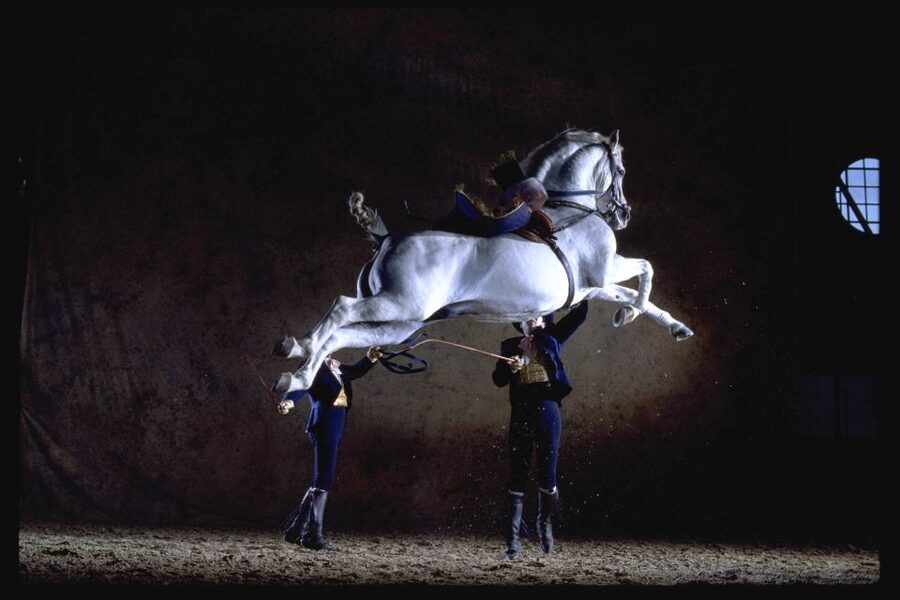
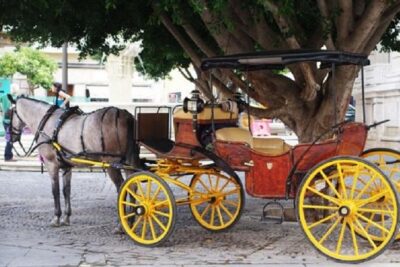
Carriage driving breaks up the horse-and-rider format. Several horses may work together to draw carriages, using traditional harnesses and coachmen who manage the reins while directing the vehicle through the arena.
These carriages were once used for transport. Today, they are preserved for sport and exhibition. The result is a striking mix of practical history and athletic display.
You will see that carriage driving requires more than guiding a horse forward. The coachman must control the horses, the harness, the vehicle, and the route through the arena at the same time. The carriage changes the scale of the performance and gives you a chance to admire the horses’ strength as well as their precision.
This can be one of the most memorable sections for people who are not especially interested in dressage. The moving wheels, formal harnesses, and old-fashioned costumes create a strong visual scene, while the driving itself supplies a little more drama than the slower dressage movements.
The final carrousel brings the riders together
The carrousel usually provides the closing number. A group of horses and riders performs advanced exercises in unison, creating a carefully arranged pattern across the arena.
This is where the show’s many skills come together. You are no longer watching one horse hold a difficult position or one rider handle a carriage. You are watching a group maintain spacing, rhythm, and direction at the same time.
The final formation works because the horses are trained to remain attentive even when several animals are moving nearby. The riders must also match one another precisely. A small error in timing would be obvious, which makes the cleanest moments particularly satisfying.
The carrousel is a fitting finish because it turns individual expertise into a shared display. It also gives the audience a clear ending rather than simply stopping after another solo performance.
Costumes and music make this more than a riding lesson
The traditional 18th-century style costumes are not a minor detail. They help frame the show as Spanish equestrian art rather than a modern sports demonstration.
The clothing gives the riders a formal, historic appearance, while the music supplies the emotional cue for each routine. Together, they make the performance easy to follow even when you do not know the technical names of the movements.
I would not book this expecting a theatrical story with spoken scenes or a large cast of performers. The horses and riders are the main event. The music, costumes, and choreography support their work rather than replacing it.
That focus is a strength. You get to watch the animals and riders without a distracting plot or excessive stage effects. The trade-off is that people who dislike formal presentations may find the pacing restrained in parts.
Timing, tickets, and useful practical details
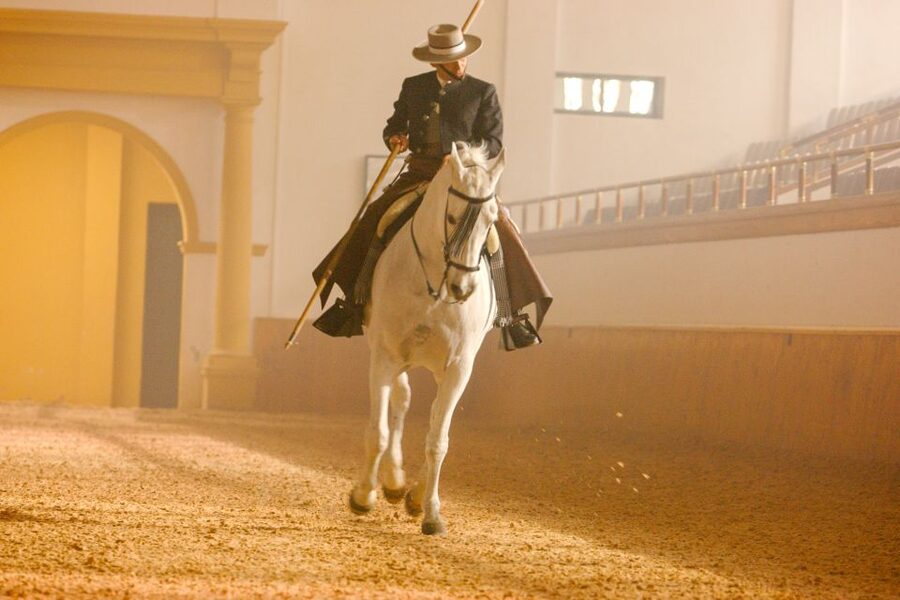
The performance lasts 90 minutes to two hours, depending on the program. Check the available start time carefully because schedules vary. The show is not an all-day activity, but you should allow extra time to reach the box office, collect your ticket, and find your seat.
The booking includes entrance to the show. It does not list transport, meals, or a separate guided visit as part of the standard admission.
Bring the following:
- A printed voucher for the reservation box office
- Your passport or ID card
- Documentary proof if you bought a discounted ticket
If you cannot show proof of discount eligibility, you may have to pay the difference to the full standard ticket price, provided full-price tickets remain available.
Photography without flash may be permitted, but flash photography is specifically forbidden. Audio recording is not allowed. Do not bring glass objects, bottles, cans, pets, weapons, or sharp objects into the grounds.
The school may change the program. That is normal for a live performance, so treat the listed choreographies as a guide rather than a guarantee that every named number will appear.
How this compares with other Andalusian activities
A flamenco show gives you singing, guitar, and dance. A sherry visit focuses on cellars and tasting. This horse performance offers a different side of Jerez, one tied to training yards, rural riding, and ceremonial display.
I would choose it for an afternoon or evening when you want something organized and visually distinctive. It also works well as a day trip from Cádiz. One visitor described the journey as an easy train ride from Cádiz to Jerez followed by a short taxi ride to the school, though you should check current transport times yourself.
The show suits families, couples, horse enthusiasts, and anyone who wants a polished cultural performance without committing to a full-day excursion. It is especially worthwhile if Andalusian horses interest you, since the program lets you compare several types of riding in one sitting.
You may enjoy it less if you want an informal encounter with animals. This is a formal public performance, and the seats, program, and access rules are managed by the school.
Should you book the Andalusian horse ballet?
Book it if you want to see Spanish horsemanship presented with real variety. The combination of Doma Vaquera, classical dressage, carriage driving, work in hand, and the closing carrousel gives you far more than a simple horse parade.
I especially recommend it if you are staying in Cádiz, Jerez, or nearby Andalusia and can spare 90 minutes to two hours. At $31, the experience offers solid value, particularly for anyone interested in horses, dressage, Spanish traditions, or carefully staged performances.
Think twice only if you need a fixed seat, dislike formal shows, or want a guaranteed list of exact routines. The school assigns seating by category and may adjust the program. For most people, those are manageable limits beside the chance to watch Andalusian horses perform some of Europe’s most demanding riding movements.
FAQ
Where does the Andalusian horse show take place?
It takes place at the Fundación Real Escuela Andaluza del Arte Ecuestre, also called the Foundation Royal Andalusian School of Equestrian Art, in Jerez de la Frontera, Andalusia, Spain.
How long does the show last?
The listed duration is between 90 minutes and two hours.
How much does admission cost?
The stated price is $31 per person.
What is included in the ticket?
The ticket includes entrance to the equestrian show.
How many choreographies are performed?
Each performance includes six to eight different choreographies selected by the school.
What types of riding can I see?
The program can include Doma Vaquera, classical dressage, carriage driving, work in hand, and a final carrousel.
Do I choose my exact seat?
No. Tickets are sold by price category, and the school allocates the row and seat number according to the order of purchase or booking.
What should I bring?
Bring your printed voucher and your passport or ID card. If you bought a discounted ticket, also bring proof of eligibility.
Can I take photographs or record the performance?
Flash photography and audio recording are not allowed. The rules also prohibit bottles, cans, glass objects, pets, weapons, and sharp objects.
Is the show wheelchair accessible?
Yes, the activity is listed as wheelchair accessible.
Just added around Jerez
- Jerez: Historic center of Jerez and horse show★ 5.0 · 3 reviews
- Jerez de la Frontera: 1.5-Hour Walking Tour with a Guide★ 5.0 · 3 reviews
- Visit to the Church of San Miguel★ 5.0 · 3 reviews
- JEREZ DE LA FRONTERA: GUIDED TOUR TO THE COOPERAGE★ 5.0 · 3 reviews
- Jerez Historic Guided Tour with Horse Show★ 5.0 · 4 reviews
- Jerez: Tour Bodegas Páez Morilla ESPAÑOL/DEUTSCH★ 5.0 · 4 reviews
- From Jerez: Day Trip to Tangier with Ferry & Lunch★ 4.8 · 5 reviews
- JEREZ DE LA FRONTERA: PREMIUM GUIDED TOUR TO THE COOPERAGE★ 5.0 · 5 reviews
Horses, compared.
Jerez & Cadiz Winery with Tasting & Opt Horse Show from Seville
Read our review →Browse the lists this tour appears in